
Key Takeaway:
If you record podcasts, digitize vinyl, or receive raw mixes from a sound engineer, you already know that WAV files eat hard drives alive. A standard one-hour stereo recording in WAV format clocks in at roughly 600MB. Try attaching that to an email, uploading it to a podcast host on a tight deadline, or syncing it to your phone, and you will feel annoyed. That is why most users want to convert WAV to MP3. However, does it sound worse? We recently ran an ABX blind test with several audio engineers using high-end studio monitors. The result? At 320 kbps, no one could reliably tell the difference between the original uncompressed file and the MP3. In this article, we will exactly how to change WAV to MP3 without losing quality in 4 tools from instant web-based converters to heavy-duty batch processing software. Read on and get your best method.
| Platform | Processing Engine | Max File Size | Internet Dependency | Batch Workflow | |
|---|---|---|---|---|---|
| AnyMP4 Video Converter Ultimate | Windows / Mac | GPU Accelerated (NVENC/QSV) | Unlimited | None (Local) | 1-Click Folder Import |
| AnyMP4 Free Online Audio Converter | Web (Browser) | Server-side CPU | Connection-bound | Required | Limited web queue |
| iTunes / Music app | Mac / Windows | Standard Local CPU | Unlimited | None (Local) | Clutters main library |
| Switch Audio Converter | Windows / Mac / Android | Standard Local CPU | Unlimited | None (Local) | Standard queue |
WAV (Waveform Audio File Format) is an uncompressed, lossless format. It captures exactly what was recorded, bit for bit. This makes it the absolute gold standard for editing and archiving. MP3 is a lossy compressed format. It uses psychoacoustic modeling to throw away audio data that the human ear theoretically cannot hear.
You convert WAV to MP3 strictly for distribution and storage. MP3s stream instantly, attach to emails effortlessly, and integrate perfectly with every piece of hardware built in the last 25 years.
Alright, let's stop talking theory and get into the actual software. Here is exactly how to get your files compressed right now.
When you just need to compress WAV to MP3 without losing quality for a quick email attachment, firing up heavy software is overkill. AnyMP4 Free Online Audio Converter handles the job directly in your browser. It doesn't bombard you with sketchy pop-up ads, and the conversion happens almost instantly on their servers.
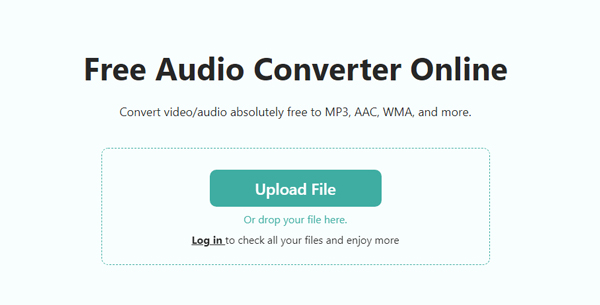
1. Open your web browser and navigate to the AnyMP4 Free Online Audio Converter page.
Click the center Upload File button and select the WAV file from your local drive.
2. Set the output format to MP3.
Adjust the audio bitrate to 320 kbps if you want maximum quality.
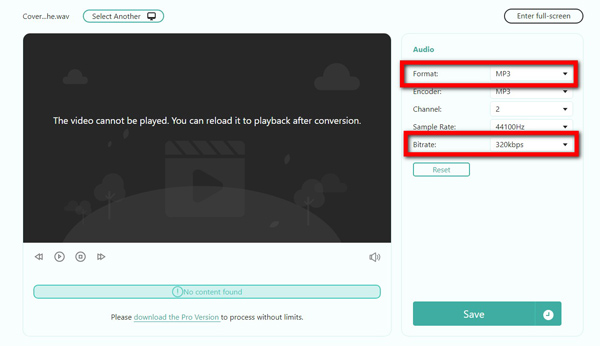
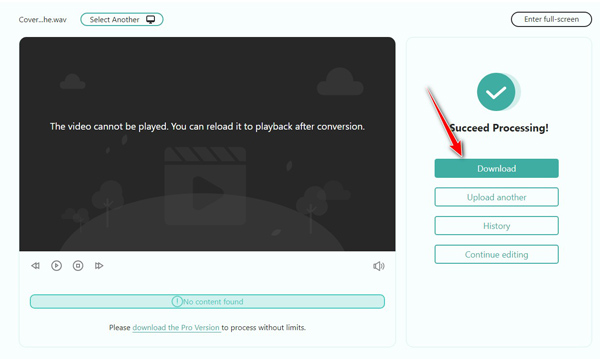
3. Hit Save to start converting WAV to MP3 immediately. and save the resulting MP3 to your desktop once the process is done.
Verdict: It is my go-to for one-off files. The interface is clean, and the output is mathematically sound, though I wouldn't use it for an entire library simply due to browser upload times.
Despite Video in the name, this is an absolute powerhouse for batch WAV to MP3 audio processing. AnyMP4 Video Converter Ultimate utilizes hardware acceleration (like NVIDIA NVENC and Intel QSV) to crunch through massive audio directories locally. If you need to set exact bitrate parameters or retain multi-track audio routing while converting hundreds of files, this is the tool.
Secure Download
Secure Download
1. Launch the software and drag your entire folder of WAV files directly into the main interface.
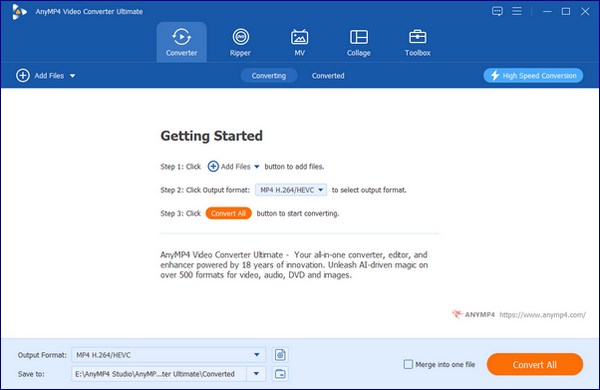
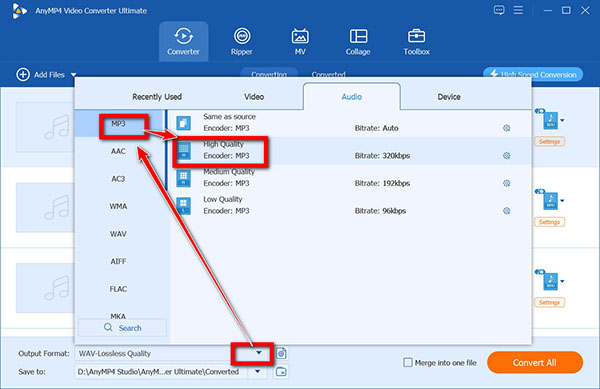
2. Click the Output Format drop-down in the bottom left corner. Navigate to the Audio tab and select MP3.
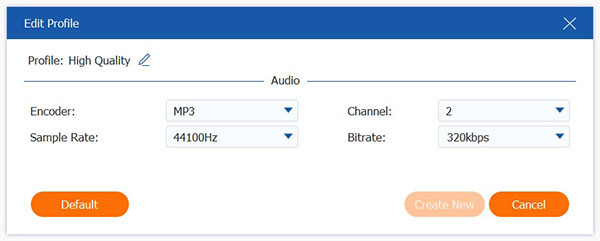
Click the custom profile icon next to the MP3 format. This is where you set a custom Sample Rate (44100 Hz) and your target Bitrate (320 kbps) for absolute transparency.
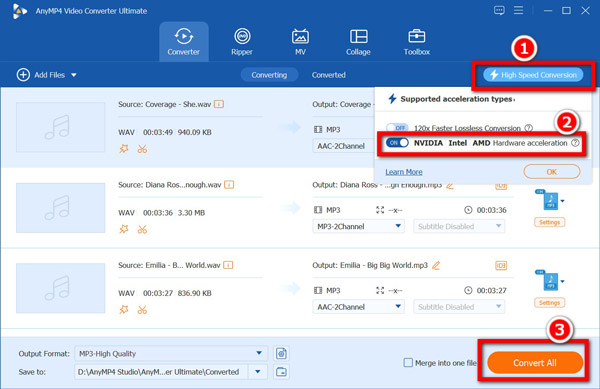
3. Choose your destination folder at the bottom and click the orange Convert All button.
Do not forget to enable the GPU acceleration before starting the WAV to MP3 conversion process, because that will speed up your task at 30 times faster.
After you convert WAV to MP3, do not forget to edit the WAV metadata information with its toolbox utilities, if you want to keep all the original cover album details.
Verdict: The speed is unmatched. Throwing a 2GB folder of raw podcast audio at this software results in perfectly tagged MP3s in seconds, completely bypassing the bottleneck of cloud-based tools.
If you are on a Mac, the Apple Music app (formerly iTunes) has a built-in WAV to MP3 encoder. While I previously griped about using it for massive batches, it works perfectly fine for converting a single track that you already imported into your library.
1. Open Apple Music and go to Settings (or Preferences) > Files > Import Settings.
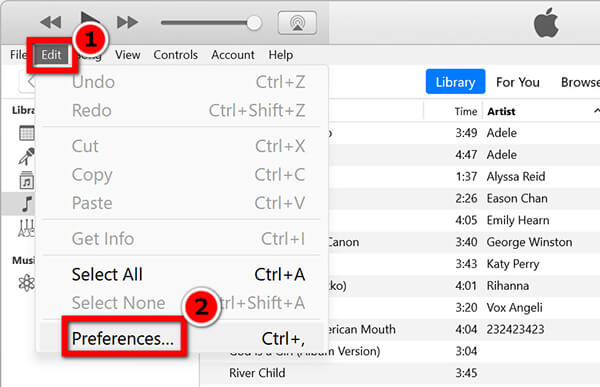
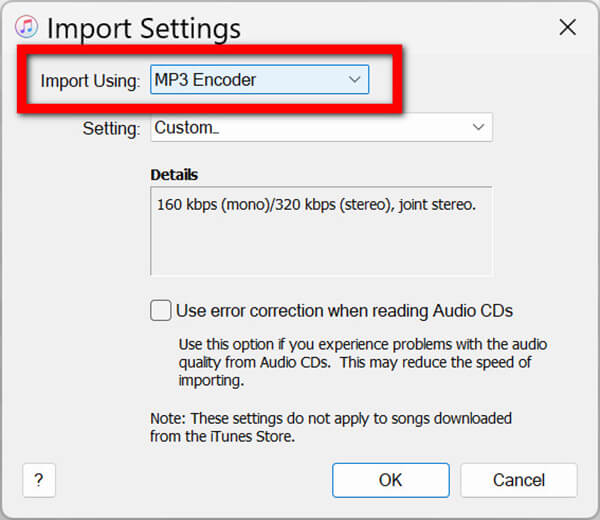
2. Change the Import Using dropdown to MP3 Encoder and set the setting to Custom to choose 320 kbps. Click OK.
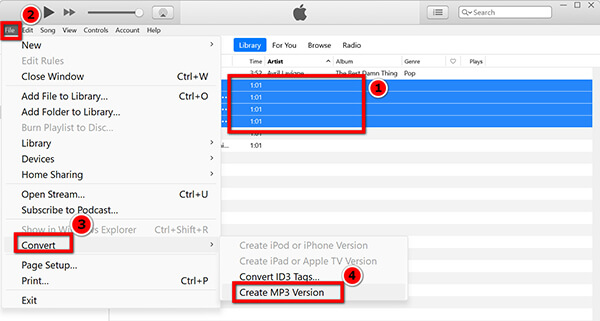
3. Select the WAV file in your music library. Make sure the track is highlighted in blue. Go to File > Convert > Create MP3 Version. The new file will appear directly beneath the original in your library.
Verdict: It works in a pinch, but having to manually dig through your library to delete the heavy WAV original afterward adds unnecessary friction to the process. Moreover, managing massive local audio libraries is a frustrating mess if you rely on default OS tools. That native batch conversion workflows are practically nonexistent in default apps. If you value your sanity and file structure, keep your batch conversions isolated in a dedicated tool.
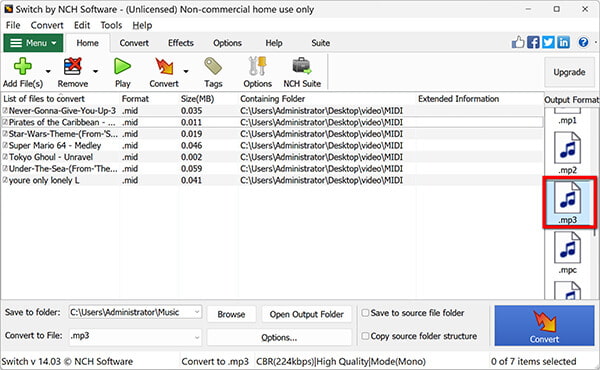
Switch by NCH Software is an old-school utility that focuses entirely on WAV to MP3 format conversion. It doesn't look modern, but it supports a massive array of obscure audio wrappers and handles cross-platform conversions efficiently.
1. Click the green Add File(s) button in the top left corner and locate your WAV.
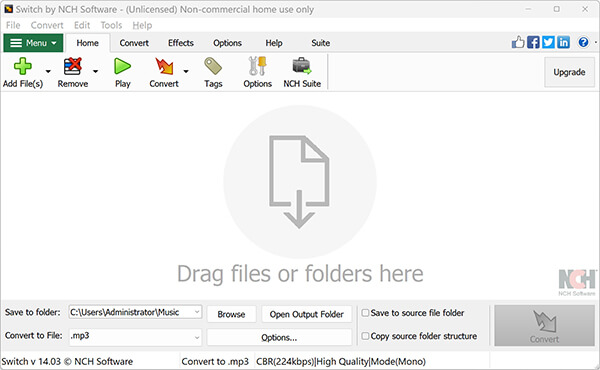
2. At the bottom left, set the Output Format dropdown to .mp3.
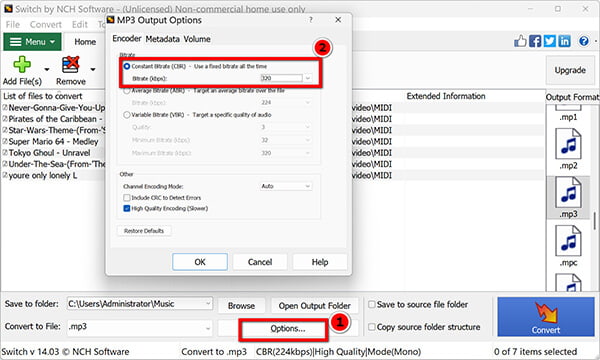
3. Click the Options… option, go to the Encoder tab to set your bitrate (choose Constant Bitrate at 192 or 320 kbps).
CBR (Constant Bitrate) is generally safer for older playback hardware than VBR (Variable Bitrate). Check more details about bitrate compression here.
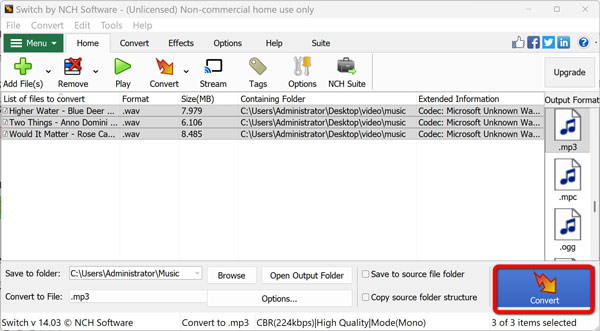
4. Click the Convert button in the bottom right corner.
Verdict: It is a highly functional, no-nonsense tool that gets the job done, provided you can ignore the outdated interface.
What MP3 bitrate sounds identical to WAV?
Based on extensive ABX blind testing, a 320 kbps MP3 (using CBR or VBR V0) reaches the point of perceptual transparency for the human ear. Even trained audio engineers struggle to distinguish it from an uncompressed WAV file on studio monitors.
How much smaller is MP3 compared to WAV?
A WAV file is generally 80% to 90% larger than a 320 kbps MP3. A standard 1-hour WAV is roughly 600MB, whereas the same audio compressed to a high-quality MP3 will only be about 140MB. If you only want to reduce WAV file size without encoding, just follow this guide to compress WAV.
My podcast WAV files are 500MB each. Uploading takes forever. How small will MP3 be?
If you export your spoken-word podcast to a standard 192 kbps MP3, that 500MB file will shrink to roughly 85MB. Because podcasts are mostly human voice, you can safely use lower bitrates without noticeable degradation, vastly improving your upload speeds.
Does converting WAV to MP3 reduce audio quality?
Technically, yes. MP3 relies on lossy compression, meaning it permanently discards audio data that psychoacoustic models dictate humans can't hear. However, at high bitrates (256 kbps to 320 kbps), the quality reduction is mathematical, not perceptual. If you use some professional tools to listen to the converted MP3 files, you can use an audio enhancement tool to fix the lossy quality from WAV.
How to compress WAV to MP3 for email attachment without losing audio quality?
Most email clients cap attachments at 25MB. To fit a longer audio file into an email, use an online WAV to MP3 converter and set the bitrate to 128 kbps. If the audio is just voice, check the Mono setting, and this halves the file size again while preserving crystal clear vocal quality.
Managing large audio files shouldn't hold up your workflow. Understanding how to compress and convert WAV to MP3 without losing quality allows you to reclaim massive amounts of hard drive space and share your media effortlessly.
For instant, one-off file compression, run your audio through a web tool.
But if you have gigabytes of raw files sitting on your desktop, you need the hardware-accelerated processing power of a dedicated utility.
Ready to shrink your audio files right now? Free download AnyMP4 Video Converter Ultimate to batch process your entire media library in seconds.
Secure Download
Secure Download
 Posted by Alice Thorne to Convert Audio
More readings
 10 Ways to Convert between WAV and MP3 on Computer & Mobile
Looking for the best WAV to MP3 converter? We tested 10 methods on desktop, online, and mobile. From AnyMP4 (top pick) to free tools, find yours here.
 4 Best Ways to Convert WMA to WAV (2026): Lossless Guide
Looking for the best way to convert WMA to WAV? Follow our step-by-step guide to convert WMA to WAV on Windows/Mac using 4 different methods.
 10 Best MP4 to WAV Converters to Extract Lossless Audio
Convert MP4 to WAV without losing quality. We tested 10 top converters for PC, Mac, and online to extract lossless PCM audio with 44.1/48kHz bitrates.
 4 Fast Ways to Convert WebM to MP3 (Lossless)
Struggling with large MKV files? Learn how to convert WebM to MP3 losslessly in seconds to extract pristine 320kbps audio offline today.