
In a Nutshell:
This guide recommends the two most effective solutions for Mac users to convert APE files to MP3: AnyMP4 Video Converter Ultimate offers high-speed batch conversion via a graphical interface, while X Lossless Decoder (XLD) provides precise lossless processing using metadata CUE tables.
The APE audio format, officially known as Monkey's Audio, is a highly efficient lossless audio compression format favored by audiophiles for its ability to bit-perfectly replicate original CD data. However, for macOS users, the APE format presents a persistent hurdle. Apple's ecosystem—including Core Audio, QuickTime, and Apple Music—provides absolutely no native support for APE files. If you attempt to sync these tracks to your iPhone or play them natively on a modern MacBook, you will hit a brick wall. This guide will provide detailed explanations of two highly reliable methods for converting APE files to MP3 on Mac, along with additional relevant information to assist you in the format conversion.
When converting file formats, it is vital to know what is happening under the hood. APE is a lossless archive format. It functions like a ZIP file for music—squeezing file size down while keeping 100% of the raw studio data intact.
MP3 is a lossy format. To make files dramatically smaller (often 10% of their original size), it strips out sound frequencies that the human ear struggles to hear.
Since you are converting lossless audio to lossy audio, it is essential to minimise any noticeable degradation in sound quality. Always choose the 320 kbps (constant bit rate) or V0 (variable bit rate) format. The 320 kbps MP3 format achieves optimal acoustic balance, delivering clear, high-quality sound that is virtually indistinguishable from lossless audio on home headphones or car speakers.
If you want to convert multiple APE files to MP3 formats, efficiency is important. AnyMP4 Video Converter Ultimate for Mac is ideal for batch converting files quickly. It supports video/audio conversion across a wide range of formats, including APE to MP3. Optimised perfectly for modern Apple Silicon architectures, it utilises Metal and hardware acceleration to deliver conversion speeds up to 70x faster than traditional software without sacrificing audio fidelity. Moreover, its built-in metadata editor allows you to adjust the file information with ease.
Now, read the following steps to learn how to convert APE to MP3.
1.Click the download buttons below to download and install the AnyMP4 Mac Video Converter Ultimate on your Mac.
Secure Download
Secure Download
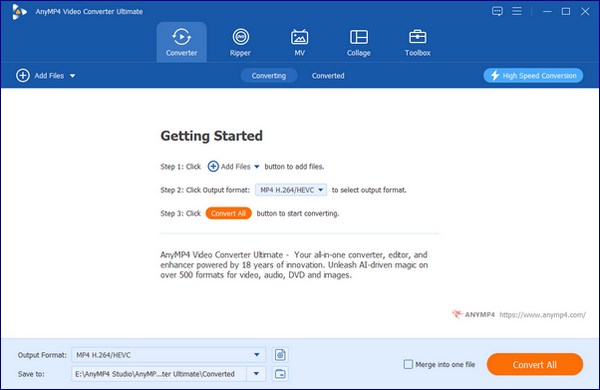
Open the software and, under the Converter section, click Add Files to import the APE file you want to convert.
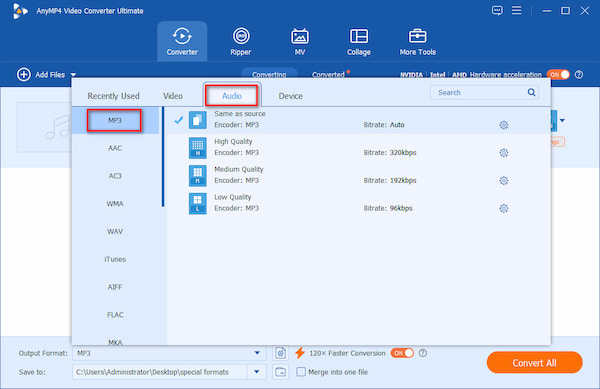
2.Choose the MP3, Same as Source option as the output profile from the Output Format drop-down list. You can choose the gear icon to further customize the encoder, channel, bitrate, and other parameters.
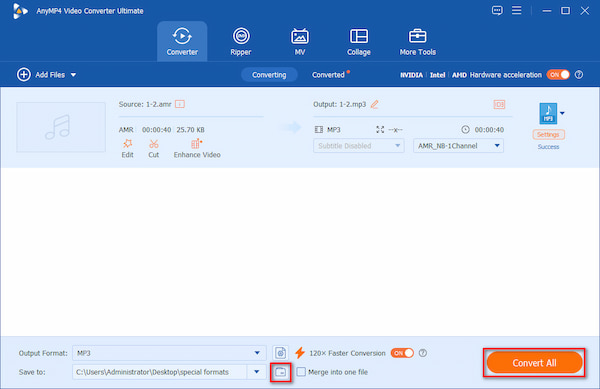
3.Click the folder icon to set a download folder and select Convert All to start the APE to MP3 conversion. Once done, the download folder will open automatically.
AnyMP4 Video Converter Ultimate for Mac enables you to convert bulk APE files to MP3 in a simple workflow. Moreover, it has the editing tools for you to adjust files. If your APE file is an entire un-split live album, you can click the Cut/Clip icon (the scissors symbol) beneath the file name. Here, you can easily use the slider to split the APE file or use the Fast Split option to chop the audio by time or average segments before converting.
For enthusiasts who demand strict, bit-perfect processing and native parsing of complex optical rip architectures, X Lossless Decoder (XLD) is the absolute gold standard on macOS. It is completely free, lightweight, and engineered specifically for high-fidelity tasks.
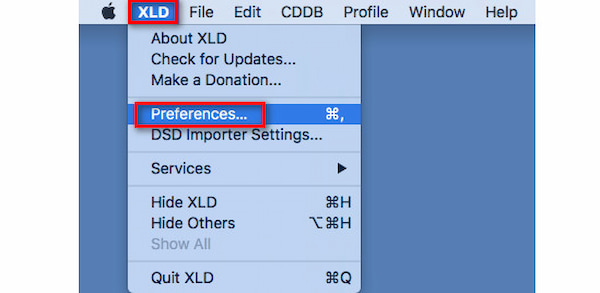
1.Open XLD on your Mac computer. Navigate to XLD > Preferences on the top menu bar to enter the new window.
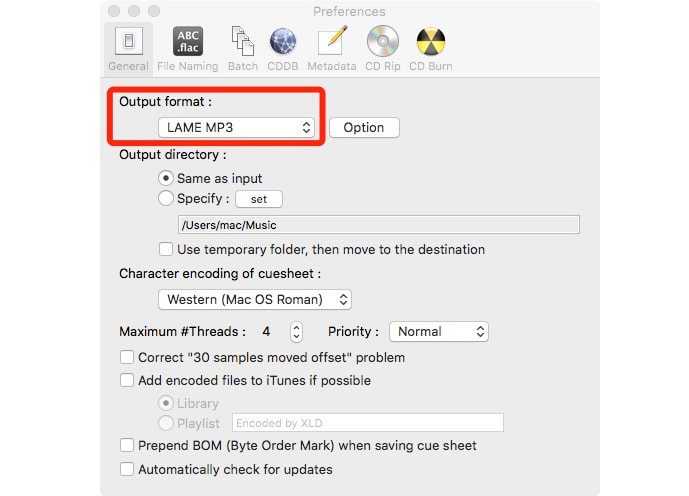
2.Choose LAME MP3 under the Output format dropdown. Remember to drag the encoding quality slider to maximum, select 'Constant Bitrate (CBR)', and specify 320 kbps. Close the preference pane to commit the profile to disk.
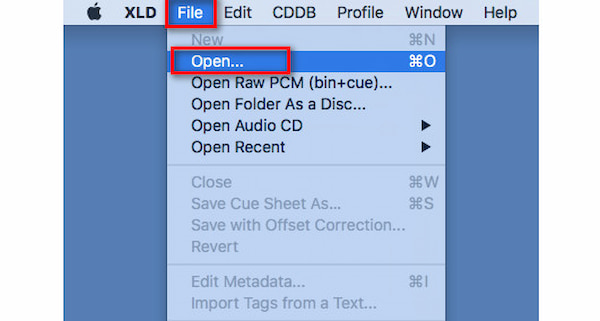
3.In the main interface, choose File > Open to import the APE file. If your album possesses a .cue index file alongside the APE asset, XLD will seamlessly parse the underlying text code, instantly populating a virtual interface displaying individual track names, exact timings, and pre-gap offsets.
4.With the CUE sheet successfully parsed inside XLD, click the 'Transcode' button to start the APE to MP3 conversion, and the file will be saved to the download folder.
While lacking a flashy modern interface, XLD remains an indispensable choice for true audiophiles and audio purists on the Mac platform. The software analyzes historical CD images using frame-level precision CUE tables, ensuring seamless album segmentation—whether for live concerts or continuous DJ mixes—with no silent gaps between tracks. However, its steep learning curve and practical design make it best suited for users who prioritize absolute accuracy over mere ease of use.
The conversion process isn't always smooth. Check the following troubleshooting tips to help you complete the format conversion more effectively.
Sometimes, basic free software tools lose complex audio container header information during encoding.
If metadata is lost, use the Media Metadata Editor tool in the AnyMP4 Toolbox tab. Alternatively, you can utilise free professional Mac tag editors (such as MusicBrainz Picard) to retrieve metadata from the internet and reapply it to newly created MP3 files.
Apple's built-in security framework (Gatekeeper) flags applications downloaded from sources other than the official Mac App Store. Go to System Preferences> Privacy and Security. Scroll down to the 'Security' section, then click 'Allow anyway' next to the blocked app notification to grant permission to install.
Many archival APE files are distributed as 'image+cue' configurations—meaning an entire 12-track CD is housed inside one massive .ape container, while a tiny plain-text .cue file maps the track divisions. If you execute a direct conversion on the raw APE file using generic software, you will end up with a single, unnavigable 60-minute MP3 file. Always check for a matching CUE file first, and utilize XLD or the advanced timeline cutting tools in AnyMP4 to process it properly.
Converting APE files to MP3 format uses destructive psychoacoustic data compression. Waveform elements identified as 'auditory redundancy' by the LAME algorithm are permanently removed to reduce file size. The original APE source file remains intact after conversion. If you later purchase high-end studio monitoring equipment or home audio systems, you will need these original APE files to re-encode them into modern lossless formats compatible with Apple devices, such as ALAC.
APE containers store metadata utilising the APEv2 tagging system, whereas MP3 files strictly adhere to the ID3 (ID3v1 and ID3v2) standard. During cross-platform conversions on macOS, character encoding conflicts frequently occur—especially with Asian fonts (such as Shift-JIS for Japanese or GBK for Chinese), resulting in garbled text (mojibake) in your song titles. Ensure that your conversion application is forced to output tags utilising Unicode UTF-8 or UTF-16 sub-specifications within the ID3v2.3 or ID3v2.4 framework to maintain cross-device readability.
Can Apple Music play APE files directly?
No, it doesn’t support this format. Apple Music cannot recognise or parse .ape containers.
Will converting APE to MP3 permanently reduce the sound quality?
Technically, yes. Because MP3 is a lossy format, sound data is discarded during conversion. You can set your export options to a maximum bitrate of 320 kbps to maintain incredibly high fidelity for standard everyday playback.
How do I convert APE to ALAC if I want to keep full lossless quality?
You can use AnyMP4 Video Converter Ultimate. Simply follow the same conversion steps outlined above, but select ALAC (.m4a) or FLAC as your destination audio profile instead of MP3.
To successfully convert APE files to MP3 on Mac, choosing and using the right tool for your needs is crucial. If you just want an easy way to convert APE files quickly, AnyMP4 Video Converter Ultimate performs well in terms of conversion speed and audio output quality. Besides, if you are handling precise historical CD archives bound tightly to structural CUE sheets, X Lossless Decoder (XLD) provides the surgical precision required by audio preservationists. Whichever route you choose, adhering to a 320 kbps standard and safeguarding your original lossless masters ensures your music collection remains future-proof, highly compatible, and acoustically brilliant.
 Posted by Alice Thorne to Convert Audio
More readings
 4 Ways to Convert HEVC to MP3 (Online & Offline Tools)
Get into this post and master how to convert HEVC to MP3 using free online tools or desktop software. Follow our step-by-step guide for smooth audio extraction.
 How to Convert MKV to MP4 on Mac: A Detailed Tutorial
Are you looking to learn how to turn MKV to MP4 on Mac? Read this article for a detailed tutorial and guide about file conversion.
 Top 2 Ways to Convert MOV Videos to SWF Format Easily
Have some MOV QuickTime files and want to compress them into SWF format? Here are two methods to do the job on your desktop and online easily and quickly.
 5 Best Ways to Convert M4A to WAV (Free, Online & Pro) - 100% Quality
Learn how to convert M4A to WAV on Windows, Mac, and Online by using AnyMP4, iTunes, VLC, and Audacity to ensure lossless audio quality.
 Add your comments to join the discussion here