
Summary
A WAV file is a digital audio format co-developed by Microsoft and IBM in 1991. It stores uncompressed PCM audio and preserves high audio quality, but produces large files. WAV is best for recording, editing, mixing, and mastering, while MP3 is better for storage and everyday listening.
Your DAW exports audio as WAV, but your hard drive keeps filling up. What is WAV, and do you actually need to use it? WAV is a digital audio container used for uncompressed PCM audio. It preserves the original recording quality at the cost of much larger file sizes than MP3s. This post explains what a WAV is and how it compares to other formats. We will also show you how to play them on any device and convert them when needed.
A WAV file, stands for Waveform Audio File Format, is an uncompressed audio container format. It was created in 1991 by Microsoft and IBM to store raw sound data on personal computers. It is stored in a RIFF container and holds PCM (Pulse Code Modulation) audio.
PROS
CONS
After learning the definition of WAV, let's move forward to what a WAV file is used for. We will also introduce three additional audio file types commonly used today. We will present a detailed table that explains how these formats differ from the main topic of this article.
| File Format and Comparison Measurements | Audio Quality | File Size (3-minute audio) | Practical Use | Technical Application and Usage | Compatibility with Media Players | Quick Verdict |
|---|---|---|---|---|---|---|
| WAV | Uncompressed and lossless. | Approximately 30 MB | Professional recording, editing, and archiving | Store high-quality, uncompressed sound. | Supported by most music and media players. | Quality and editing |
| MP3 | Depends on the bitrate used. | 2.8 to 7.0 MB | Every day use for personal entertainment | Shrink uncompressed audio files while keeping near-transparent quality. | Universally compatible with almost all music and media players. | Portability and size |
| AIFF | Uncompressed and lossless. | Approximately 31 MB | Burning Audio CDs, music production, and movie soundtracks | Store high-quality, professional-grade sound. | Supported by most modern desktop and media players. | Uncompressed Apple workflows |
| FLAC | Bit-perfect. | 15 to 30 MB | Master audio archiving, high-fidelity listening, and lossless streaming | Shrink file size without losing a single drop of quality. | Supported by most music and media players. | Lossless compression and archiving |
Know more about FLAC vs MP3 vs WAV in this guide.
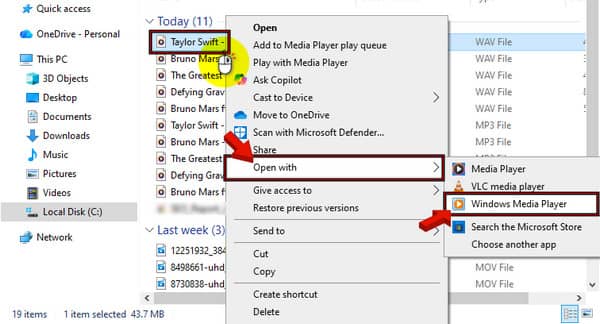
Windows computers have strong native support for the WAV format. So, how to play WAV files? You can open and play WAVs using the default app, the Windows Media Player.
To open: Right-click the WAV source, click Open With, and select Windows Media Player. Or, open Windows Media Player and drag the WAV into the player to play it.
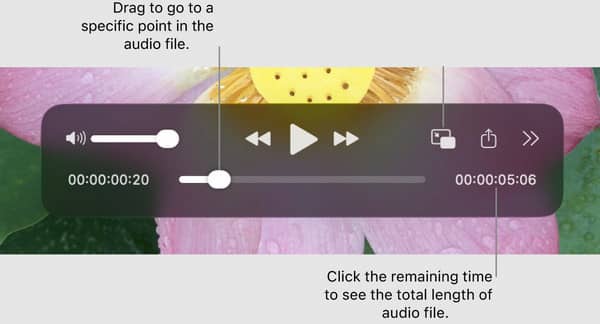
You can open a WAV on a Mac using the QuickTime Player app. However, it may fail to play the file if it uses an obscure compression codec, such as an ADPCM variant.
To open: Double-click the WAV in the Finder to automatically open it in QuickTime Player.
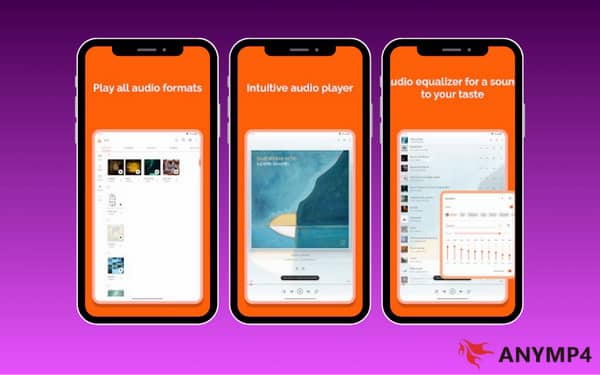
You can play WAV files on Android devices, but support depends on your device and Android version. If your default music player cannot handle it, you can use VLC for Android.
To open and play: Install VLC for Android from the Google Play Store and launch it. Tap the Audio option, find the WAV on your device, then tap it to start playback.
AnyMP4 WAV Player is a multimedia player that can run both high-quality videos and audio. It can bring out everything that WAVs have to offer, made possible by their Dolby Digital 7.1 support. It was originally designed to project surround sound for movies and high-quality audio formats, including WAVs.
Here's how to play WAV files:
1. Download the WAV player, install it, and complete the installation.
Secure Download
Secure Download
In the software's main interface, select Open File and select the WAV file that you want to listen to.
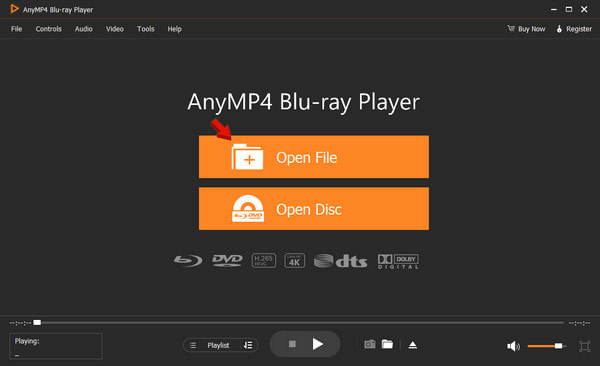
2. With the music now playing, let AnyMP4 WAV Player play your favorite music in the background.
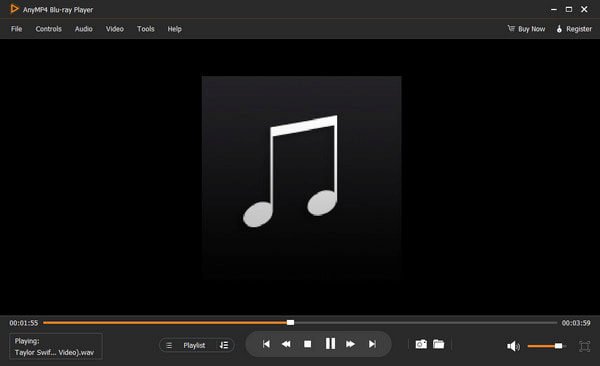
AnyMP4 WAV Player does everything you need for a dedicated multimedia player. Along with its ability to play your favorite music and films, its top-notch audio quality, powered by Dolby Digital and DTS, is unmatched in the digital software market.
AnyMP4 Video Converter Ultimate is, by default, a video-to-video conversion software. Similar to the previously featured Blu-ray player, it delivers more than its name suggests. It can convert WAV to MP3, AIFF, FLAC, and 500+ other formats. It can batch-convert hundreds of WAVs simultaneously without lag or crashing the software. It uses the most advanced hardware-accelerating media processing to achieve a 120× conversion speed.
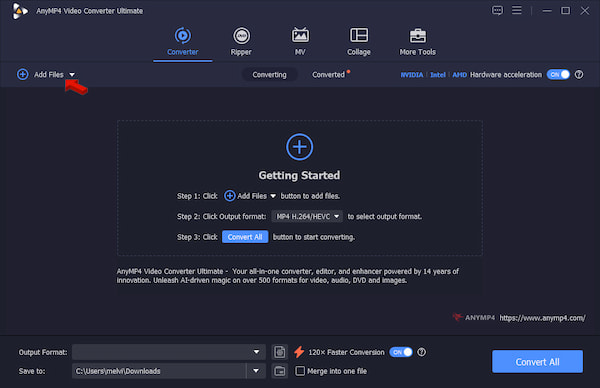
1. Download AnyMP4 Video Converter Ultimate and complete the installation. After setup, it will open to the Converter tab.
Secure Download
Secure Download
Click +Add Files to import the WAV sources from your computer. AnyMP4 does not limit the number of files or the file size you can process, so you can upload multiple files.
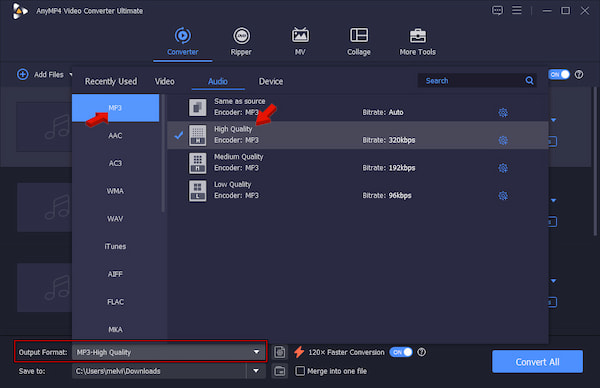
2. Head to the Output Format picker, click the Audio category, and select MP3. Set the quality preset to High Quality to keep high frequencies from your source.
3. Back to the main interface and enable Hardware Acceleration to speed up the conversion. Set the output folder, then click Convert All to convert WAV to MP3.
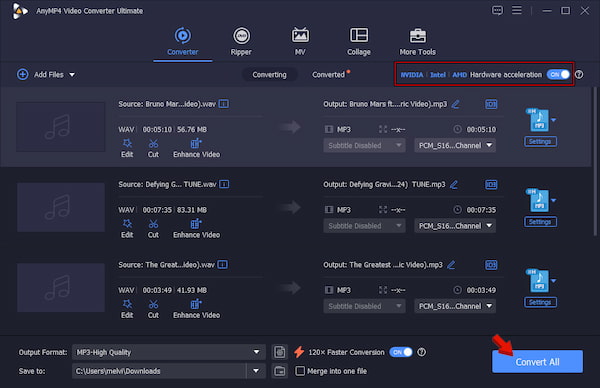
Yes, converting WAV is as simple as following these three steps, thanks to the convenience and practicality that AnyMP4 Video Converter Ultimate provides. To go along with that, you can also access their toolbox, where you can compress WAV files.
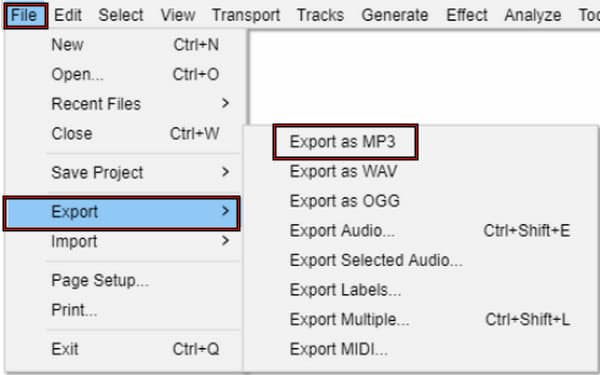
Audacity is a time-tested open-source audio editor. Aside from being an editing tool, you can also use it to convert WAVs into different formats, including MP3.
To convert. Click Import and select Audio to load your WAV file. Click the File menu again, but this time select the Export option. Then select Export as MP3 to save the WAV as MP3.
A WAV file is not the best format for every situation. Its large file size can become a problem when you are storing hundreds of recordings or sending audio through bandwidth-limited services.
1. Streaming music: Use MP3 for streaming music and online playback.
2. Portable storage: FLAC keeps lossless quality while using less space.
3. Messaging and sharing: MP3 or AAC is a better choice for messaging and sharing.
4. Large music libraries: Use FLAC for lossless archival quality.
Why are WAV files so large?
WAV files are large because they capture every single detail of the original sound recording. They do not use algorithms to compress the data or discard inaudible audio frequencies.
Is WAV lossless?
Yes, it is lossless. These files store raw audio data without compression, meaning no audio data or quality is discarded during recording.
Is WAV better than MP3?
WAV is technically better in audio quality because it is uncompressed and lossless. But when comparing WAV vs MP3 for convenience and smaller file size, MP3 is better.
So, what is WAV, and should you keep using it? The answer depends on what you do with your audio.
| Use Case | Recommended Format |
|---|---|
| Recording & music production | WAV |
| Audio editing | WAV |
| Casual listening | MP3 |
| Lossless music storage | FLAC |
WAV is not simply a format you should avoid because of its large files. Its uncompressed PCM audio makes it valuable throughout the production process. Once you no longer need that level of quality, use AnyMP4 Video Converter Ultimate to convert it to MP3. For straightforward playback, AnyMP4 WAV Player is a handy tool when you want more than your system's default media player offers.
 Updated by Alice Thorne to Glossary
More readings
 AAC vs. AC3 Comparison (2026): Key Differences Between Them
Confused by AAC vs. AC3? This post explores the differences between them, when to use each, and how to convert formats losslessly when necessary.
 What Is AIFC File Format? A Simple 3-Min Guide for Beginners
Confused by AIFC? Read this post to learn what the AIFC file format is, and how to open it. Convert AIFC to MP3/WAV and fix common errors with our simple guide!
 What is the M4B Format: Everything You Need to Learn in 2026
Do you want to learn what M4B files are and how they compare to popular audio formats? Read this article to know more about this audiobook format.
 Is M4B Better than MP3: A Detailed Comparison and Guide
Are you looking for a direct comparison and matchup of MP3 vs. M4B files? Read this article to learn what format you should use and in what scenario.
 Add your comments to join the discussion here