- Convert video, audio, and DVD over 500 formats.
- GPU acceleration to speed up the conversion process at 70X faster.
- More than 16 editor tools in the toolbox (Updating).
- Create videos for TikTok, YouTube, Facebook, etc.

Free Download100% Clear & Secure
Free Download100% Clear & Secure
Convert OPUS to MP3 Online
Back to main page
Setting
Custom resolution:
| Core Features | Web Version | Pro Desktop |
| Max File Size | 50MB (Login: 100MB) | No Limit |
| Daily Limit | 2 Files (Login: 10 Files) | Unlimited |
| AI Video Upscaling | No | Yes (Up to 4K/8K) |
| GPU Acceleration | No | Yes (70X Faster) |
| Batch Processing | No | Yes |
Failed to upload media file! Please try again, or use AnyMP4 Video Converter Ultimate for Desktop.(Error code: 20015)

The original video resolution is higher than 1080p. If you want to output the original high resolution, you need to download the Pro Version. Or would you like to output the default 1080p resolution?

Quick Summary
If you have downloaded a voice message from WhatsApp, saved a Discord recording, or exported an audio clip from a communication app, you may have noticed that the file ends with .opus. OPUS is a high-quality audio format commonly used for voice communication because it keeps file sizes small while maintaining clear sound. However, many built-in media players on Windows, Mac, and mobile devices do not support OPUS files by default. When you need to share the audio, edit it, or play it on another device, converting OPUS to MP3 is usually the easiest solution. MP3 files can be opened by almost all music players, smartphones, car audio systems, and editing programs. This guide shares 2 ways to convert OPUS to MP3, including a free online solution and desktop software for fast batch conversion.
If you only have a few OPUS files to convert, an online converter is usually the quickest option.
AnyMP4 Free Online Audio Converter allows you to convert OPUS files directly in your browser without installing desktop software. It is 100% free without any ad or virus. Besides, no watermark will be included, even if it is a freeware to make OPUS conversion. So you can feel easy to use it to convert OPUS to MP3 on the web.
1. Upload Your OPUS File
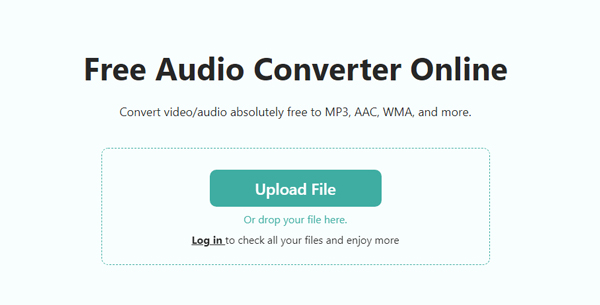
Open the online OPUS to MP3 audio converter and add your .opus file by clicking the Upload File button. You can upload voice recordings, downloaded audio clips, or other OPUS files saved on your device.
2. Select MP3 as Output Format
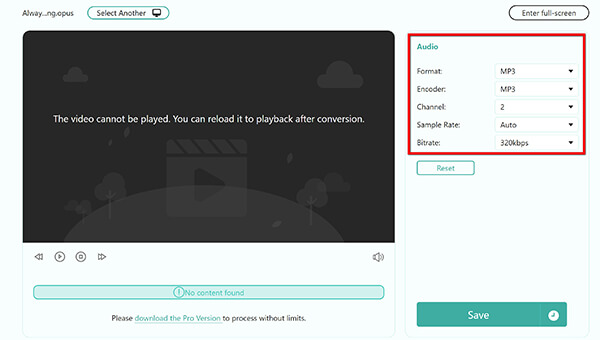
Choose MP3 from the available audio formats next to Format. Besides, you can adjust the output MP3 encoder, channel, bitrate, etc., according to your different device requirements.
3. Convert and Download
Start the conversion process by clicking the Save button. Download the MP3 file when it is finished.
Your converted audio can then be played on more devices or shared more easily.
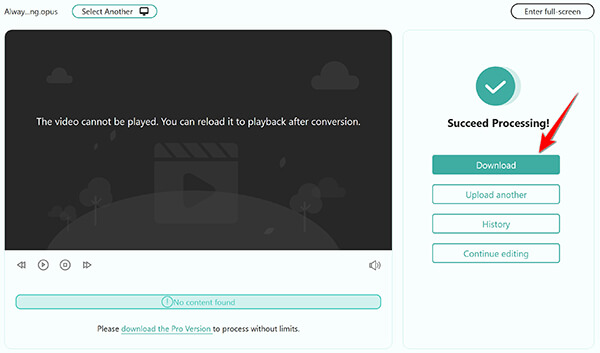
Online converters are convenient for occasional conversions. However, they may not be the best option when you need to process many files. For example, if you have hundreds of WhatsApp voice messages saved as OPUS files, converting them one by one can take a lot of time.
A desktop converter provides more control over:
AnyMP4 Video Converter Ultimate supports OPUS conversion on Windows and Mac, including:
Steps to convert multiple OPUS files to MP3:
1. Add OPUS Audio Files
Free download and install AnyMP4 Video Converter Ultimate on your Windows or Mac computer.
Secure Download
Secure Download
Drag and drop your individual files or multiple OPUS recordings at once into this software. Or, you can import all your OPUS files into the whole folder.
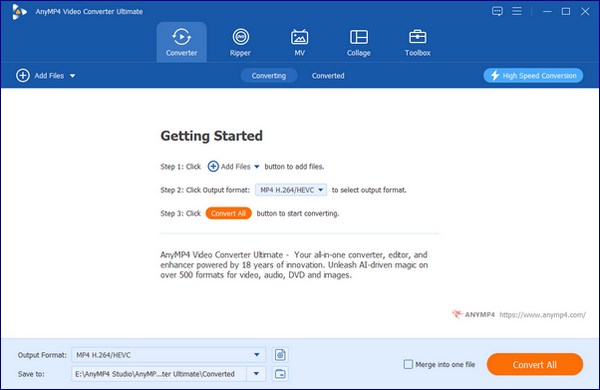
Optional to edit audio:
If needed, trim unwanted parts from your recordings or merge several OPUS clips into one MP3 file by clicking the trim button.
2. Choose MP3 Output
Select MP3 from the audio output options by clicking Output > Audio > MP3.
Here, the output MP3 has many options, and you can select the MP3 quality for your needs.
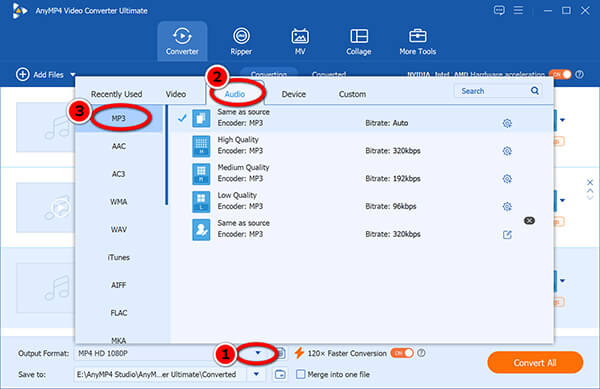
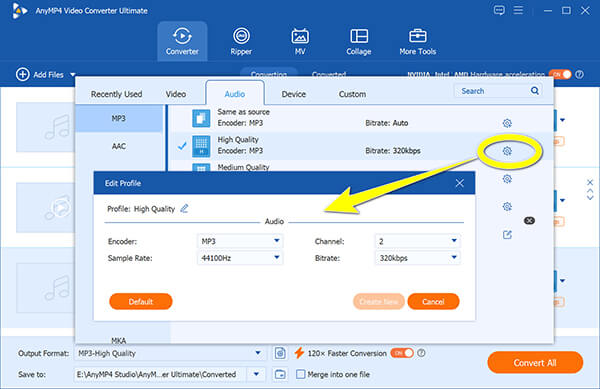
For professional users, you can customize audio quality settings with more details by clicking the Custom profile option:
For high-quality MP3 output, 256 kbps or 320 kbps is commonly recommended.
3. Convert OPUS to MP3
After all settings are ready, just return to the main interface, click the Convert Allbutton to process your OPUS files.
One thing you should remember is to enable the GPU acceleration at the top-right side, which can speed up your OPUS to MP3 conversion process at 30X faster.
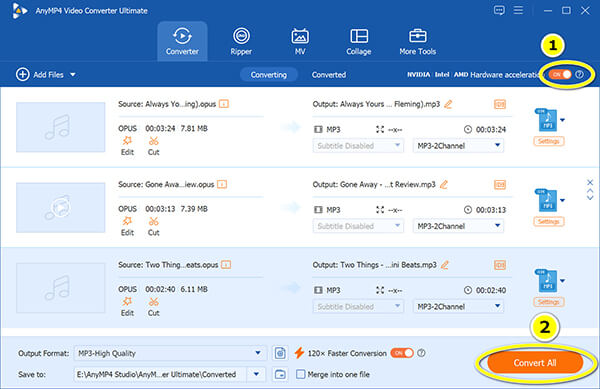
Choosing between an online converter and desktop software depends on how you use OPUS files.
| Feature | Online Converter | Desktop Converter |
|---|---|---|
| Installation | No | Required |
| Single file conversion | Good | Good |
| Batch conversion | Limited | Supported |
| Large audio collections | Less convenient | Better choice |
| Audio settings | Basic | Advanced |
| Offline processing | No | Yes |
For occasional conversions, an online tool is usually enough.
For large collections or professional audio work, desktop software provides more flexibility.
Secure Download
Secure Download
One common situation is this:
You receive a WhatsApp voice message. It plays perfectly inside WhatsApp, but after exporting the file to your computer, your default media player cannot open it.
The reason is simple: OPUS was created mainly for real-time communication, not universal playback.
Applications such as WhatsApp, Discord, and other voice communication platforms use OPUS because it delivers high-quality audio with very low latency. However, many default players do not support native OPUS.
OPUS is an open audio codec designed for both speech and music applications. It was developed to handle real-time audio transmission while maintaining good sound quality at smaller file sizes.
Unlike older formats such as MP3, OPUS focuses heavily on low latency and efficient compression.
Advantages of OPUS:
OPUS is especially useful for:
OPUS is widely used for voice communication is that it can keep voices sounding clear even with limited bandwidth. Therefore, OPUS is very useful for apps that rely on real-time audio.
You’ll often come across OPUS files in places like:
OPUS and MP3 are both popular audio formats, but they are designed for different purposes.
| Feature | OPUS | MP3 |
|---|---|---|
| Full name | Opus Interactive Audio Codec | MPEG-1 Audio Layer III |
| Main purpose | Voice communication and streaming | General audio playback |
| Compression efficiency | Excellent | Good |
| Compatibility | Limited | Very broad |
| Latency | Very low | Higher |
| Best use | Calls, chat, streaming | Music, sharing, playback |
Is OPUS better than MP3?
OPUS is a great choice when space is limited, especially for voice recordings at lower bitrates. However, its compatibility beats many of you. That’s where MP3 still wins. I usually recommend MP3 when the main priority is convenience. If your goal is simply to play, share, or edit audio files, MP3 is often the more practical choice.
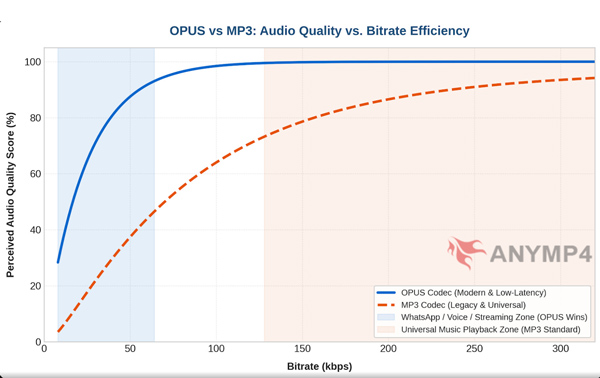
Although OPUS has technical advantages, MP3 remains the more convenient format for everyday use.
You do not always need to convert an OPUS file. If you only want to listen to it, several applications can open OPUS directly.
VLC Media Player: It supports OPUS playback on:
foobar2000: A lightweight Windows audio player that supports many audio formats, including OPUS.
AnyMP4 OPUS Player: it is an all-in-one audio, video, Blu-ray, and DVD player, which supports OPUS, MP3, 4K video, and more with smart playlist management.
Secure Download
Secure Download
Web Browsers: Some modern browsers, including Chrome and Firefox, can play OPUS files directly.
Can I convert OPUS to MP3 for free?
Yes. Online OPUS to MP3 converters let you convert audio files without installing any additional software. AnyMP4 Free Online Audio Converter is a free online tool to convert OPUS to MP3.
Is OPUS better quality than MP3?
Yes. For voice recordings, OPUS can achieve good sound quality while keeping file sizes small, even at lower bitrates. If you need an audio format that plays almost everywhere, MP3 is usually the safer choice thanks to its broad support.
Does converting OPUS to MP3 reduce quality?
Yes, but the quality difference is usually small. When you convert OPUS to MP3, the audio has to go through another compression step, so some detail may be lost. In my experience, you won’t notice much of a change for voice messages or casual recordings. If you’re converting music or important audio files, choosing a higher bitrate like 256 kbps or 320 kbps is a good way to keep the sound closer to the original.
How do I convert WhatsApp OPUS voice messages to MP3?
Locate the OPUS voice message file from your WhatsApp media folder, upload it to an OPUS to MP3 converter, and export it as an MP3 file for easier playback and sharing.
Can VLC convert OPUS to MP3?
Yes. Although VLC can convert OPUS files, the process is not always the most user-friendly, especially when working with multiple files. A dedicated OPUS converter can make the process faster and more efficient with a simpler interface and batch conversion support. Follow this guide to convert audio and video to MP3 in VLC.
What MP3 bitrate should I choose when converting OPUS?
For voice recordings, 128-192 kbps is usually enough. For higher-quality audio, 256 kbps or 320 kbps provides better results.
OPUS is widely used for voice recordings and online communication because it offers good audio quality with efficient compression. However, its compatibility is still limited compared with more common formats like MP3. Converting OPUS files to MP3 makes them easier to open, share, and edit across a wider range of devices and applications.
For quick conversions, AnyMP4 Free Online Audio Converter provides a simple way to convert OPUS files directly online. If you need to process many files, adjust audio settings, or convert OPUS recordings in bulk, AnyMP4 Video Converter Ultimate offers a more complete desktop solution.
Secure Download
Secure Download
Which method is your favorite one? Or if you have better recommendations? Tell us by leaving your comments below.
 Updated by Alice Thorne to Convert Audio
More readings
 How to Convert MP3 to FLAC Safely (2026 Batch Processing Guide)
How to convert MP3 to FLAC without losing your ID3 tags or album art? Learn from the top 4 offline and online methods for batch conversion.
 How to Add MP3 to Apple Music (Mac, Windows & iPhone Sync)
Learn exactly how to add MP3s to Apple Music, including fixing messy metadata, bypassing sync errors, and streaming your local files anywhere.
 5 Ways to Convert M4B to MP3 and Keep Audiobook Chapters
Want to listen to your audiobooks on an Android phone or a car stereo? If yes, just follow the 4 ways to convert M4B to MP3, and open them on your device.
 4 Fast Ways to Convert WebM to MP3 (Lossless)
Struggling with large MKV files? Learn how to convert WebM to MP3 losslessly in seconds to extract pristine 320kbps audio offline today.
 Add your comments to join the discussion here