
Quick Summary:
FLAC, MP3, and WAV represent the three pillars of digital audio. WAV provides uncompressed, studio-grade sound; FLAC uses lossless compression to save storage space without discarding data; and MP3 applies lossy compression to discard inaudible frequencies, drastically reducing file sizes for everyday streaming.
You may sometimes find yourself in a dilemma: should you preserve the original studio-grade depth and quality, or prioritize storage space? To settle the debate between FLAC vs. MP3 vs. WAV once and for all, this guide compares these three audio formats across multiple dimensions using rigorous, objective data from our internal lab tests, helping you strike the perfect balance among audio bitrate, storage usage, and sound quality.
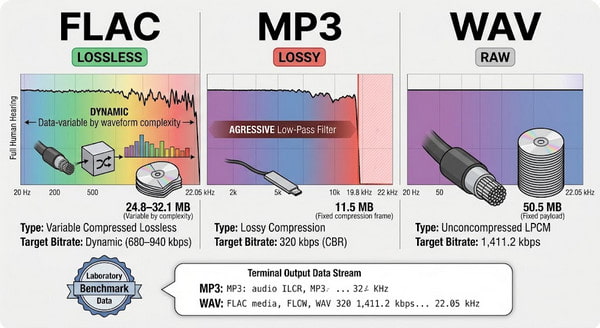
| Format | Target Bitrate | High-Frequency Cutoff (kHz) | Exact File Size (5-Min Stereo Track) |
|---|---|---|---|
| FLAC | Dynamic (680–940 kbps) | None (Unfiltered ~22.05 kHz) | 24.8–32.1 MB (Variable by waveform complexity) |
| MP3 | 320 kbps (CBR) | ~19.8 kHz (Aggressive brickwall shelf) | 11.5 MB (Fixed compression frame) |
| WAV | 1411.2 kbps | None (Unfiltered ~22.05 kHz) | 50.5 MB (Fixed payload) |
FLAC is a specialized format for passionate music enthusiasts with Free Lossless Audio Codec, also known as FLAC. Developed as an open-source project for ripping music data from CDs, FLAC is a lossless audio format built on open-source principles to capture music without sacrificing quality in exchange for a larger file size. Because of its higher audio quality, FLAC became a standard for listeners seeking audio quality better than MP3.
The exact opposite of FLAC, MP3 sacrifices a little audio quality in exchange for a highly compressed file size. Because of that, music files saved in MP3 format are generally portable and optimized for use on modern devices. It is the perfect format for people who love music for its entertainment value, since MP3 files can be downloaded in bulk without worrying about storage space.
Originally developed for storing audio on personal computers, the Waveform Audio File Format is an audio file format that can be considered a perfect copy of the recorded audio. Compared to the previously mentioned FLAC, WAV files are even clearer and crisper. Additionally, they are also about 70% larger than the already bulky FLAC audio files. Because of that, WAV has become the standard for professional audio recording, including studio music recordings, journalistic interviews, and audio intended for use in films or general video editing.
Loading FLAC files onto legacy car head units or older hardware often triggers an "Unreadable USB" or "Format Not Supported" error screen. Early embedded decoders lack native FLAC hardware instruction sets, stranding audiophile archives on legacy media players.
WAV relies on a standard 32-bit header integer to declare file length. This imposes a strict 4 GB file size limit (roughly 6.6 hours of 16-bit/44.1kHz audio). Long multitrack live sessions exceeding this threshold will fail to write or corrupt the RIFF header.
Native iOS apps historically shun FLAC in favor of ALAC. Attempting to sync raw FLAC files directly to default iOS system libraries results in unplayable tracks unless third-party players or container conversions are deployed. Furthermore, WAV files suffer from poor native ID3 tag indexing on mobile platforms because WAV lacks a standardized metadata chunk format, causing missing album art and track details across mobile OS interfaces.
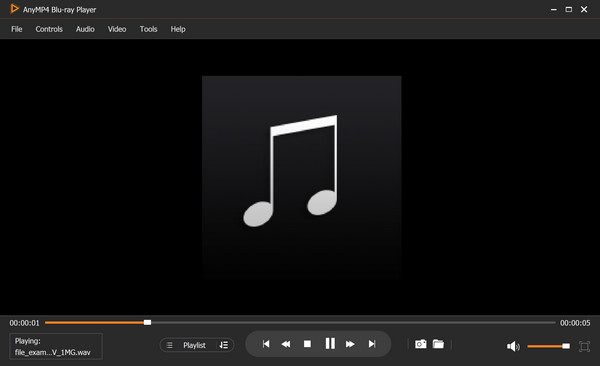
When listening to master-grade files on desktop monitors, standard media players often route audio through the operating system's sound mixer, introducing unwanted bit-depth truncation and resampling artifacts. AnyMP4 Blu-ray Player serves as a specialized, audiophile-grade desktop tool. Its DTS-HD Master Audio and Dolby TrueHD pass-through support ensures zero-loss, bit-perfect playback of your master-grade WAV and FLAC files directly to your studio monitors.
Secure Download
Secure Download
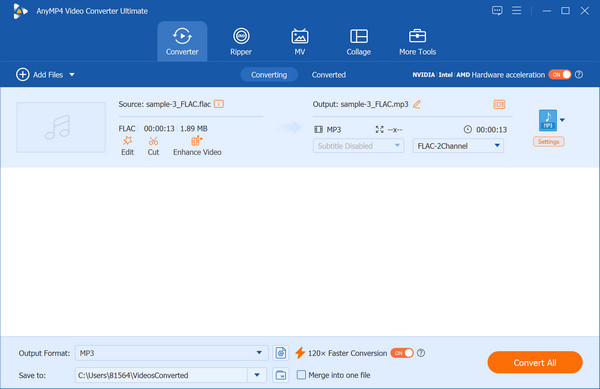
For field listening, DAPs, and mobile storage management, converting massive lossless audio archives into lightweight, highly compatible formats demands both processing speed and metadata preservation. AnyMP4 Video Converter Ultimate operates as the ultimate library management and transcoding solution for extensive digital music collections.
Secure Download
Secure Download
Is FLAC genuinely better than 320kbps MP3 on standard Bluetooth headphones?
No. On standard Bluetooth headphones, a FLAC file will not offer a genuinely better-quality advantage over a 320-kbps MP3.
Why does my car stereo say my WAV files are unreadable?
When a car stereo displays "unreadable" for WAV files, it is usually due to hardware limitations, incorrect file parameters, or drive formatting limitations.
Can I upmix an MP3 back into a FLAC to restore lost audio quality?
No. Converting an MP3 to FLAC will not restore the lost audio quality.
What is the exact technical difference between 16-bit and 24-bit FLAC audio?
The technical difference between 16-bit and 24-bit FLAC audio comes down to two variables: bit depth and dynamic range.
Choose MP3 for broad compatibility and lightweight storage, FLAC for space-efficient digital archiving, and WAV for active audio production in studio DAWs.
Ready to test your gear? Experience your studio collection without compromise with AnyMP4 Blu-ray Player for bit-perfect audio delivery, or optimize your DAP storage today by downloading AnyMP4 Video Converter Ultimate to batch-transcode your FLAC vs. MP3 vs. WAV library in seconds!
Secure Download
Secure Download
 Posted by Alice Thorne to Glossary
More readings
 4 Best Ways to Convert FLAC to MP3 (2026: Lossless Quality & Batch)
Looking for the fastest FLAC to MP3 converter? Get AnyMP4, VLC, and online tool to batch convert while keeping 320kbps quality and ID3 tags on Windows/Mac.
 10 Ways to Convert between WAV and MP3 on Computer & Mobile
Looking for the best WAV to MP3 converter? We tested 10 methods on desktop, online, and mobile. From AnyMP4 (top pick) to free tools, find yours here.
 5 Methods to Convert FLAC to WAV for Lossless Audio Quality
Read this post to learn how to convert FLAC to WAV with 5 tested tools in 2026. Keep the original audio quality with our step-by-step beginner guide.
 FLAC Audio Compression to Make Big FLAC File into Smaller
FLAC files come with larger file sizes compared with other formats. For that, we will discover the best audio FLAC compression methods. See here for more.