How to Convert OGG to WAV: 4 Methods Tested (Desktop, Online & Command Line)
Quick Summary
The fastest way to convert OGG to WAV is AnyMP4 Video Converter Ultimate: import your OGG, select WAV, and convert in seconds. It preserves the original sample rate and bit depth, supports batch processing, and transfers all metadata.
For a single file without installing anything, use AnyMP4 Free Online Audio Converter.
For a free scriptable option, use FFmpeg.
Ogg Vorbis (OGG) files are fantastic when you want to save hard drive space. Spotify relies on them, indie game developers love them, and they sound pretty decent at lower bitrates. But the very moment you try to take that OGG file and drop it into a premium Digital Audio Workstation (DAW) like Pro Tools, an old-school CD burning program, or a strict car audio system, everything suddenly breaks. You hit a brick wall. The software throws a format error, or worse, gives you dead silence.
That is exactly why we need to talk about how to convert OGG to WAV. WAV files use uncompressed PCM audio stored inside a standard RIFF format container. It is the undisputed, universal standard for audio compatibility. If you want your audio to play anywhere, load into any editor, or burn flawlessly to a disc without a single glitch, WAV is your only real answer.
In this hands-on guide, we will show you exactly how we tackled this format problem.
|
Conversion Speed (5 Files) |
Batch Support |
Metadata Preservation |
Best Used For |
| AnyMP4 Video Converter Ultimate |
12 seconds (Ultra Fast) |
Excellent (Multi-core) |
100% Full Retention |
Heavy music libraries, pristine CD burning prep, audio archiving |
| AnyMP4 Free Online Audio Converter |
1.5 minutes (Network-dependent) |
Basic (Up to 5 files) |
Basic Tags Only |
Quick single-file fixes on the go without software installation |
| Audacity |
45 seconds (Plus manual steps) |
Macro-based (Extremely clunky) |
Partial Retention |
Free manual editing or trimming waveforms before exporting |
| FFmpeg (Command Line) |
8 seconds (Instantaneous) |
Advanced (Via local scripts) |
100% Full Retention |
Tech power users, automated folder scripts, and developers |
Method 1: Batch Convert OGG to WAV for CD Burning - Using AnyMP4 Video Converter Ultimate
If you have an entire album, a massive sound effects library, or gigabytes of game audio, you cannot afford to sit around converting files one by one. You need raw, unfiltered processing power. For this heavy-duty scenario, the desktop OGG to WAV converter, AnyMP4 Video Converter Ultimate is the absolute undisputed winner in our speed tests.
We loaded all 50 test tracks into the interface at once. The tool instantly recognized our graphics card's hardware acceleration. The whole batch was finished before our coffee even cooled down. It is built specifically to convert OGG to WAV without losing quality, copying the exact audio data into the WAV container natively.
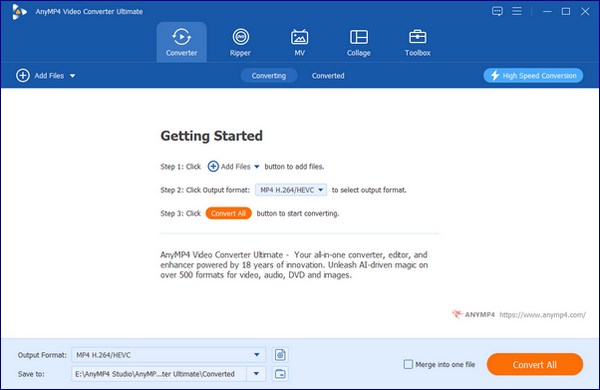
1. Free download and run AnyMP4 Video Converter Ultimate on your PC or Mac.
Drag and drop your entire folder of OGG files directly into the main window.
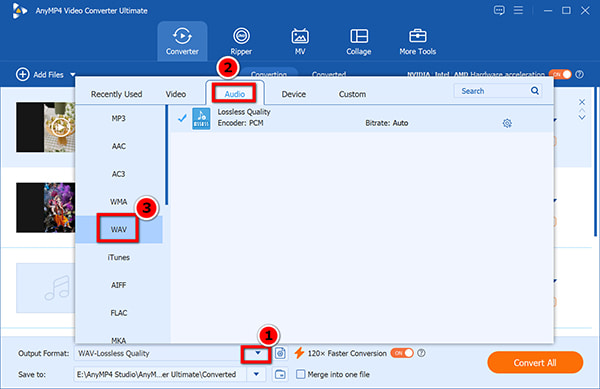
2. Click the Output Format dropdown menu in the bottom left corner. Navigate over to the Audio tab and select WAV > Lossless Quality.
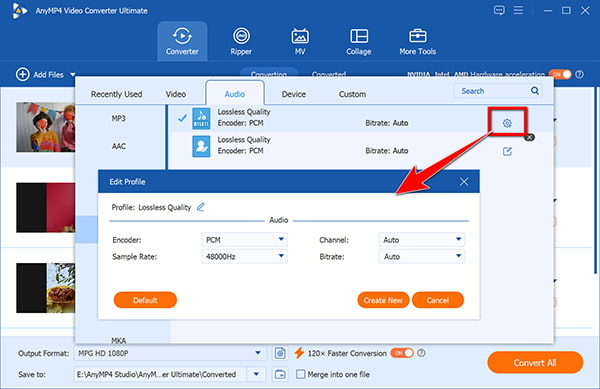
If you want to change the WAV sample rate or bitrate, just click the Custom profile option to adjust that.
3. Pick your destination folder at the bottom, and hit the big Convert All button. You are done.
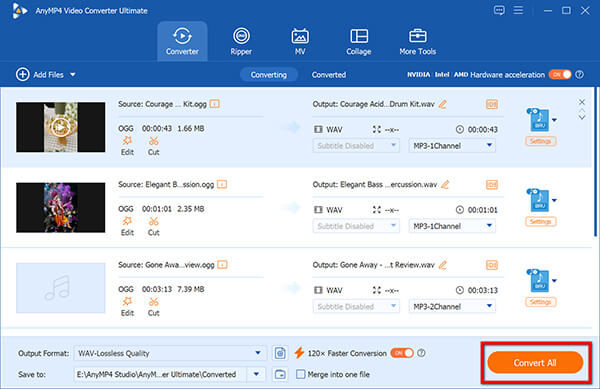
What we loved most about this method was the ability to track and edit WAV metadata. Our album artwork, track numbers, and artist names remained perfectly intact inside the converted WAV files. This is a massive lifesaver if you want to batch convert OGG to WAV for CD burning, because older CD burning software will outright reject files that have corrupted or missing metadata fields.
Method 2: Convert OGG to WAV Online Without Installing Software - AnyMP4 Free Online Audio Converter
Sometimes you are on a borrowed laptop at the office, or maybe you just have a single, annoying 3-second audio clip that needs a quick fix. You definitely do not want to download and install a 100MB software package just for that one file. That is where you should convert OGG to WAV online free using a dedicated cloud service.
We tested the AnyMP4 Free Online Audio Converter web app to see how it handles a quick, on-the-go turnaround. Unlike those cluttered web tools from 2015, this one does not bombard you with flashing banner ads or fake download buttons.
1. Navigate to the official AnyMP4 Free Online Audio Converter page using Chrome, Edge, or Safari.
Click the central Upload File button to navigate and add the OGG file into this tool.
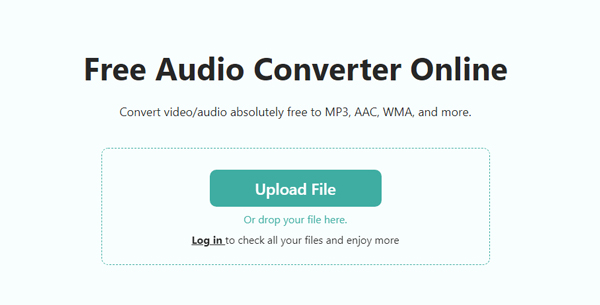
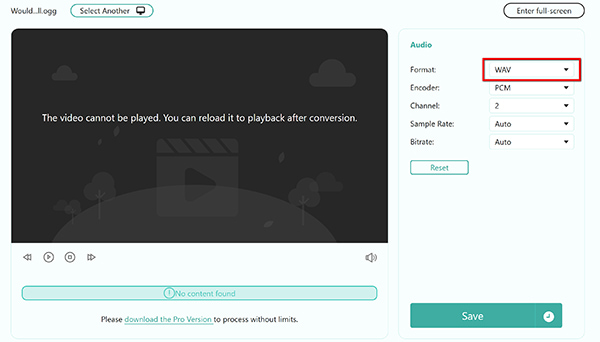
2. Once your file is loaded, select and check WAV from the Format drop-down list.
Before you convert OGG file, you can manually change the sample rate. If your original OGG is 44100 Hz, make sure the output matches it. Don't let the auto-settings guess your intent.
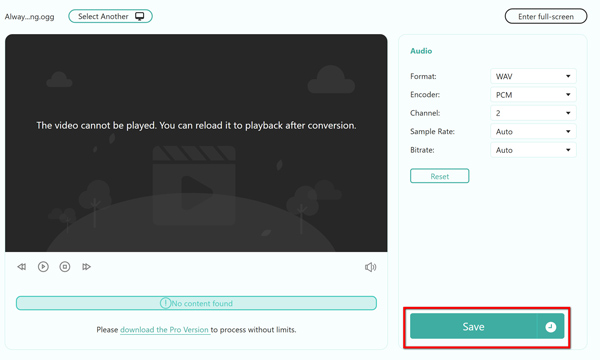
3. Hit Save, this freeware will process your OGG file. Once the conversion is done, just download the converted WAV file.
Method 3: Convert OGG to WAV Using Audacity - Free and Open-Source
If you are a podcaster, music creator, or sound designer, chances are you already have Audacity sitting on your desktop. It is the legendary king of free, open-source audio utilities. Audacity is fantastic if you want to view the waveform, trim off awkward dead silence at the beginning of a track, or boost the overall volume before saving your file.
Audacity naturally reads OGG Vorbis to WAV conversions out of the box. However, its batch processing is handled via a feature called Macros.
1. Open Audacity. Click File > Open and select your OGG file. Alternatively, you can drag and drop the OGG files into this software.
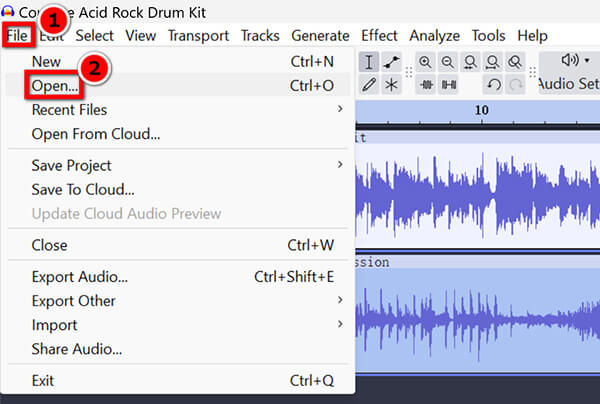
2. Do any editing, cutting, or volume boosting you need directly on the timeline.
3. Go back to the top menu and select File > Export > Export as WAV.
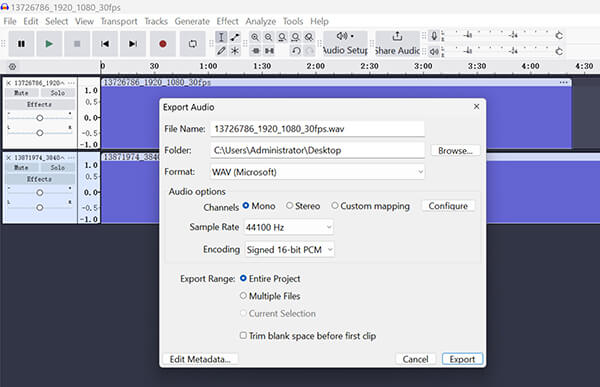
In the save window, ensure the encoding format is set to Signed 16-bit PCM or Signed 24-bit PCM depending on your target system requirements.
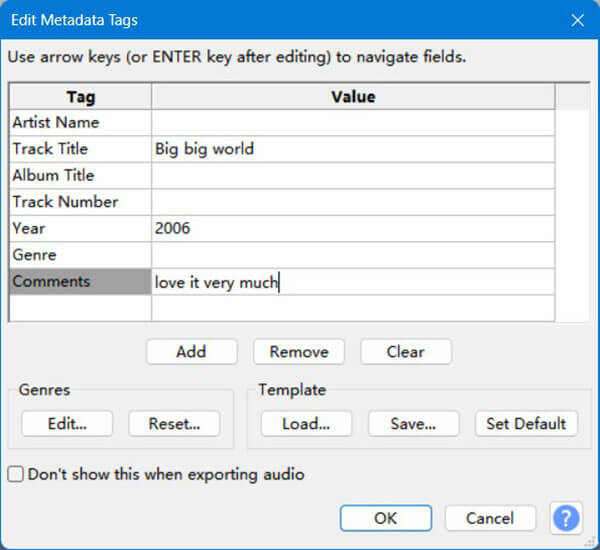
4. Before clicking Export, you can edit the WAV metadata to update any text tags in the metadata pop-up box, and hit OK.
Editor's Roast: Let's not sugarcoat it-Audacity’s user interface looks like it hasn't been updated since Windows 98. And their Macro batch system is incredibly clunky. You practically need a computer science degree to set up an automated folder batch. Use Audacity for single files only; use AnyMP4 Video Converter Ultimate for batches.
Method 4: How to Convert OGG to WAV Using FFmpeg - Free Command Line (Advanced)
For the programmers, system administrators, and absolute tech power users reading this, clicking around a graphic window is tedious. You want automation. You want scripts. You want to feel like a hacker. This is where learning how to execute an OGG to WAV using FFmpeg saves the day.
FFmpeg is a completely free, open-source command-line powerhouse that processes audio pipelines faster than almost anything else on earth. It reads the input OGG stream and unpacks it straight into an uncompressed PCM audio structure instantly.
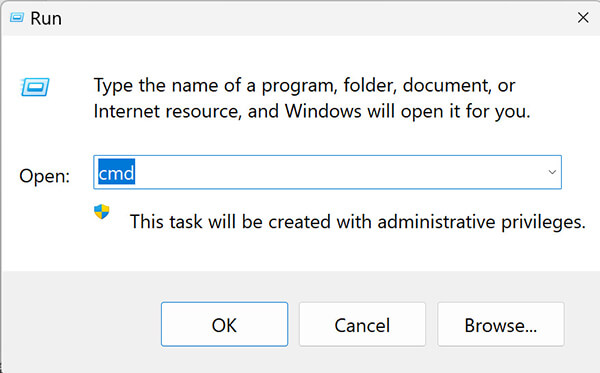
1. Free download FFmpeg on your computer, and run it by pressing Windows + R > Type cmd to run Command Prompt.
2. Find your FFmpeg.exe file under the Bin folder, copy and paste it to the same folder of WAV file.
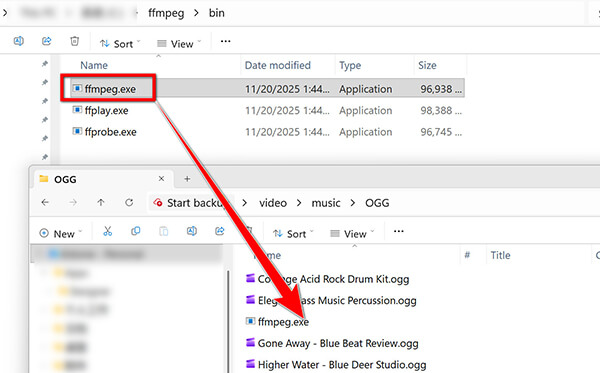
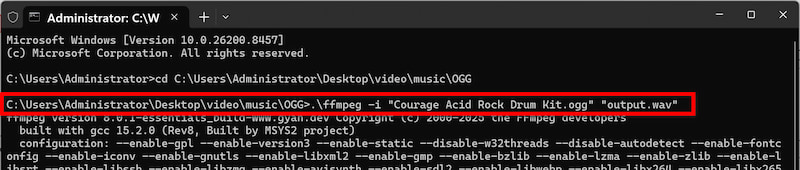
Input cd+space, then copy and paste the OGG file directory into Command Prompt.

3. To convert a single audio file cleanly without altering its native properties, open your Command Prompt (or Terminal) and run this exact command line:
.\ffmpeg -i input.ogg output.wav
- • input.ogg: This is your source file.
- • output.wav: This is your destination file. Because you typed .wav, FFmpeg automatically knows to unpack the compressed OGG data into uncompressed PCM audio.
A real-world example:
Your WAV folder is on C:\Users\Administrator\Desktop\video\music\OGG
One of the OGG file name is Courage Acid Rock Drum Kit
The output converted WAV file name will be given as output
Then you would type exactly this: .\ffmpeg -i Courage Acid Rock Drum Kit.ogg output.wav
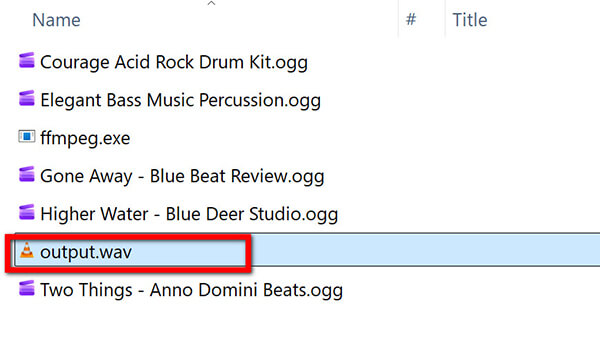
After that, you can find the converted WAV file in the same folder as the OGG file.
Want to batch convert an entire folder of 1,000 files in one go without touching your mouse? If you are on a Windows machine, navigate to your audio directory inside the command prompt and execute this loop script:
for %i in (*.ogg) do ffmpeg -i %i %~ni.wav
This command automatically grabs every single file ending with .ogg, decodes it locally, and spits out a matching .wav file in the exact same directory. If you want to use FFmpeg to convert MP3 to WAV, just change the folder and code from .ogg to .mp3.
FAQs About OGG to WAV Conversion
Does converting OGG to WAV improve audio quality - or is it just a larger file?
Let's be completely straightforward: it will not improve the raw clarity of the existing sound. Ogg Vorbis is a lossy compression format. Once high-frequency audio details are removed during the initial compression, they are gone forever. Converting it to WAV simply creates a larger file because it removes the compression wrapper. The primary benefit is gaining 100% hardware compatibility and halting any further generational compression loss if you decide to edit the file again.
How much bigger will my file be after converting OGG to WAV?
Expect a massive jump in physical file size. On average, a standard compressed Ogg Vorbis track operating at a decent 192 kbps takes up about 4 to 5 megabytes of storage space. Once you unwrap that track into an uncompressed, 16-bit linear PCM audio WAV file, that exact same 3-minute song will balloon up to roughly 30 to 40 megabytes. Make sure your local hard drive has plenty of breathing room before running massive batch conversions.
Will up-sampling my OGG file to a 96 kHz WAV make it sound like a studio master?
Not at all. If your original OGG file was recorded at 44.1 kHz, forcing your converter to export a 96 kHz WAV cannot magically invent high frequencies that aren't there. It just creates bloated, 100MB files full of empty data blocks. Always keep your output settings matching the original source to save space.
Why does my converted WAV file sound harsh or distorted?
You are likely experiencing digital clipping. Some shady, low-end online tools blindly boost the audio gain during the format transition to make the track sound louder. This causes ugly digital distortion. Always use a trusted desktop tool that respects normal gain staging boundaries.
Will I lose my track titles and artist tags when I convert OGG to WAV?
It depends entirely on your converter. Bad conversion utilities throw away metadata. If you lose your track titles and artist names, finding your songs inside a car stereo database or DJ software becomes an absolute nightmare. Always use premium software that writes your tags directly into the new WAV header.
What are the exact WAV settings I need for CD burning?
If your primary goal is to convert OGG to WAV for CD burning, you must strictly adhere to the Red Book audio standard. Set your output explicitly to a 44.1 kHz sample rate, 16-bit depth, and full Stereo channels. Anything higher than this will cause legacy CD utilities (like Nero, iTunes, or ImgBurn) to crash or refuse to compile the disk.
Which WAV format should I choose for DAW imports or media archiving (16-bit vs 24-bit)?
For modern studio DAW imports (like Logic Pro or Ableton) or long-term media archiving, step things up. Go for a 48 kHz or 96 kHz sample rate at 24-bit depth. This provides an incredibly wide dynamic range floor, ensuring your editing suite has maximum mathematical precision when applying plugin effects and heavy compressors later down the line.
Conclusion
If your OGG files won't open in your DAW, your car stereo refuses to play them, or your CD burner spits out an error code - WAV is the universal answer.
Your Quick Decision:
- • Single file, no install needed → Use AnyMP4 Online Converter.
- • Massive music library batch, preparing for CD → Use AnyMP4 Ultimate Desktop.
- • Free software + manual visual waveform editing → Use Audacity.
- • Scriptable automation, purely for power users → Use FFmpeg.
Your privacy and safety are incredibly important. AnyMP4 Video Converter Ultimate processes everything locally on your own CPU/GPU, meaning your private audio files never even touch the open internet in the first place.
Ready to fix your audio compatibility issues right now?





 Add your comments to join the discussion here