What Is AAC? Definition, Quality, Bitrate and Uses
Summary:
AAC powers audio on Apple Music, YouTube, and certain game consoles. In this guide, we’ll explain how AAC compares to MP3 and FLAC, what bitrate you actually need, and how AAC files behave on devices and platforms.
When you download music, export a video, or connect wireless headphones, you've encountered AAC. It is a lossy audio codec that delivers good sound quality while using less storage space. It is used for music streaming, digital video, mobile devices, and online platforms. It may appear as an .aac file or be inside an .m4a container, making the two easy to confuse. In this guidepost, we will explain what AAC is, its features, bitrate and quality differences, and how it compares with other formats.
What Is AAC? Key Features & Quick Specs
Advanced Audio Coding, known as AAC, is a lossy digital audio compression format. It was developed through the collaboration of Dolby, AT&T, Fraunhofer, and Sony. It uses lossy compression, meaning it discards less important audio data, thereby reducing file size. AAC audio uses the .aac extension, while AAC-encoded files use the .m4a extension. The AAC-LC profile is common for music, with bitrates ranging from 96 to 320 kbps. In terms of sound quality, AAC is reasonably good at low bitrates. However, re-encoding it can lead to a loss of quality.
AAC vs MP3 vs FLAC: Which Audio Format Should You Use?
| Format |
Quality |
Bitrate and Sample Rate |
File Size |
Compatibility |
Best For |
| AAC |
Excellent lossy quality |
96 to 320 kbps | 44.1 kHz/48 kHz |
5.6 MB for a 3-minute song at 256 kbps |
Streaming and Apple ecosystems |
Streaming |
| MP3 |
Standard quality |
32 to 320 kbps | 44.1 kHz/48 kHz |
7.0 MB for a 3-minute song at 320 kbps |
100% universal compatibility |
Archiving and editing |
| FLAC |
Studio quality |
700 to 9,216+ kbps | up to 192 kHz |
18.7 MB for a 3-minute song at 850 kbps |
Modern OS and third-party media players |
Maximum compatibility |
Need to switch between formats? AnyMP4 Video Converter Ultimate isn’t just built for video-to-video conversion. It can also convert AAC audio format to MP3, FLAC, M4A, and 500+ other formats. It uses advanced hardware-accelerated media processing to batch-convert hundreds of media files at 120× speed without lag or crashes.
AAC vs M4A vs AAC Bluetooth Codec: Clearing the Confusion
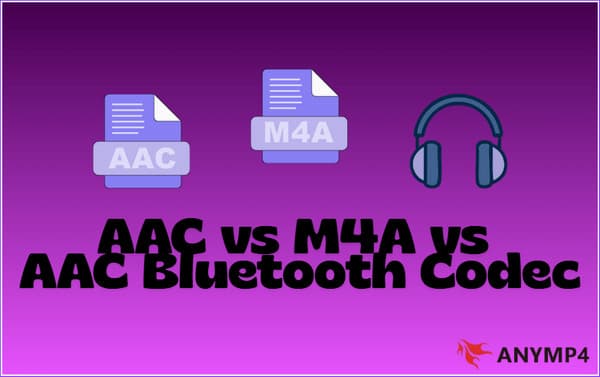
Many people confuse AAC, M4A, and Bluetooth AAC, but these are different things. AAC is a way of compressing audio, while .m4a is a container that holds the audio. To make things simple, AAC is the audio encoding, and M4A is the container/file format.
After knowing the difference between AAC and M4A, you are probably wondering what AAC Bluetooth codec is. It is an AAC-based codec used to compress audio for wireless transmission from a device to Bluetooth headphones or speakers.
Important Note
If your headphones show AAC in Bluetooth settings, that does not mean your music file has suddenly become an .aac file.
Is AAC Good Enough for Audiophiles? Bitrate & Quality Guide
For our part, high-bitrate AAC is good enough for audiophiles. However, the term good enough depends on the source, listening equipment, and hearing. Below is a quick guideline of bitrate and quality for everyday listening:
- • 128 kbps: It is optimized for speech and spoken-word content, like podcasts. While compression may be noticeable in complex music, the overall quality is still good.
- • 256 kbps: It is a strong bitrate choice for music streaming and is transparent to most listeners. Its lossy compression algorithm removes only data that your brain naturally filters out anyway.
- • 320 kbps: It is the maximum bitrate for lossy encoding, offering high quality with very little perceptible compression.
The important distinction is that a higher bitrate does not automatically mean better source quality. Encoding a poor-quality MP3 into 320 kbps AAC cannot restore information that the MP3 already discarded.
Which Devices and Platforms Support AAC?
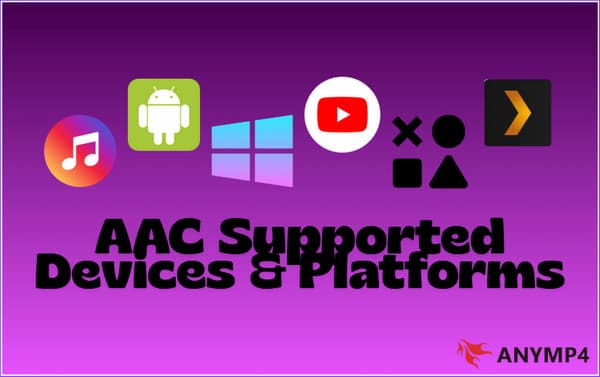
AAC has broad support across modern devices, operating systems, streaming services, and media players. See the list of devices and platforms that support AAC:
- • Apple Devices and Services: AAC is also called by Apple users as the Apple Music audio format. It is because standard Apple Music streams are encoded in AAC at 256 kbps.
- • Android: Android has supported AAC since Android 4.1, including AAC-LC. However, the actual Bluetooth AAC support can vary by device and manufacturer.
- • Windows: Modern Windows apps can play AAC. Compatible versions of Windows Media Player and other media players can handle AAC well.
- • YouTube: AAC is the main standard for audio delivery. YouTube recommends AAC-LC at a bitrate of 128-256 kbps in some video-audio workflows.
- • Gaming Consoles: AAC is supported on certain game consoles, including Nintendo Switch, PlayStation 4, and PlayStation. These consoles feature native hardware decoders to support AAC playback.
- • Plex: Home media server software fully supports direct play for AAC audio streams. It allows streaming content to client devices without forcing CPU-heavy real-time transcoding.
Can You Convert AAC Without Losing Quality? (Honest Guide)
Now that you know what the AAC file format is, you surely want to know whether you can convert it without losing quality. When you convert a lossy audio to another lossy format, for example, AAC to MP3, it only re-compresses the file. This can introduce further loss in quality, especially when repeatedly converting between formats.
To avoid quality degradation, you need to re-encode it from the lossless source to create new AAC or MP3 files. Converting an existing AAC to MP3 is only recommended when required for older devices, podcast hosting, or car stereos that lack AAC support.
FAQs about AAC Format
Is AAC better than MP3?
Yes, AAC is better than MP3 in terms of efficiency and quality. However, at high bitrates, the audible difference can be very small for most listeners. If you need an audio file that is compatible with more devices, just convert AAC to MP3.
If AAC is better, why is MP3 still more popular?
MP3 remains more popular due to its broad compatibility and long history. Most computers, mobile phones, media players, and car stereos, just to name a few, can play the format.
Are AAC and M4A the same?
No, they are not the same. AAC is an audio codec, while M4A is a container format. To make it simple, an M4A file can contain AAC audio and ALAC.
Does YouTube use AAC or MP3?
YouTube uses AAC for streaming and playback, rather than MP3. When you upload a video with any audio format, YouTube re-encodes the audio stream into its own efficient streaming formats.
What's the best way to play AAC files on PC?
The best way to play AAC files on a PC is to use a modern media player, like VLC Media Player. This media player natively supports AAC playback without extra codecs.
Conclusion
What is AAC? It is a lossy audio codec for efficient, high-quality audio. AAC remains a preferred choice when you want a good sound quality, file size, and compatibility. If you need to convert AAC files, use AnyMP4 Video Converter Ultimate. It allows you to conveniently convert AAC to different formats in batches at high speed.




 Add your comments to join the discussion here