
Key Takeaways:
If you are an audiophile, a music archivist, or simply someone who wants to rip a CD collection in the highest possible quality, you have likely encountered the term FLAC. Unlike standard formats like MP3 that permanently delete sound data to save storage space, FLAC promises a bit-perfect, studio-grade listening experience. Here is the straightforward guide to handling FLAC, including its definition, pros, cons, and how to use it.
FLAC (Free Lossless Audio Codec) is the gold standard for lossless digital audio. Unlike MP3, FLAC preserves every detail of the original recording while cutting the file size by about half. FLAC retains the original recording quality while compressing to roughly half the file size, and it is a practical balance between fidelity and storage efficiency.
This guide explains what FLAC is, how to play and convert FLAC files, and how it compares to alternatives like ALAC and WAV.
To help you decide if FLAC is the right audio format for your needs, here is a quick overview of its advantages and limitations:
Pros:
Cons:
| Format | Quality | Compression / Size | Licensing & Ecosystem |
|---|---|---|---|
| FLAC | Lossless | ~50% compression (3–4× MP3 size) | Open source (Universal, except native Apple) |
| MP3 | Lossy | ~90% compression (Smallest) | Patented (Universally supported) |
| ALAC | Lossless | ~45% compression (Similar to FLAC) | Apple proprietary (Best for iOS/Mac) |
We compared FLAC specifications against official Xiph.org documentation, tested playback across 6 media players, and verified file-size ratios using real 44.1kHz/16-bit audio samples. Our conversion tests covered lossless-to-lossy transcoding quality.
While FLAC offers superior audio quality, it isn't universally supported by default media players (especially within the Apple ecosystem). To enjoy the full bit-depth and sample rate of your FLAC files without downsampling, you need a dedicated media player capable of handling lossless codecs.
AnyMP4 Blu-ray Player is best overall for users who want to replicate a home theater experience, and it is our primary recommendation. It bypasses standard OS audio limitations to deliver pristine, original sound quality. It natively decodes high-resolution FLAC files and supports advanced audio tech like Dolby Digital 7.1. It’s an ideal choice if you are listening through high-end headphones or a dedicated speaker system on Windows or Mac.
Secure Download
Secure Download
Enjoy the full potential of lossless audio listening thanks to FLAC file format and AnyMP4 Blu-ray Player by following three simple steps:
1. Listen to your favorite music via AnyMP4 Blu-ray Player by opening it first. Next, select the Open File option and find the audio saved in FLAC format that you want to listen to.
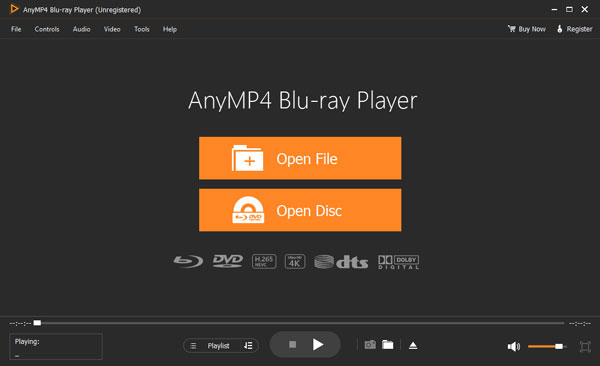
2. You can now enjoy listening to your favorite music with top-notch quality audio provided by this FLAC player software.
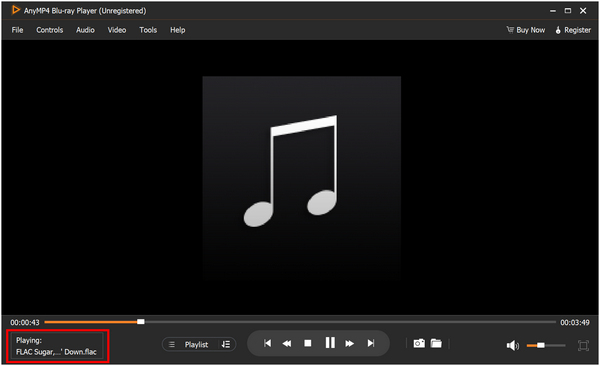
Developed as an extremely effective multimedia player, AnyMP4 Blu-ray Player is perfect for all kinds of video and music experiences thanks to their Dolby Digital and DTS audio support. With that, playing the highest quality audio format, such as FLAC, will not be a problem because the FLAC player software is designed from the ground up to handle these kinds of digital files.
To help you choose the right tool for your specific setup, here is a breakdown of the best FLAC players available:
| Best For | Platform Compatibility | Key Feature | |
|---|---|---|---|
| AnyMP4 Blu-ray Player | Audiophiles & Home Theater | Windows, Mac | Dolby Digital 7.1 & Lossless playback |
| VLC Media Player | General cross-platform use | Win, Mac, Linux, iOS, Android | Free, open-source, plays everything |
| MusicBee | Managing massive libraries | Windows | Excellent tagging and organization |
| Poweramp | Android mobile listening | Android | Custom EQ and high-res output |
Although FLAC is excellent for archiving, its large file size can be an issue for portable devices with limited storage. You may need to convert FLAC to MP3 for your car stereo, or to ALAC for native playback on an iPhone. The goal is to transcode the file efficiently without losing metadata or introducing unwanted audio artifacts.
When dealing with large music libraries, batch processing is essential. AnyMP4 Video Converter Ultimate allows you to load hundreds of FLAC files and convert them simultaneously to MP3, WAV, ALAC, or AAC. It utilizes hardware acceleration to complete conversions up to 70x faster, all while perfectly preserving your original metadata tags and album art.
Secure Download
Secure Download
1. In the main interface of AnyMP4 Video Converter Ultimate, proceed to the Converter tab and select the Add Files button to start processing it.
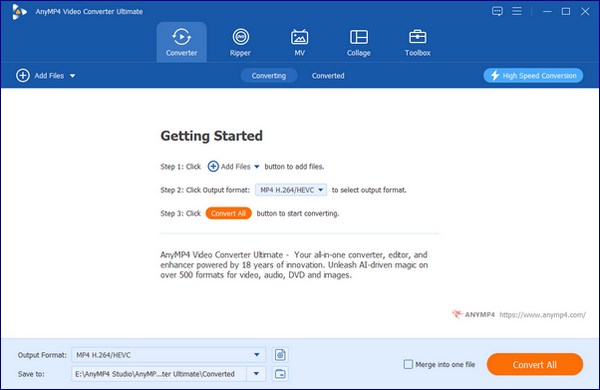
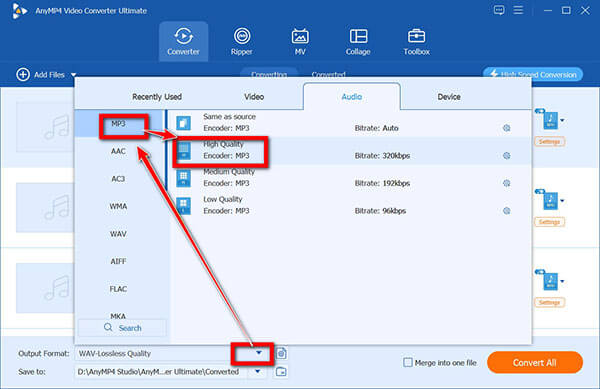
2. Once the audio file has been added, expand the Output Format drop-down option and select Audio. Choose the format you want to convert your FLAC audio into and choose its conversion quality.
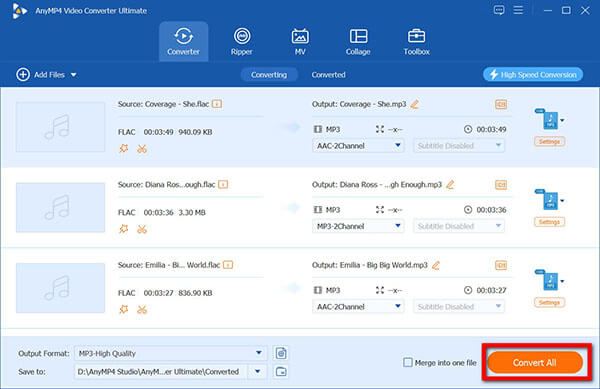
3. With the settings now set, simply click on Convert All and wait for the process to finish.
Depending on whether you need a quick web tool or professional desktop software, here are the top alternatives:
| Best For | Platform | Pros | |
|---|---|---|---|
| AnyMP4 Video Converter Ultimate | Batch conversion & Metadata | Windows, Mac | Hardware acceleration, 100% metadata retention |
| Audacity | Audio editing & exporting | Win, Mac, Linux | Free, allows deep audio manipulation |
| dBpoweramp | CD Ripping | Windows, Mac | Industry standard for accurate rips |
| CloudConvert | Quick, one-off web tasks | Web-based | No installation required (file size limits apply) |
While FLAC is the most widely used lossless format, alternatives like ALAC and WAV serve specific ecosystems and professional use cases. Understanding their technical differences is crucial for correctly archiving your audio library.
Here is a technical breakdown of how FLAC vs. ALAC vs. WAV to its main lossless competitors:
| FLAC | ALAC (Apple Lossless) | WAV | |
|---|---|---|---|
| Compression | ~50% (Lossless) | ~45% (Lossless) | None (Uncompressed) |
| Bit-Depth Support | Up to 32-bit | Up to 32-bit | Up to 32-bit |
| Sample Rate | Up to 655kHz | Up to 384kHz | Virtually unlimited |
| Metadata (Tags) | Excellent (Vorbis comments) | Excellent (MP4 tags) | Poor (Limited ID3 support) |
| Album Art Support | Fully supported | Fully supported | Not natively supported |
| DRM Status | Always DRM-Free | Supports DRM (FairPlay) | Always DRM-Free |
| Best Ecosystem | Universal / Open Source | Apple (iOS, macOS, iTunes) | Studio Recording / Editing |
Although FLAC is vastly superior for audio fidelity, it isn't always the most practical choice. Knowing when to avoid FLAC can save you storage space and compatibility headaches. You should consider alternatives like MP3 or AAC in the following scenarios:

What is FLAC audio?
FLAC (Free Lossless Audio Codec) is an open-source lossless audio format that compresses audio without any quality loss. It's ideal for archiving CDs, high-resolution audio, and audiophile listening. FLAC files are typically 50–60% smaller than the original uncompressed PCM/WAV data while retaining 100% of the audio information.
Can I play FLAC on iTunes or my iPhone?
No, Apple devices and software (like iTunes and the iOS Music app) do not natively support FLAC. Apple uses its proprietary ALAC (Apple Lossless Audio Codec) format instead. To play FLAC on iTunes or Mac, you need to either convert the FLAC files to ALAC or use a third-party media player app like VLC.
Is FLAC better than CD quality?
FLAC and CD quality are identical when the FLAC file is ripped from a CD at 44.1kHz/16-bit. FLAC is a lossless container, meaning a properly ripped FLAC is a bit-perfect, mathematical copy of the original CD source, just stored in a smaller file size.
What is the best FLAC player?
AnyMP4 Blu-ray Player is the top choice for Windows and Mac users who want Dolby Digital 7.1 FLAC playback. For free alternatives, VLC Media Player (cross-platform), MusicBee (Windows), and Poweramp (Android) are excellent options depending on your specific platform and feature needs.
Is FLAC better than WAV?
Both FLAC and WAV deliver identical lossless audio quality. FLAC's main advantage is compression - it saves 50–60% storage space while remaining completely lossless. WAV has no compression and offers slightly faster decoding for audio editing. For most consumers and music archiving, FLAC is the superior, practical choice due to its smaller file size.
What bitrates and sample rates does FLAC support?
FLAC supports up to a 655,350 Hz sample rate and up to 32 bits per sample, with support for 1 to 8 audio channels. This makes FLAC suitable for everything from standard CD rips (44.1kHz/16-bit) to the highest-resolution studio masters (192kHz/24-bit and beyond).
Does FLAC support metadata and album art?
Yes, FLAC fully supports metadata tags (artist, album, title, genre, etc.) and embedded album art via METADATA_BLOCKS. It is highly compatible with standard tagging schemes like Vorbis comments, making it easy to organize massive music libraries.
FLAC remains the definitive format for preserving audio exactly as the artist intended. While it requires more storage space than MP3 and needs specific apps for Apple devices, its bit-perfect quality makes it the ultimate choice for music archiving and high-end listening. Whether you are setting up a home theater with AnyMP4 Blu-ray Player or shrinking your high-res library for portable use with AnyMP4 Video Converter Ultimate, handling FLAC files is easier than ever.
 Updated by Alice Thorne to Glossary
More readings
 AIFF vs FLAC: Which Lossless Format Should You Choose
Understand lossless audio formats with this AIFF vs FLAC comparison. Discover their key differences in sound quality, file size, and device compatibility.
 AAC vs FLAC Explained: Which Audio Format Should You Use?
Compare AAC vs FLAC in audio quality, file size, and compatibility. Learn which format is best for streaming, storage, and high-fidelity listening.
 What Is CAF File Format and How Do You Open It
Learn what a CAF file is, how Apple uses Core Audio Format, and why it may cause playback issues outside Apple devices. All you need to know about CAF is here.
 What is a DAT File? Types, Uses, and Opening Methods
Come across an unfamiliar format and don't know how to open it? Discover what is a DAT file, why it appears, and the safest way to open it without confusion.
 Add your comments to join the discussion here