
Summary:
M4V is Apple's video format used by iTunes, based on MPEG-4. Some files have FairPlay DRM, while some are unprotected. Here's the difference, how to play it on a non-Apple device, and whether you can just rename the file to MP4.
M4V is a video format you might encounter while watching or downloading videos from Apple. This format is associated with iTunes, Apple TV, and Apple devices. It has been used for movies, TV shows, podcasts, and other video content. But what is M4V, exactly? Simply put, M4V is similar to MP4, but it has one important distinction: some M4V files are protected by DRM while others are DRM-free. That difference can affect how you play, rename, transfer, or convert an M4V file. In this post, you'll learn the definition of M4V, how it compares with MP4, and when you can rename it. Also, we will show how to play and convert these files.

What is an M4V file? M4V is Apple’s video format based on MPEG-4 and closely related to MP4. It can hold video encoded with H.264 or H.265 and AAC or AC-3 audio. Apart from video and audio, it can also contain metadata and an optional FairPlay DRM. To let you know, M4Vs have two types: DRM-free and DRM-protected. These types are used for podcasts, movies, and TV shows distributed through iTunes and Apple TV.
To better understand the two types of M4Vs, we will explain them in more detail in this section. The .m4v extension alone won't determine if the file is protected.
Referring to the outlined question, the answer is sometimes, yes. DRM-free M4V format contains media compatible with the MP4 container, and you can rename .m4v to .mp4 without re-encoding the video. However, renaming it does not convert and remove FairPlay DRM. Changing the filename of an M4V with DRM to .mp4 won’t decrypt its content. Likewise, even a DRM-free M4V requires a conversion if the codecs, structures, or other streams are incompatible with your target device.
Check this guide to know more about the differences between M4V and MP4.
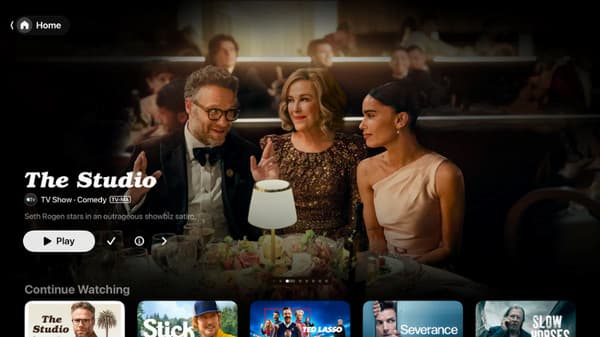
Apple TV app is Apple's built-in media application for watching movies and TV shows. Below are the two ways to play them:
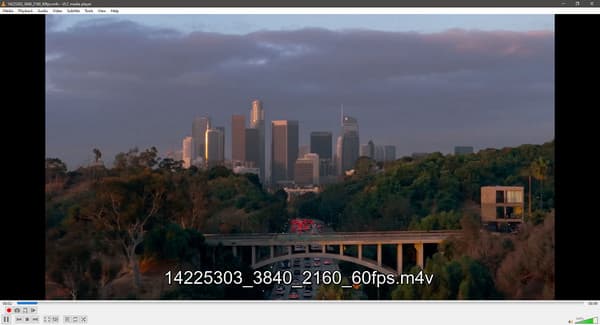
You can use VLC Media Player to play unprotected M4Vs on your Windows system. This established media player can play nearly all media files and formats, including M4Vs.
To play: Navigate to Media and select Open File to import M4V. You can also drop the file directly into the interface to start the playback.
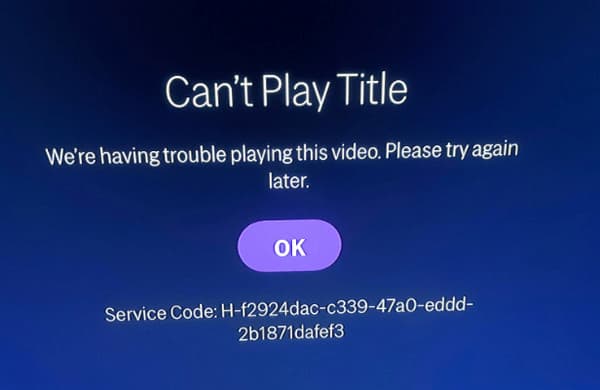
Android devices cannot play purchased or rented M4Vs because these files use codecs that standard Android media frameworks cannot decode. It means you cannot play the files outside Apple-approved software. In this case, you need to convert M4V to MP4.
Chromecast and Smart TVs cannot open and play M4Vs natively. However, if the file is unprotected and uses a codec similar to MP4, certain media players can cast it. Still, support is inconsistent on different brands and USB ports.
AnyMP4 Video Converter Ultimate is a safe and secure video-to-video conversion software that can handle both DRM-free and protected M4V files. It can convert M4V to MOV, MKV, MP4, and more than 500 other media formats. It lets you batch-convert hundreds of files simultaneously without experiencing lag. This M4V-to-MP4 converter uses the most advanced hardware-accelerating media processing to achieve 120× speed. Also, you can adjust the encoder, bitrate, and sample rate to ensure smooth playback.
Secure Download
Secure Download
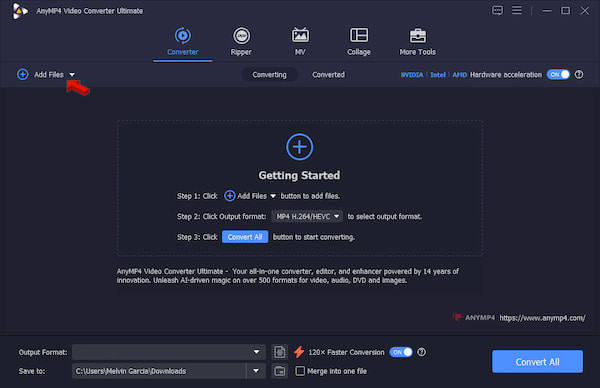
1. Download AnyMP4 Video Converter Ultimate and complete the installation. After setup, click +Add Files in the Converter tab and upload the M4V sources.
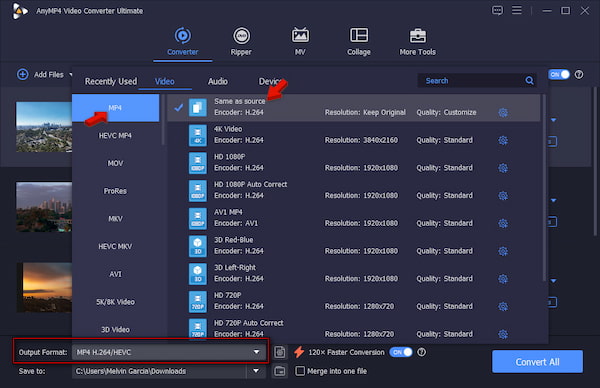
2. Go to Output Format and select MP4 under the Video category. Select Same as Source as your quality preset to keep the exact video and audio quality of your M4V.
3. Toggle on the Hardware Acceleration button to speed up the conversion. Specify the output destination, then click Convert All to batch-convert M4V to MP4.
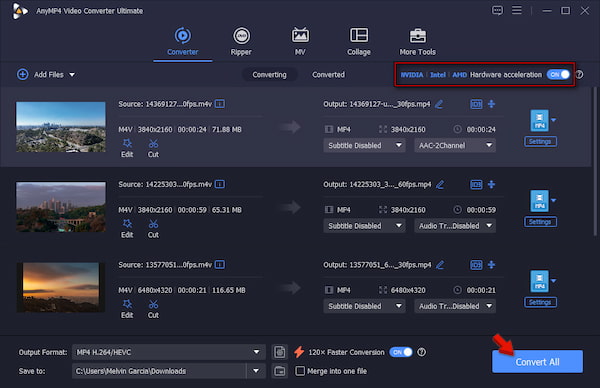
In our test, we use 50 M4Vs, totaling 3.2 GB. It took only 2 minutes and 7 seconds to convert them into MP4 format. During our video quality assessment, the final output looks identical to the original M4V. Also, there was no degradation in the quality.
When the Apple ID authorization expires, Apple’s FairPlay DRM blocks access to your purchased media. Apple uses FairPlay DRM to encrypt iTunes movies and TV shows in M4V format. You can only authorize up to 5 computers simultaneously per Apple ID. When you play a movie, iTunes checks your local authorization key against Apple's servers. If authorization expires, your computer loses the decryption key, causing playback to fail.
Is M4V the same as MP4?
M4V format and MP4 are almost the same file type. Both formats use the MPEG-4 container; it’s just that Apple made M4V. If the M4V has no DRM, you can rename .m4v to .mp4, and it will play fine. You can follow this guide to convert M4V to MP4.
How do I remove DRM from an iTunes M4V file?
FairPlay DRM locks the video file so it only plays in authorized Apple TV or iTunes apps that are signed in with the correct account. Apple provides no built-in export option labeled DRM-free for movies and TV shows.
Does YouTube accept M4V?
No, YouTube does not list M4Vs as a directly supported upload format. However, since they share the same MPEG-4/H.264 structure as MP4 files, you can rename the file extension to .mp4.
What is M4V comes down to more than simply being an Apple video file. It is an MPEG-4-based format associated with iTunes and Apple devices. Some files are DRM-free, while Apple's FairPlay DRM protects others. If you need to convert M4Vs to a more universal format, AnyMP4 Video Converter Ultimate offers a convenient way. It lets you convert them to MP4 and 500+ other formats while preserving the original file.
 Updated by Alice Thorne to Glossary
More readings
 2026 MP4 to M4V Guide: 4 Best Ways for Desktop & Online
Read the post to master the 4 best MP4 to M4V methods for desktop and online, so that you ensure perfect Apple ecosystem compatibility and lossless quality.
 Convert M4V to MOV: 2026 Ultimate Guide for Beginners
Read this ultimate guide in 2026 to learn how to convert M4V to MOV losslessly: batch convert large files offline with VLC, AnyMP4, or FreeConvert under 1GB.
 3 Ways to Convert M4V to MP3 Format with Detailed Tutorial
Are you looking for the best tools to convert M4V to MP3 for free? Read this article for a full tutorial and quick review of the three software you can use.
 Best 8 M4V Recorders to Capture Video on Phone/Computer
Here're top 8 M4V video recorders for desktop and mobile users. You can use any recorder to capture popular video with audio on your phone or computer here.
 Add your comments to join the discussion here