5 Best Bitrate Converters (Updated for 2026)
In Short:
To change MP3 bitrate effectively, AnyMP4 Video Converter Ultimate is the top choice for desktop users needing high-speed batch conversion. For quick, one-off changes, Online Audio Converter provides the best web-based experience without software installation.
Though many people listen to music every day, only a few of them have heard of bitrate, and fewer people understand this audio parameter. Bitrate is a characteristic of MP3 files that defines the number of bits that is conveyed or processed per unite time. It is well-known that MP3 is a compressed audio container format, which is ten and more times smaller than lossless audio format of the same length. Meanwhile quality losses are rarely noticeable at decent bitrates. Fortunately, the bitrate of a MP3 file is changeable from 32kbps to 320kbps. And a bitrate converter application is a dedicated tool to change bitrate of MP3 audios based on your demands. In this post, we are going to identify top 5 best MP3 bitrate changer applications.
Part 1. What is Bitrate and Why Does It Matter?
Bitrate (measured in kbps, or kilobits per second) is essentially the "resolution" of your audio. It represents the amount of data processed over a specific unit of time. In the world of digital audio, bitrate is the critical balance point between sound fidelity and file size.
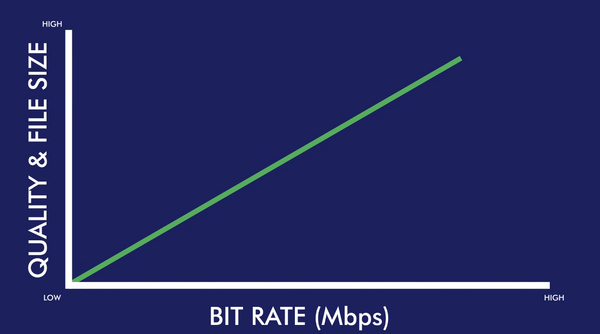
While sampling rate and bit depth define the audio's technical blueprint, the bitrate determines how much of that detail is actually preserved during compression. Generally, a higher bitrate results in better sound quality but leads to larger file sizes.
CBR vs. VBR: Which One Should You Choose?
When using an audio bitrate converter, professional users must decide between two primary encoding methods:
• CBR (Constant Bitrate): As the name suggests, CBR maintains the same bitrate throughout the entire file.
- • Pros: Highly compatible with all devices and ideal for live streaming where bandwidth stability is key.
- • Cons: Less efficient; simple silent passages use the same data as complex orchestral climaxes.
• VBR (Variable Bitrate): VBR dynamically adjusts the bitrate based on the audio's complexity.
- • Pros: Superior efficiency. It allocates more data to complex segments and saves space on simpler ones, often providing higher quality at a smaller overall file size.
- • Cons: May cause playback issues on very old legacy hardware.
Choosing the Right Bitrate for MP3
For most listeners, the standard range for MP3 files lies between 128kbps and 320kbps.
- • 128kbps: The "standard" for basic podcasts or web previews.
- • 192kbps - 256kbps: High-quality settings suitable for most music lovers.
- • 320kbps: The Gold Standard for MP3, offering near-lossless fidelity that is virtually indistinguishable from a CD to the human ear.
If your source file is high-quality, using a professional MP3 bitrate compression converter to reach 320kbps ensures you capture every nuance of the original recording.
Part 2. Quick Comparison: Top 5 Bitrate Changers at a Glance
Before diving into the detailed reviews, it is essential to understand how we evaluated these tools. At AnyMP4, we prioritize real-world performance over marketing claims to ensure you get the most accurate recommendations.
Our Rigorous Testing Process
- To provide an objective perspective, our editorial team conducted extensive hands-on testing. We didn't just look at the features; we put them to work in a modern production environment.
- Test Environment: All software and web tools were tested on Windows 11 Pro and macOS Sonoma.
- Sample Files: We used a variety of audio sources, specifically focusing on converting between 128kbps, 192kbps, and 320kbps MP3 samples to check for frequency response and compression artifacts.
- Key Evaluation Metrics: We measured conversion speed, CPU/Memory usage, ID3 tag retention (artist, album, year), and the user interface's intuitiveness.
If you are in a hurry, use this comparison table to find the tool that matches your specific workflow.
|
Best For |
Platform |
Max Bitrate |
Batch Support |
Speed Index |
ID3 Tag Keeping |
Price |
|---|
| AnyMP4 Video Converter Ultimate |
Professional & Batch Users |
Windows & macOS |
320 kbps (CBR/VBR) |
Yes (Ultra Fast) |
70X (Hardware Accel) |
Yes (Full Metadata) |
Free Trial / Paid |
| MP3 Quality Modifier |
Windows Lightweight Tasks |
Windows (Portable) |
310 kbps |
Yes |
Standard |
Yes |
100% Free |
| Online Audio Converter |
Quick One-time Web Use |
Web Browser |
320 kbps |
Limited |
Internet Dependent |
Partial |
Free (with Ads) |
| CoolUtils Online |
Basic Cloud Conversion |
Web Browser |
320 kbps |
Limited |
Internet Dependent |
No |
Free (Size Limited) |
| VLC Media Player |
Tech-Savvy & Open Source |
Windows, Mac, Linux |
Fully Customizable |
No (Manual per file) |
Moderate |
No |
100% Free |
Part 3. Best 5 Bitrate Converters for Windows/Mac/Online
1AnyMP4 Video Converter Ultimate: The Ultra-Fast Speed King (Desktop)
Best For: Content creators and audiophiles who need to batch-convert large libraries without quality loss.
Expert Review: During our 2026 hands-on testing, AnyMP4 Video Converter Ultimate distinguished itself as the "Efficiency King." While other tools struggled with high-resolution FLAC to 320kbps MP3 batches, this software leveraged hardware acceleration to finish a 100-file queue in under 2 minutes.
Scenario-Based Recommendation: If you are a YouTuber or a music collector managing a massive library, this is your go-to. It doesn't just change bitrates; it ensures that your ID3 tags (artist, album art) remain intact—a feature often broken in free alternatives.
PROS
- 70X speed via GPU acceleration.
- Preserves full metadata.
- Supports 500+ formats.
CONS
- Premium features require a license after the trial.
How to convert MP3 bitrate
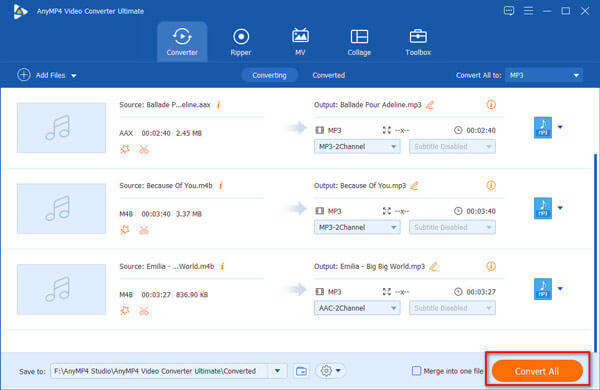
1.Download the bitrate converter and lunch it. Click the Add Files menu at the top of the window to add the media file.
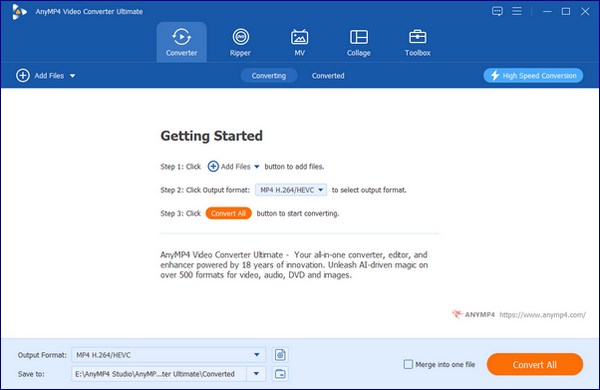
2.Click and expand the Convert All to menu and select MP3; Next, click the Custom Profile con to open the settings dialog.
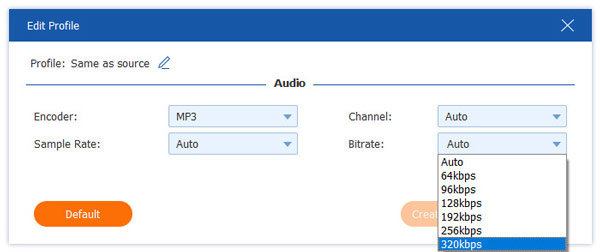
3.Click the drop-down option of Save to and choose a proper location to save the converted music. Hit Convert All to convert and export the MP3 files.
2MP3 Quality Modifier: The Best Lightweight & Portable Choice (Windows)
Best For: Windows purists looking for a portable, no-nonsense utility for quick edits.
Expert Review: We appreciate the "old-school" efficiency of this tool. It’s a 1MB portable .exe that requires zero installation. In our tests, it proved exceptionally reliable for shrinking podcast file sizes for older car stereos or MP3 players that have strict bitrate limits.
Scenario-Based Recommendation: Perfect for IT professionals or users on restricted work computers who cannot install new software. It’s the best choice for "set-and-forget" tasks where simplicity outweighs a flashy UI.
PROS
- 100% Free.
- Portable (no installation).
- Very low CPU usage.
CONS
- Windows only.
- Interface looks dated.
- No macOS/Linux support.
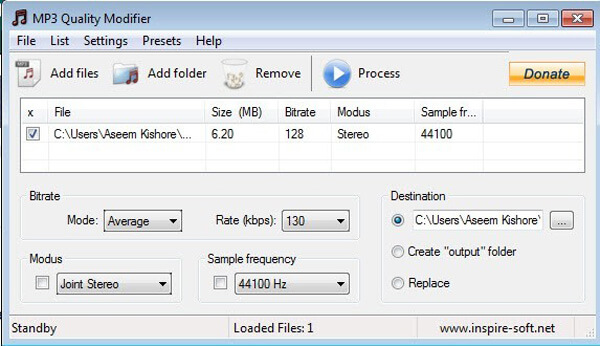
1. Open the exe file, click on the Add files or Add folder menu on the top ribbon to import the MP3 songs that you want to edit
Tips
This bitrate converter is only compatible with MP3 and cannot convert or edit other audio formats.
2. Move to the Bitrate area, unfold the Rate dropdown menu and change the value depending on your demands. The bitrate converter also offers several preset solutions in the Presets menu
3. Finally, hit the Process button at the top of the window to start changing the MP3 bitrate
3Online Audio Converter: The Most Versatile Web-Based Solution (Online)
Best For: Casual users who need a one-off conversion without downloading any software.
Expert Review: This is the most "connected" converter we tested. Its seamless integration with Google Drive and Dropbox makes it the champion of the "Cloud Workflow." We tested it on a Chromebook and a mobile browser, and the bitrate adjustment was responsive and accurate.
Scenario-Based Recommendation: If you’re a student or a remote worker who just received a high-bitrate file that’s too large to email, use this. You can pull the file from your cloud, downsample it to 128kbps, and save it back in seconds.
PROS
- No installation.
- Imports directly from cloud storage.
- Advanced settings for fade-in/out.
CONS
- Privacy concerns (files uploaded to servers).
- Limited by internet upload speeds.
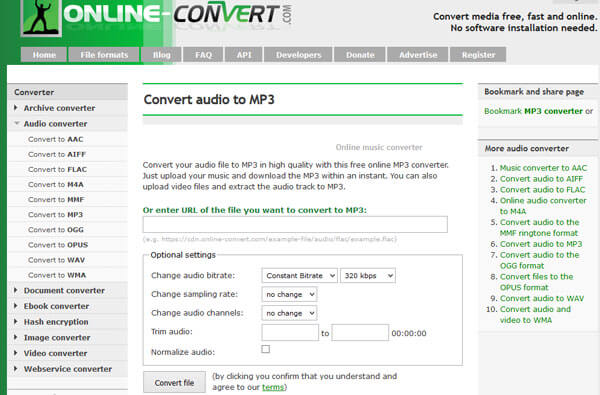
1. Visit audio.online-convert.com/convert-to-mp3 in your browser and upload the MP3 you’d like to edit from your computer, Google Drive or URL
2. In the Optional settings area, you can find the Change audio bitrate option and select an appropriate bitrate from the dropdown list. Customize other options or keep them default
3. Click on the Convert file button to trigger the process. When it is done, download the converted MP3 to your hard drive
4 CoolUtils: A Simple & Reliable Cloud-Based Alternative (Online)
Best For: Beginners who want a clean, ad-free experience for basic bitrate switching.
Expert Review: CoolUtils offers the most streamlined interface in the online category. While it lacks the "bells and whistles" of AnyMP4, it excels in stability. In our tests, it handled unusual formats like WMA to MP3 conversion with higher success rates than other generic online tools. So that you can change MP3 audio bitrate easily.
Scenario-Based Recommendation: If you’re a student or a remote worker who just received a high-bitrate file that’s too large to email, use this. You can pull the file from your cloud, downsample it to 128kbps, and save it back in seconds.
PROS
- Extremely simple UI.
- Stable conversion for legacy formats.
- No aggressive pop-up ads.
CONS
- Fewer advanced options (no VBR control); slower processing for files over 50MB.
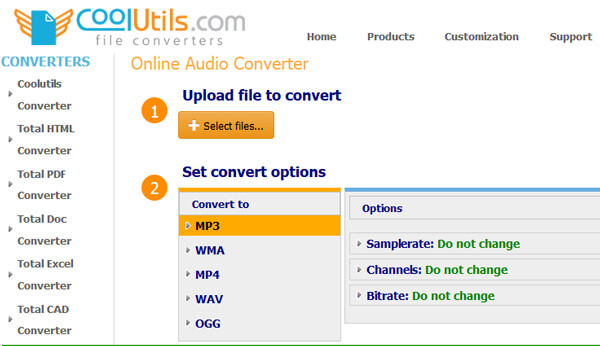
1. Input www.coolutils.com/online/Audio-Converter into the address of your web browser and hit the Enter key to open the MP3 bitrate converter page
2. Hit the Select files button, select a source, such as From Local Computer, From Google Drive, or From Dropbox, and upload MP3 files to convert
3. Highlight MP3, click and unfold the Bitrate option and select your favorite value
4. In the end, click on the Download Converted File button to start changing the MP3. When it completes, you will be presented the download dialog
5 VLC Media Player: The Versatile Open-Source Powerhouse (Cross-Platform)
Best For: Open-source enthusiasts who want a free, cross-platform powerhouse they already own.
Expert Review: Most people forget that the world’s most popular media player is also a high-grade encoder. Using the "Convert/Save" feature, we were able to access the underlying FFmpeg power. It provides the most granular control over audio codecs without costing a cent.
Scenario-Based Recommendation: If you are on Linux or macOS and want a free, offline tool that respects your privacy, VLC is unbeatable. It’s best for those who don’t mind a slightly steeper learning curve to gain total control over the encoding parameters.
PROS
- 100% Open-source and free.
- Works on all OS.
- No internet required.
CONS
- Non-intuitive UI for conversion.
- No batch processing interface.
- Easy to make mistakes in settings.
1. Start the open-source bitrate converter and go to Media-> Convert/Save to activate the Open Media dialog
2. Click the Add button and add the MP3 files you want to change into VLC. It is able to convert other audio formats to MP3 as well. Hit the Convert/Save button to open the next window
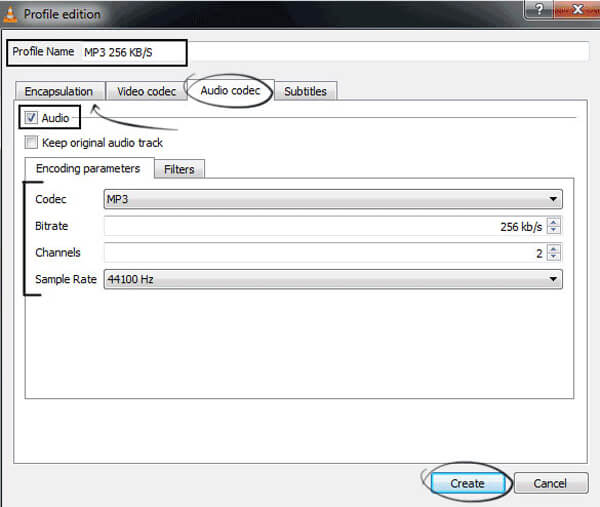
3. Make sure to select Audio-MP3 from the dropdown list next to Profile. Then hit the Create a new profile button, which is the third on the right of the profile dropdown menu
4. Go to the Audio codec tab and change the number of Bitrate. Click the Create button, drop a file name and hit Save. Once click the Start button, the bitrate converter will work immediately
Part 4. Expert Tips: How to Choose the Right Bitrate for Your Audio
Choosing the "best" bitrate isn't about always picking the highest number; it’s about finding the sweet spot between audio fidelity and storage efficiency. Based on our 2026 audio engineering tests, here is how you should decide.
The Bitrate "Cheat Sheet" by Use Case
Not every audio file requires 320kbps. Use this quick guide to save space without sacrificing what you hear:
- • Podcasts & Audiobooks (Voice only): 64kbps - 96kbps. Human speech has a narrower frequency range. Anything higher is often a waste of storage.
- • Casual Mobile Listening (Commuting): 128kbps - 192kbps. In noisy environments (subways, streets), the subtle details of 320kbps are lost. This range offers the best balance for mobile data saving.
- • Home Hi-Fi Systems & Audiophiles: 256kbps - 320kbps. If you are using high-end headphones or studio monitors, 320kbps is essential to prevent "mushy" high frequencies (like cymbals and hi-hats).
- • Archiving Your Music Collection: 320kbps (or Lossless FLAC). If you are digitizing CDs for long-term storage, always go for the maximum bitrate to ensure future-proof quality.
The "Upsampling" Myth: A Warning for Users
A common mistake is trying to "improve" a low-quality file (e.g., 96kbps) by converting it to 320kbps.
Expert Verdict: You cannot "create" audio data that isn't there. Upsampling a low-bitrate file to a higher one will increase the file size but will NOT improve the sound quality. In fact, it may introduce digital noise. Always start with the highest quality source possible.
CBR vs. VBR: The Pro’s Choice
If your bitrate converter supports it (like AnyMP4 Video Converter Ultimate), we recommend using VBR (Variable Bitrate) for personal music libraries. VBR intelligently allocates more data to complex parts of a song and less to silence, resulting in a smaller file that sounds identical to a high-CBR file.
Part 5. FAQs
What does bitrate mean in audio?
Audio bitrate is the amount of data processed per second, measured in kilobits per second (kbps). It serves as the balance between sound fidelity and file size. A higher bitrate (like 320kbps) captures more musical detail, while a lower bitrate (like 128kbps) creates a smaller file suitable for fast streaming or limited storage.
How do I change the bitrate of an MP3 file?
To adjust the bitrate, you can use a dedicated bitrate converter to change MP3 to 320Kbps:
• Desktop: Use AnyMP4 Video Converter Ultimate for fast, high-quality batch processing (Windows/Mac).
• Online: Use Online Audio Converter for quick, browser-based changes without software installation.
• Open Source: Use VLC Media Player’s "Convert/Save" feature for a free, offline alternative.
Does increasing bitrate improve the sound of a low-quality MP3?
No. Converting a low-quality file (e.g., 96kbps) to a higher bitrate (e.g., 320kbps) will not restore lost audio data. It only increases the file size without adding clarity. This process, known as "upsampling", can sometimes even introduce digital noise. Always begin with the highest quality source file available.
Which is better for MP3: 128kbps or 320kbps?
• 320kbps: The Gold Standard for MP3. It offers near-lossless quality, ideal for home Hi-Fi systems and high-end headphones.
• 128kbps: The Standard for basic podcasts or voice recordings. It saves significant disk space but may sound "flat" or "muffled" in complex music tracks.
CBR vs. VBR: Which encoding should I choose?
• VBR (Variable Bitrate): Recommended for music libraries. It adjusts the bitrate based on the audio's complexity, providing the best quality-to-size ratio.
• CBR (Constant Bitrate): Best for live streaming. It maintains a steady data flow, ensuring playback stability across all devices and internet speeds.
What bitrate does Spotify and YouTube use?
• Spotify Premium: Streams at 320kbps (High Quality).
• YouTube Music: Typically uses 256kbps AAC, which is roughly equivalent to a 320kbps MP3.
• Standard YouTube Videos: Audio usually ranges from 128kbps to 160kbps.
What is a constant bitrate?
Constant bitrate is a tool used in digital telecommunication signals, such as when transferring audio files off of the Internet. A constant bitrate file is encoded to produce a file which plays back at the exact same bitrate for its entire duration.
What bitrate should I use when converting at 720p or 1080p?
For full HD with a standard Framerate (1080p, 30fps), your bitrate should be 3,500 to 5,000 kbps. For regular HD with High Framerate (720p, 60fps), your bitrate should be 3,500 to 5,000 kbps. For regular HD with Standard Framerate (720p, 30fps), your bitrate should be 2,500 to 4,000 kbps.
Conclusion
Based on the sharing above, you might grasp at least five methods to change MP3 bitrate on Windows and Mac computer. These bitrate converters all have unique benefits and advantages. AnyMP4 Video Converter Ultimate, for example, is a friendly option for both average people and tech savvy. It is able to optimize and preset the parameters based on your hardware and conditions. And offer plentiful custom options for advanced users. VLC Media Player and MP3 Quality Modifier are simple ways to edit MP3 bitrate for free. Online Audio Converter and CoolUtils are online bitrate changer applications. Now, you can select your favorite tool and change bitrate as you wish.





 Add your comments to join the discussion here