
I am a vlogger and usually use OBS for streaming and recording; however, recently I got the Encoder overload error in OBS, how to fix this problem?
Encoding is the process to convert video to the recording quality of your choice. OBS uses x264, which is the best video encoding library until now. Encoding overload means that your CPU cannot encode the recording at the desired time. Fortunately, you can learn 5 solutions to fix this problem easily.
This OBS encoding overloaded issue is primarily due to fewer CPU resources and other elements. Some of them include:
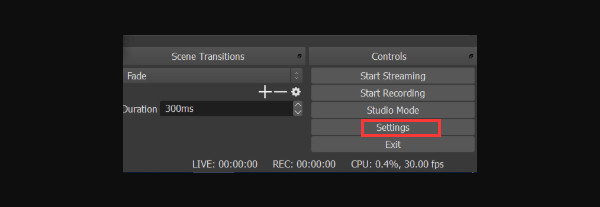
1. When Encoder overloaded error occurs in OBS, click the Setting button at the bottom right side.
2. Go to the Video tab, expand the Output Resolution and choose 960 × 540 or smaller resolution.
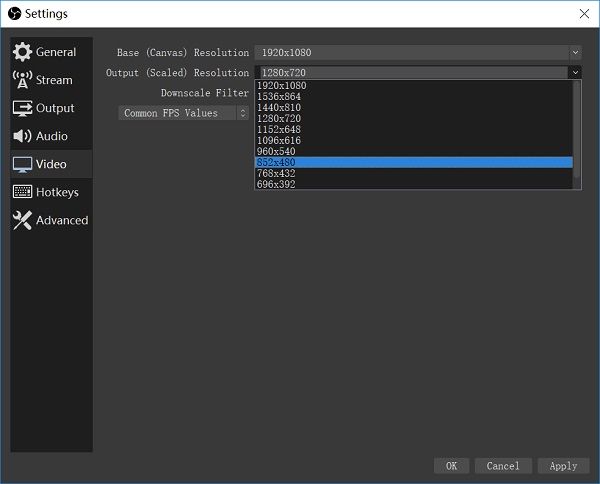
3. Hit OK to confirm it.
1. Also go to the Video tab on Settings dialog when OBS encoder overloaded happens.
2. Unfold the drop-down list next to Common FPS Values and drop it to 30 FPS. It won't impact your stream or screen record.
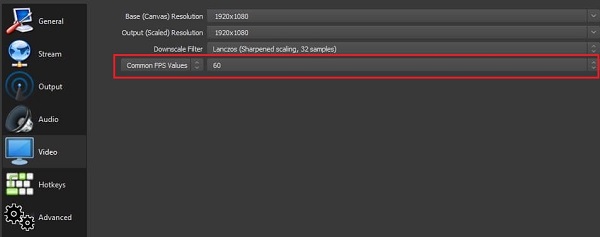
This solutions can also fix OBS black screen.
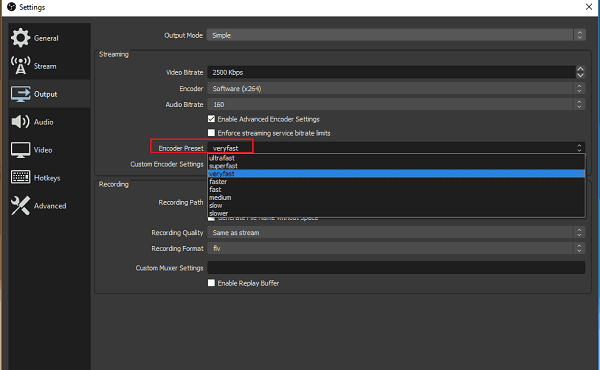
The x264 encoder may be responsible for OBS encoding overloaded, but you can change the preset.
1. Locate the Settings dialog in OBS.
2. Head to the Output tab and locate the Streaming section.
3. Open Encoder Preset option and choose veryfast. It will use less power and help you get rid of the OBS encoding overload issue.
Two-pass encoding can improve video quality slightly, but it requires more GPU resources. This leads to the OBS encoding overloaded error during real-time streaming or recording. Disabling two-pass encoding reduces the workload on your system and helps OBS process frames faster and more smoothly. Fortunately, hardware encoders handle this especially well:
For most users, using a hardware encoder with single-pass encoding provides better stability and prevents dropped frames.
1. If you are using NVENC and OBS encoding overload issue occurs, go to the Output tab on Settings dialog.
2. Switch the Output Mode to Advanced and head to the Streaming panel. Open the Encoder menu and select your available hardware encoder.
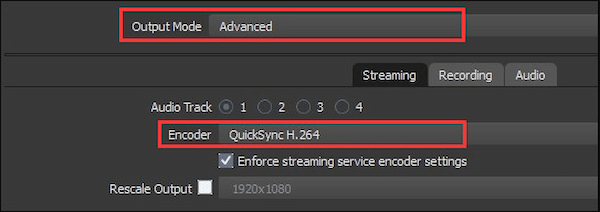
3. Make sure to turn off 2-pass encoding and try OBS again.
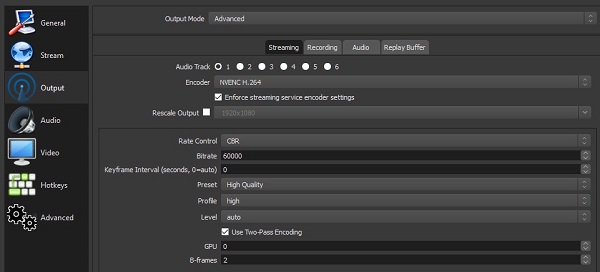
Disable two-pass encoding and use CBR + single-pass for the best stability.
| What to Check | Action to Take | Where to Change | Why This Helps |
|---|---|---|---|
| Lower FPS | Reduce the frame rate to 30 FPS or lower. | In the Settings, navigate to the Video section, and select Common FPS Values. | Lowering the frame rate reduces how many frames OBS must encode each second, which greatly decreases CPU and GPU load. |
| Downscale Output Resolution | Lower the output (scaled) resolution. | Go to Settings, open the Video tab, and choose Output (Scaled) Resolution | Encoding high-resolution video requires more processing power, so downscaling helps prevent overload. |
| Change ×264 Preset | Change the ×264 encoder preset to Veryfast or faster. | Go to Settings and follow the Output. Select the Streaming path to adjust the Encoder Preset. | Faster presets use fewer CPU resources and are more suitable for real-time encoding. |
| Disable Two-Pass Encoding | Disable two-pass encoding when using a hardware encoder. | Open Settings, click on Output, switch to the Advanced tab, select Streaming, and locate Multipass Mode. | Single-pass encoding reduces GPU workload and minimizes the risk of dropped frames. |
| Close Background Apps | Close unnecessary background applications and system processes. | Press Ctrl + Shift + Esc to open Task Manager, then on the Processes tab, right-click any high-resource app, and select End Task. | Freeing system resources ensures OBS has enough CPU and GPU power to encode smoothly. |
If you have performed the common solutions above and the OBS encoding overload issue persists, it is time to use an alternative. AnyMP4 Screen Recorder is a multimodal screen recording software designed to simplify recording while maintaining stability.
Compared with OBS, its encoding settings interface is much cleaner and easier to understand. It uses plug-and-play hardware acceleration detection and optimization, eliminating manual adjustment of advanced parameters. Not to mention, it automatically identifies supported hardware encoders and applies balanced settings without technical configuration. This greatly reduces the risk of encoding overload caused by incorrect setup.
Recommendation
Secure Download
Secure Download
How to Fix OBS Encoding Overload Issue Using an Alternative
1. Install Screen Recorder
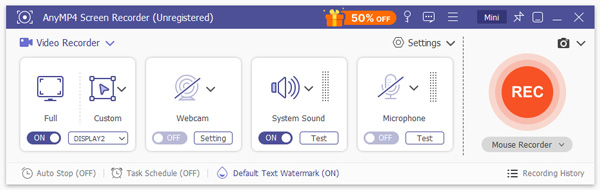
Start the best alternative to OBS after you installed it to your computer. There are two versions, one for PC and the other for Mac. Pick Video Recorder from the home interface to open the main window.
2. Record Screen
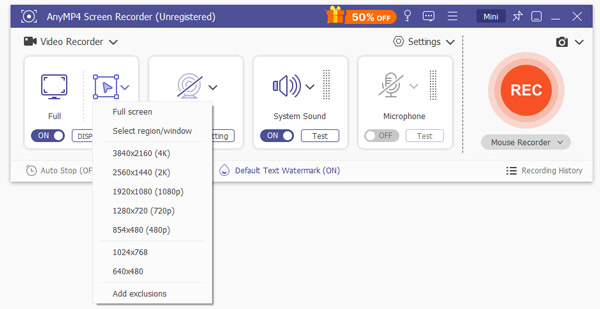
Turn on Display and select the recording area you wish to record. To add your face to the recording, toggle on Webcam; otherwise, disable it. Then decide the audio source, such as System Sound and Microphone. The former is used to record audio from your system and the latter can capture your voice through microphone. Click the REC button and screen recording will start after the countdown.
Click the Settings option and select the Output Settings from the pulldown menu. In the Output section, navigate to the Screen Recording Settings to configure video parameters. You can modify the video format, codec, frame rate, keyframe interval, quality, etc. Please be informed that AnyMP4 automatically detects your GPU/CPU and optimizes these settings. This means you don’t need to manually adjust them.
3. Preview and save screen recording
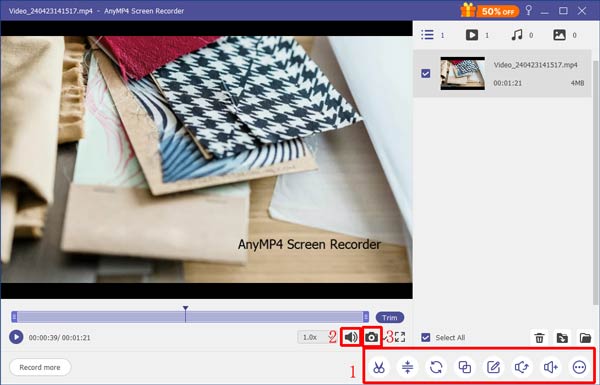
During recording, you can add paintings or text with the Pen tool, or take a screen with the Camera icon. When screen recording is done, click the Stop button. On the preview window, view the video and remove redundant frames with Clip tool. Finally, click the Save button to export it to hard drive.
The OBS encoding overload issue happens partly because it is a desktop program. As an alternative, you can use an online screen recording tool to prevent encoding overload issues. AnyMP4 Free Online Screen Recorder is a highly convenient tool that makes the recording simple. Since it is browser-based, you are not exposed to complex encoding options at all. There is no need to configure advanced parameters, making it ideal for quick recordings on lower-end systems. This lightweight design minimizes system strain and avoids many of the performance issues commonly associated with OBS.
Basic Features of the Online Alternative to OBS
How to Fix OBS Encoder Overloading Online
1. Run a browser and open this free online video recorder.
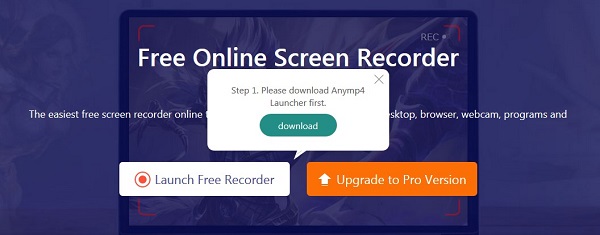
Click Launch Free Recorder to get the launcher.
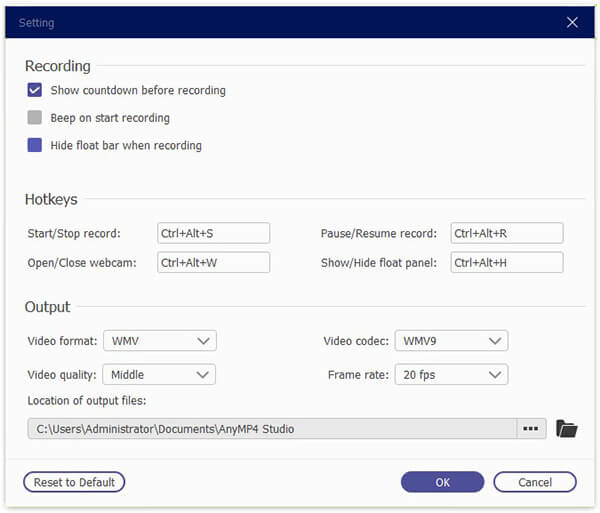
2. Click the Gear button to open the Setting dialog. In the Output section, set basic options like video format, video quality, video codec, and frame rate.
3. There are four icons on the window, Display, Webcam, System sound, and Microphone. Turn on and off each one according to your situation.
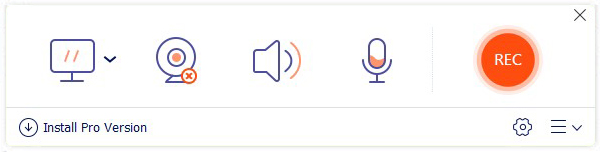
4. Hit the REC button to begin recording screen online. Click the Stop button after recording, and download the video.
Both OBS alternative tools benefit from a key advantage over OBS: they are focused on screen recording, not live streaming. OBS’s live streaming features require strict real-time encoding. This places heavy and continuous pressure on CPU and GPU resources. In contrast, AnyMP4 Screen Recorder and AnyMP4 Free Online Screen Recorder avoid these extreme demands, resulting in more stable recording performance, fewer dropped frames, and no encoding overloaded warnings.
What rate control should I use for OBS?
If you have got a better graphics card than the x264 in OBS settings, set rate control to CBR and set bitrate to 40000. For low-end specs, downscale bitrate to 15000 to 25000.
Does OBS use a lot of CPU?
Since OBS uses x264 to encode videos, users might experience high CPU utilization. You have to downscale frame rate and video quality to fix it.
Should I use hardware encoding OBS?
According to developer, hardware encoding is supported in both the Mac and Windows version of OBS; however, it is only recommended to use it on machines with Windows. Moreover, you'd better use hardware encoding if you run a Nvidia GPU.
What are ×264 vs NVENC encoders? Which should I choose?
×264 is a software encoder that uses the CPU to compress video. It offers excellent quality but can overload your CPU, especially at high resolutions or frame rates. On the other hand, NVENC is a hardware encoder on NVIDIA GPUs that uses a dedicated chip. It reduces CPU load while maintaining good quality. Use ×264 if you want maximum quality and have a powerful CPU. However, use NVENC for smoother performance and less CPU usage.
How much does lowering resolution help with encoding overload?
Lowering the resolution reduces the total pixel count that OBS must process for every frame. For instance, downscaling from 1080p to 720p cuts the workload by more than half. This can resolve encoding overloads while maintaining an acceptable level of visual clarity.
If all else fails, should I upgrade the CPU or GPU?
Yes. If you mostly use x264/software encoding, upgrading your CPU will reduce encoding overload. If you rely on hardware encoders like NVENC, a stronger GPU can handle higher resolutions and frame rates more smoothly. However, you can also consider alternative tools like AnyMP4 Screen Recorder or AnyMP4 Free Online Screen Recorder. These tools handle encoding efficiently without manual adjustments, avoid the extreme demands of live streaming, and are much less likely to trigger encoding overload errors.
The troubleshooting offers five solutions to fix the problem of OBS encoder overloading. You can try the common solutions by optimizing OBS options. The ultimate solution is to use an alternative to OBS, such as AnyMP4 Screen Recorder. It is not only easy to use, but also performs smoothly. Moreover, AnyMP4 Free Online Screen Recorder allows you to do screen recording without installing any software. If you have more questions, please write it down below this post.
Secure Download
Secure Download
 Posted by Alice Thorne to Recorder
Related Articles
 What CamStudio Screen Recorder can Do and How to Use It Capture Desktop
CamStudio is able to record from your screen, add annotations, and save in video format. Want to learn this free screen recorder? Here is a comprehensive review.
 6 Best Open-source Screen Recorders for Windows and Mac OS X/11/12
If you're trying hard to find an excellent free screen recorder application, check our top list of 6 best open-source screen recorders for Windows 10/8/7 and Mac OS X/11/12.
 How to Record PUBG Gameplay with Internal Sound on Mobile and PC
How to Record PUBG with internal audio on your Android phone or computer? Just learn more about the most recommended screen recorders for PUBG gameplay from the article.
 A Simple Review of ShareX Screen Recorder and Best Alternative You Should Know
When you come across ShareX Screen Recorder, should the program be the default screen capture to record screen videos, share some recorded files and edit them with ease?
 Add your comments to join the discussion here