
Quick Answer: AVI vs MP4
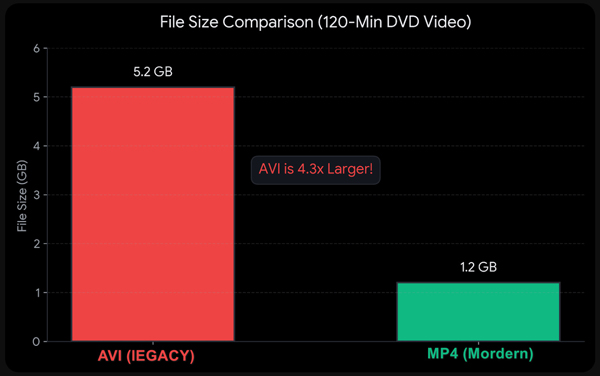
The primary difference between AVI and MP4 lies in compression efficiency and compatibility. AVI (Audio Video Interleave) delivers uncompressed, lossless quality but produces massive files (a 120-minute DVD in AVI is ~5.2 GB). MP4 (MPEG-4 Part 14) utilizes modern H.264/HEVC compression to deliver near-identical visual quality at a fraction of the size (~1.2 GB for the same video).
The Verdict: If you are wondering which video format is better, AVI or MP4, the answer is MP4 for everyday playback, streaming, and editing. Choose AVI only if you need uncompressed master files for long-term local archiving.
When you click to open a video file, only to be greeted by a blank screen, a spinning wheel of death, or a frustrating error message saying your media player doesn't support the format. More often than not, the culprit behind these playback headaches is a classic clash of containers: AVI vs. MP4.
While both formats have been around for years, they serve completely different purposes in the digital landscape. Keeping your entire video library in the wrong format can lead to wasted hard drive space, stuttering playback, and uploads that take forever. In this guide, we will explain the key differences between these two digital containers and help you decide once and for all which one is the right fit for your projects, devices, and storage needs.

If you have ever tried to play, edit, or upload a video file, you've probably asked yourself: Is AVI better than MP4, or should I stick with the modern standard? To find the answer, I always tell people to look at what these two formats actually represent. They are not just random extensions at the end of a file; they are digital containers holding your video, audio, subtitles, and metadata together.
AVI (Audio Video Interleave) is a Microsoft classic introduced way back in 1992. It is a robust Windows legacy format designed to store high-quality media. Because it doesn't compress video heavily, it preserves details perfectly, but requires enormous storage space. If you ever have trouble playing these files on Windows, you can learn how to play AVI on Windows Media Player without headaches.
MP4 (MPEG-4 Part 14) is the industry-standard format developed by the ISO. It is the absolute king of digital video containers, designed to compress high-definition video using advanced codecs. It works seamlessly across almost all hardware, editing tools, and web platforms, making it the go-to choice for creators worldwide.
To understand the true AVI vs MP4 video format battle, we need to compare them across several critical technical categories. Let’s break down how they stack up in real-world scenarios
The most obvious difference you'll see on your hard drive is the file size. I ran a test transcoding a standard 1080p source video. The AVI file size vs MP4 gap is staggering:
Because AVI utilizes less compression, its files are consistently 4 to 5 times larger than MP4 files of identical length and quality
When comparing AVI vs MP4 quality, AVI technically has the upper hand because it supports lossless compression. This allows you to store raw, uncompressed video MP4; however, it uses lossy compression. But don't let that fool you: modern MP4 codecs are so advanced that quality loss is completely invisible to the human eye, giving you great-looking video with huge storage savings.
Analyzing the AVI vs MP4 codec support reveals why MP4 dominates the modern web:
Compatibility is where AVI really shows its age. AVI files work well on Windows systems, but playing them natively on Apple devices or smartphones usually results in an error. If you are a Mac user, you will likely need a workaround to play AVI on Mac without issues. MP4, by contrast, plays natively on iPhones, iPads, Android devices, Smart TVs, and every modern web browser
Sick of "Codec Not Supported" Errors?
If you want to watch your AVI videos on Windows or Mac right away without waiting for any conversions, you don't need to struggle with raw system codecs. AnyMP4 Blu-ray Player is a universal media powerhouse that plays AVI, MP4, MKV, and almost any video format flawlessly with hardware acceleration. It can smoothly play 4K/UHD videos, DVDs, Blu-rays, and rare AVI files with high-definition audio.
Secure Download
Secure Download
Because AVI was designed in the early 1990s, it lacks native support for modern 4K, 8K, and HDR (High Dynamic Range) video metadata. MP4 fully supports these high-end formats, making it the only reliable choice for watching ultra-high-definition content on modern screens.
| AVI | MP4 | Winner | |
|---|---|---|---|
| File Size | Extremely large | Compact and optimized | MP4 |
| Quality | Lossless options available | Visually near-perfect | AVI (Raw) |
| Compatibility | Limited (Windows-focused) | Universal | MP4 |
| 4K & HDR Support | No native support | Full native support | MP4 |
When deciding on AVI or MP4 for YouTube, editing, or archiving, your choice should depend on what you plan to do with the video. Let's look at the best options for different situations:
If you want to share your videos online, MP4 is the undisputed standard. YouTube and other social platforms recommend MP4 as the best format for uploads. Trying to upload an AVI file will take a long time due to the massive size, and the platform's automatic compression will often lower your video quality anyway
Most editing programs like Premiere Pro, DaVinci Resolve, or Final Cut love working with MP4 files because they stream smoothly during editing. But if you are working with older footage or need a quick way to transcode without editing, you can use a free MP4 converter.
If you want to keep old home videos in their absolute rawest format and storage space is not an issue, AVI's lossless nature makes it great for local preservation, but if you have too many AVI files taking up space, you can learn how to convert AVI to MP4 for free or use an advanced AVI to MP4 converter to reclaim your hard drive.
If you have physical media collections, you might want to digitize them. You can easily convert Blu-ray to MP4 or DVD to MP4 using a dedicated DVD-to-MP4 converter to back up your favorite movies.
If you have modern ultra-high-definition disc backups, you can transcode BDMV to MP4 or convert VOB to MP4 for smooth playback.
On the other hand, if you have digital MP4 videos that you want to burn to a physical disc, you can use a professional tool to convert MP4 to DVD.
According to the YouTube Help Center, the platform officially recommends the following upload specs:
Troubleshooting: Can't Play AVI Files on Mac or Mobile?
If you find that the downloaded AVI files cannot play on iPad or Mac, the most time-saving way is to convert them to the universal MP4 format. You can use AnyMP4 Video Converter Ultimate to achieve fast, lossless conversion, ensuring your videos play smoothly on any device without codec errors. It can convert AVI, MP4, and 500+ formats instantly. Built-in video compressor, subtitle editor, and basic trimmer included.
Secure Download
Secure Download
What is the best video format?
AVI is excellent for preserving raw quality for local master storage, while MP4 is the undisputed king of compatibility, internet sharing, and mobile devices. Your choice should depend on what you need the video for.
Is AVI bigger than MP4?
Yes, because AVI uses legacy compression, its files are typically 4 to 5 times larger than MP4 files. A standard 2-hour AVI movie takes up about 5.2 GB, compared to only 1.2 GB in MP4.
Is AVI good for YouTube?
No. YouTube's recommended standard upload format is MP4. AVI files are incredibly heavy and require long upload times and automatic conversion on YouTube's servers, which can lower your initial quality.
Does AVI support 4K video?
Technically, yes, but practically, no AVI's older 1992 architecture does not handle 4K metadata natively. For 4K, 8K, and HDR playback, MP4 (paired with HEVC or AV1 codecs) is the standard.
Can I convert AVI to MP4 without losing quality?
Lossless conversion is not possible when moving to a compressed container like MP4. However, using a high bitrate H.264 or HEVC render, any quality loss will be completely invisible to the human eye, and you'll save up to 80% of your disk space.
At the end of the day, both AVI and MP4 have a place in your media library. Use AVI when you are preserving precious raw footage, and storage space is not an issue. For everything else, from uploading to YouTube, playing on your phone, or editing your next video, MP4 is the clear, hassle-free winner. If you have old AVI files lying around that refuse to play on your devices, converting them to MP4 is the fastest way to get them working again without sacrificing noticeable quality.
 Updated by Alice Thorne to Glossary
More readings
 The Advantages and Disadvantages about AVCHD and MP4
Do you know AVCHD and MP4 these two formats? The article will introduce the difference between them. Keep reading to understand more details.
 MKV vs MP4 – The Difference Between MKV and MP4
The file formats MP4 and MKV are widely used. Do you know the difference between them? The following article will compare MP4 and MKV about their details.
 Comparisons of MOV vs MP4 and M4V vs MP4
MOV, M4V, or MP4, which file format you should choose? Here you will learn about what is MOV/M4V/MP4, and the difference between MOV and MP4, and M4V vs MP4.
 H.264 vs. MPEG-4: Which One to Use for Beginners in 2026
Confused by H.264 vs. MPEG-4? This guide provides an in-depth comparison between them and detailed steps to help you choose the most suitable option.
 Add your comments to join the discussion here