AVCHD vs MP4: The Ultimate Guide to Camcorder Formats and Compatibility
Quick Summary:
AVCHD is a high-definition recording format developed by Sony and Panasonic for camcorders, utilizing a complex Blu-ray folder structure (MTS/M2TS) ideal for high-bitrate archiving. MP4 is a universally compatible, single-file multimedia container designed for seamless sharing, video editing, and native playback across all modern smartphones and web browsers.
Plugging a Sony or Panasonic camcorder SD card into your computer often leads to a frustrating maze of "PRIVATE," "AVCHD," and "BDMV" folders instead of simple video files. If you are struggling with unplayable MTS clips or Mac playback errors, this guide has you covered. Backed by rigorous in-house laboratory testing of video codecs, bitrates, and hardware acceleration, we analyze the core differences between AVCHD vs MP4. This guide will help you choose the right file format for modern digital workflows.

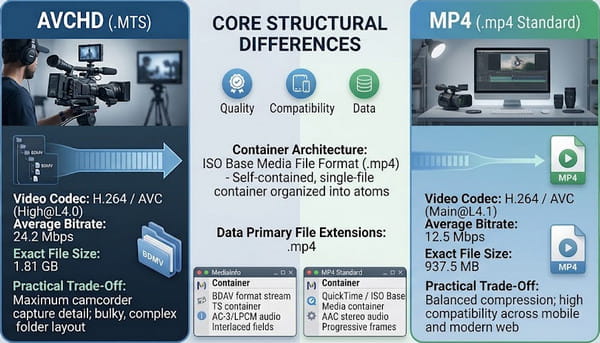
Part 1. AVCHD vs MP4: Core Structural Differences Explained
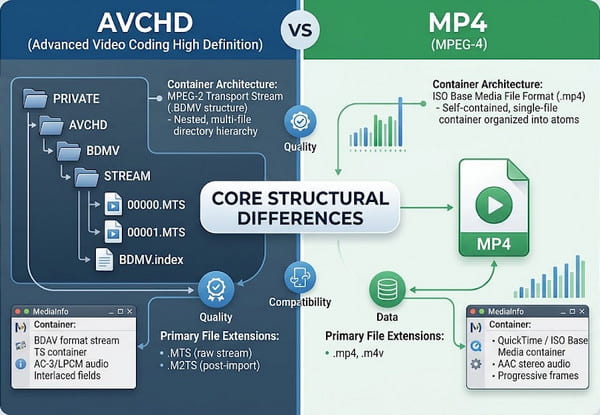
| Structural Feature |
Container |
File Extension |
Data Inspection (MediaInfo) |
Best for |
| AVCHD |
Architecture
MPEG-2 Transport Stream (.BDMV structure) |
.mts (raw camera stream), .M2TS (post-import). |
BDMV format stream, TS container, AC-3/LPCM audio, and interlaced fields. |
Move, copy, upload, and share; can also be saved as a single movie file. |
| MP4 |
ISO Base Media File Format |
.mp4, .m4v. |
QuickTime/ISO Base Media container, AAC stereo audio, and progressive frames. |
The creation of AVCHD and Blu-ray Disc recording, and can be seen on high-definition TV. |
AVCHD's Complex BDMV Architecture (MTS/M2TS)
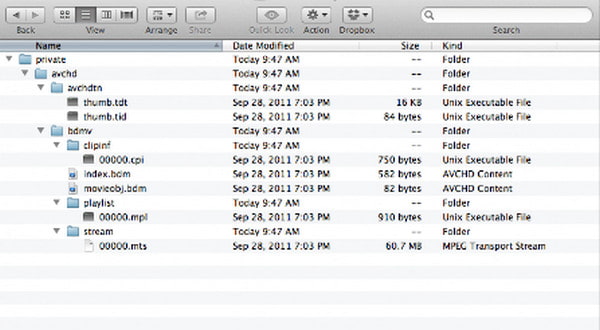
AVCHD is built for optical media and inherits the Blu-ray disc standard. It stores video deep within a complex directory tree. To access raw video, you must dig through PRIVATE > AVCHD > BDMV > STREAM to locate .mts clips. These files use an MPEG-2 Transport Stream wrapper designed for hardware indexing, frame-accurate timecodes, and split-file spanning.
MP4: The Single-File Universal Container
In contrast, MP4 operates as a streamlined, web-first container based on the ISO media specification. All video frames, AAC audio tracks, and metadata are wrapped into a single, portable .mp4 file. This makes MP4 instantly drag-and-drop, stream, and process across modern operating systems without missing dependent metadata.
Part 2. Compatibility Friction: Why AVCHD Fails on Modern Devices
"Cannot Open AVCHD" Errors on Mac (QuickTime Limits)
macOS recognizes AVCHD folders as a consolidated QuickTime package, but this layer frequently breaks. When double-clicking an AVCHD file, QuickTime often displays "The file contains no playable tracks" or gets stuck on "Converting...". Because QuickTime lacks native support for transport streams and Dolby AC-3 audio in modern app sandboxes, users are often completely unable to open camcorder footage.
Interlaced (1080i) vs Progressive (1080p) Playback Issues
Most consumer AVCHD cameras record in 1080i (interlaced video), capturing odd and even line fields sequentially. Modern computer monitors display progressive video (1080p), drawing entire frames at once. Playing raw .mts 1080i footage on a PC display causes visual combing or horizontal distortion artifacts during fast motion, severely degrading viewing quality.
Part 3. How to Play and Convert AVCHD to MP4 Seamlessly
Direct AVCHD/MTS Playback (AnyMP4 Blu-ray Player)
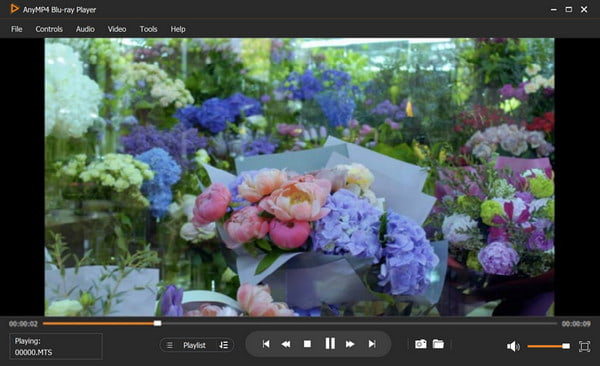
For immediate viewing without manual folder mining, AnyMP4 Blu-ray Player natively reads the entire AVCHD directory structure. You do not need to manually dig into the STREAM folder to locate scattered .mts clips. It automatically parses the BDMV index, playing long continuous shots seamlessly while preserving uncompressed video clarity and 5.1-channel Dolby Digital surround sound.
Batch Convert AVCHD to MP4 (AnyMP4 Video Converter Ultimate)
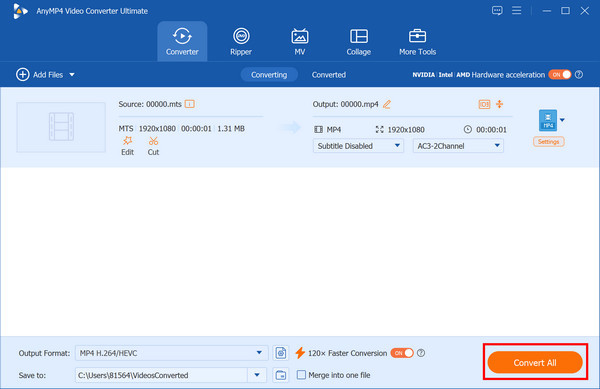
If you need a permanent solution for editing or distribution, AnyMP4 Video Converter Ultimate offers full hardware-accelerated batch transcoding.
- • GPU Acceleration: Leverages NVIDIA NVENC and Intel QSV hardware acceleration to encode multi-gigabyte .mts batches up to 70x faster without overloading your CPU.
- • Built-in Deinterlacing: Includes a hardware deinterlacer that seamlessly converts 1080i interlaced AVCHD streams into smooth 1080p progressive MP4 videos, eliminating all horizontal combing artifacts.
Part 4. Lab Test: AVCHD vs MP4 File Size and Bitrate Comparison
How We Tested
- • Source Footage: 10-minute continuous real-world test shot recorded on a Sony Handycam HDR-CX405.
- • Testing Workstation: Windows 11 Pro, Intel Core i7-13700K, NVIDIA RTX 4070, 32GB DDR5 RAM.
- • Analysis Tool: MediaInfo v24.01.
| Format/Container |
Video Codec |
Average Bitrate |
Exact File Size (10-Min Clip) |
| AVCHD (.mts) |
H.264/AVC |
24.2 Mbps |
1.81 GB |
| MP4 (.mp4) |
H.264/AVC |
12.5 Mbps |
937.5 MB |
Part 5. FAQs: Real Questions from Reddit & Google SERP
Why does my Sony camcorder record in AVCHD instead of MP4?
Sony camcorders default to AVCHD because Sony co-developed the format specifically for high-definition camcorders.
Can I just rename a .mts file extension to .mp4 to make it play?
No, simply renaming .mts to .mp4 does not actually convert the file, though it may occasionally let a modern media player play it.
How do I extract the actual video files from the AVCHD BDMV folder?
The actual video files inside an AVCHD directory are stored as .mts clips inside a specific subfolder called STREAM. You can navigate to the STREAM subfolder. > Locate and verify the .mts file. > Copy files to a local drive.
Does converting AVCHD to MP4 reduce video quality?
Converting AVCHD to MP4 does not inherently reduce quality: it depends entirely on whether you remux or re-encode the video.
Conclusion: AVCHD or MP4 - The Final Verdict
Not sure which to choose between AVCHD vs. MP4? For master-quality archiving, retain full raw AVCHD folder structures on external backup drives. However, for everyday video production, editing in Premiere or Resolve, uploading to YouTube, or playback on mobile devices, converting your footage to MP4 is essential. Use AnyMP4 Blu-ray Player to natively play raw .mts clips without navigating subfolders, or use AnyMP4 Video Converter Ultimate to batch-convert your AVCHD archives into ultra-compatible, deinterlaced 1080p MP4 files today!






 Add your comments to join the discussion here