
Which method is best to add an MP3 to an iPhone:
How to use iTunes to transfer MP3 songs to an iPhone? If you still search for the old method, you will encounter outdated steps and broken links. iTunes is officially gone. Apple retired it on macOS back in 2019, and Windows finally replaced it with the standalone Apple Devices app.
In this guide, we gather the updated 3 methods to add MP3 to iPhone, so that you can send a single MP3 track wirelessly or move an entire music folder from your PC without losing your current songs.
| Need a Computer? | Add to Native Music App? | Overwrites Existing Music? | Batch Folder Import | Automatic Audio Encoding | Built-in Ringtone Maker | Difficulty Level | Best For | |
|---|---|---|---|---|---|---|---|---|
| Way 1: AnyMP4 iPhone Transfer Pro |  (Windows & macOS) (Windows & macOS) |
(shows up directly) |
 (adds without deleting) (adds without deleting) |
(1,000+ tracks at once) |
(converts incompatible files) |
(direct to settings) |
Easy (drag and drop) | Big local collections, safe adds, ringtones |
| Way 2: Files App + VLC (No PC) | (iPhone standalone) |
(plays in player) |
(isolated files) |
(manual single transfers) |
Player-dependent | |
Moderate (extra steps) | Quick emergency clips, no PC around |
| Way 3: Apple Devices / Finder (Official) | (Windows & macOS) |
(shows up directly) |
(sync replaces device library) |
(entire library or playlist) |
Needs pre-converted AAC/MP3 | |
Advanced (strict sync rules) | Official-only users with pristine PC libraries |
Apple changed its media tools on both platforms over the last few years. If you bought an iPhone recently or updated your PC, the old methods no longer apply. Here is the quick translation table to clear up the confusion.
| What You Used to Hear | The Reality Today |
|---|---|
| Use iTunes to sync music to iPhone. | Mac uses the Music app (or Finder). Windows 11 uses the Apple Devices app from the Microsoft Store. |
| Use iTunes to back up and manage iPhone | macOS Catalina and newer use Finder. Windows uses the Apple Devices app. |
| Buy songs in the iTunes Store | Folded directly into the Apple Music app. |
| Does iTunes still exist? | The old Windows installer is in an archive and receives no updates. Apple actively recommends the Apple Devices + Apple Music apps. |
If you want the quickest way to put MP3s on an iPhone without having to follow strict sync rules, AnyMP4 iPhone Transfer Pro is the top pick. Most people hate Apple's default sync because it forces an erased replacement. Transfer Pro works like a standard USB drive: it adds new songs without erasing any existing music on your iPhone.
Beyond simple MP3 transfers, it automatically handles audio conversion. If you want to import iPhone-incompatible formats like FLAC, WMA, etc., this tool will convert them to MP3 before writing the file. Moreover, it supports batch transfer, and you can even drag an entire folder of 1,000+ songs straight in, and they will immediately appear inside your native Apple Music app.
1. Download and install AnyMP4 iPhone Transfer Pro on your Windows 11 PC or Mac.
Secure Download
Secure Download
Plug your iPhone into your computer with a Lightning or USB-C cable. Tap Trust on your iPhone screen and enter your passcode if prompted.
If your iPhone fails to connect, check your cable. Make sure you unlocked the phone screen. Apple blocks access to external files until you enter your screen passcode.
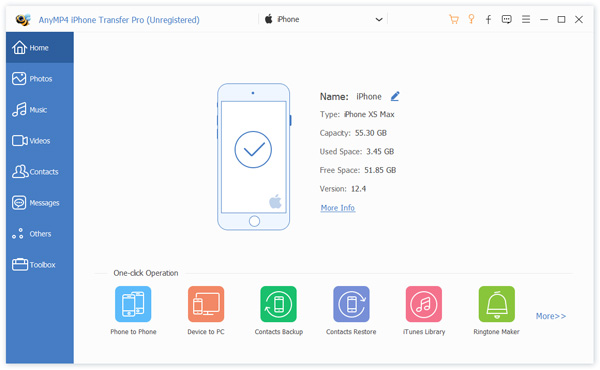
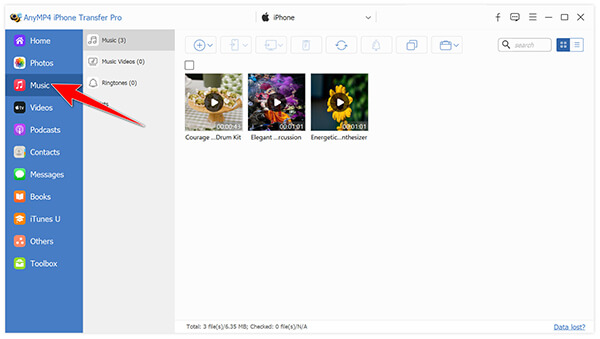
2. Click Music on the left sidebar. The program scans your device and lists all your current tracks, playlists, audiobooks, and ringtones.
3. Click the Add button (the folder icon with a plus sign) on the top bar. Pick Add File(s) for single songs, or choose Add Folder to drop an entire album at once. Select your MP3 files and hit Open. If you have similar MP3 songs in your Apple Music, it will pop up a window asking whether you want to keep both. Then the tool copies them straight to your phone.
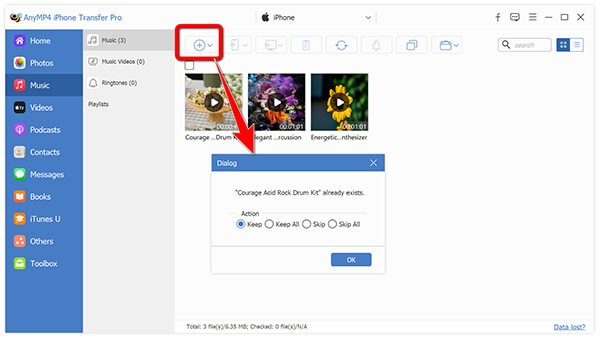
Besides, if the imported music formats are not compatible with your iPhone, it can convert them automatically to MP3 for your device.
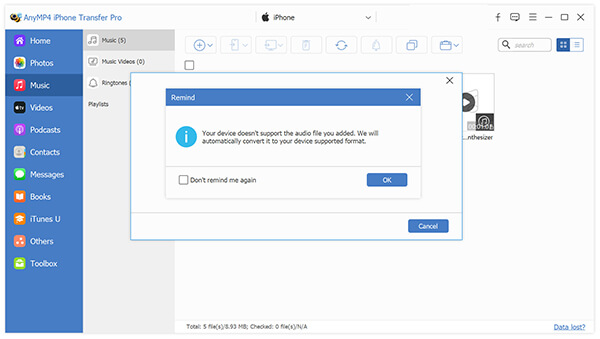
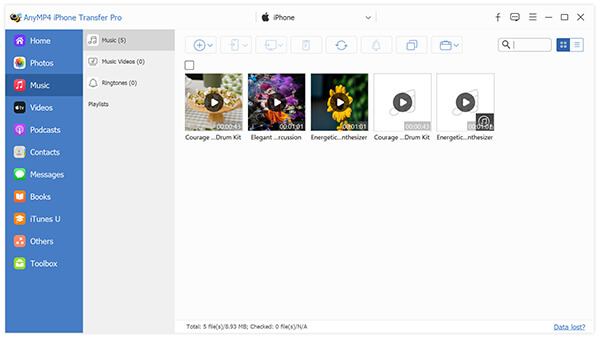
Then you will find the added MP3 songs in your iPhone from this software.
Bonus: Turn MP3 into iPhone Ringtone
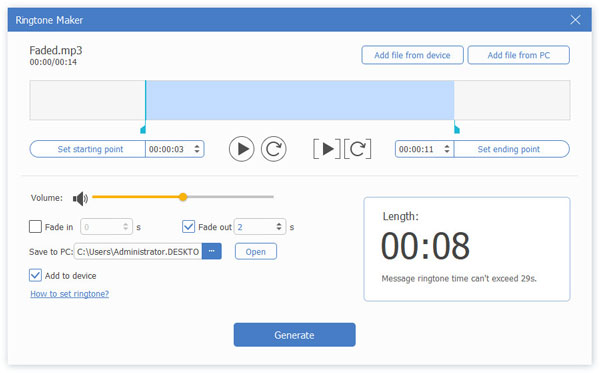
You can also use this tool to make a custom alert track without messing with GarageBand. iOS ringtones must use the .m4r file extension and be under 30 seconds long.
1. Head to the Toolbox tab inside Transfer Pro and launch Ringtone Maker.
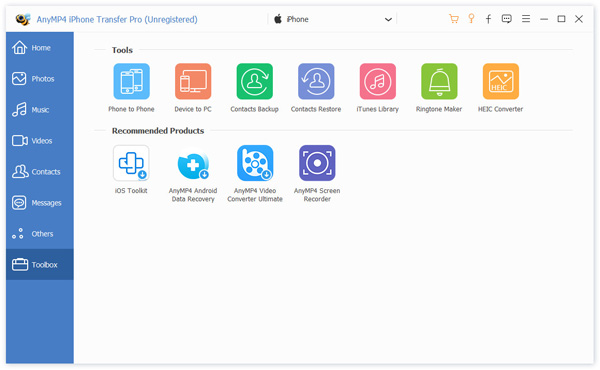
2. Pick your MP3 from your computer or phone. Trim your favorite 29-second clip, adjust the volume, check Add to device, and click Generate.
3. Once it writes to your phone, go to Settings > Sounds & Haptics > Ringtone to pick your new beat.
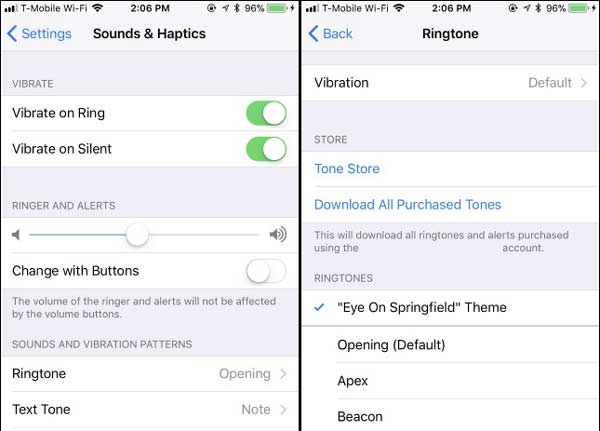
If you want to make ringtone alerts from clips you captured on screen, you can also learn how to record a ringtone on an iPhone.
We tested this software with a 4.2 GB mixed folder containing 450 songs. The entire transfer took roughly three minutes over a basic USB-C cable. Every song appeared directly in the native Apple Music app with full metadata and album artwork intact. Nothing on my iPhone was erased. The only drawback is that the free trial lets you test 30 files, while the paid version removes all file count limits.
Need to add MP3 to iPhone without computer access? You can store and play audio files directly inside the built-in iOS Files app.
Keep in mind that this method will not put songs inside the official Apple Music app. Apple isolates the native Music library behind desktop sync permissions. However, if you want to listen to an audio lecture, a podcast track, or your friend's new demo, playing the file in Files or a free media app like VLC or foobar2000 works well.
1. Get your MP3 onto your iPhone storage:
Here are 2 ways to put your MP3s into a third-party place, then sync them to your iPhone.
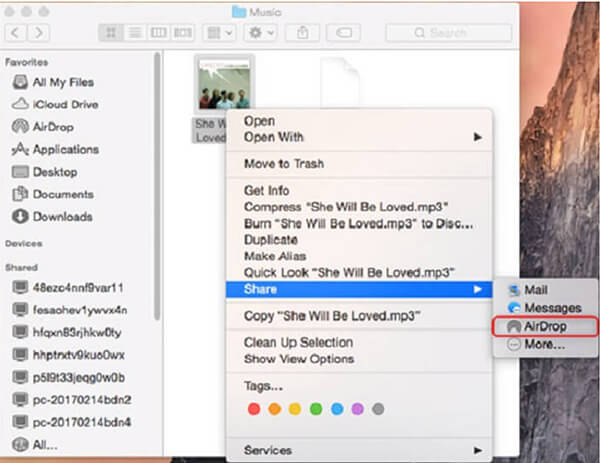
• Way A (AirDrop): If you are on a Mac, right-click the MP3, choose Share > AirDrop, and select your iPhone. When the prompt shows up on your phone, tap Save to Files.
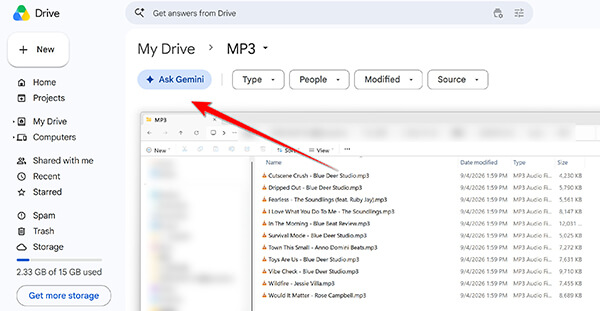
• Way B (Cloud Storage): Upload your MP3 to Google Drive, Dropbox, or iCloud Drive from your source device. Open the corresponding cloud app on your iPhone, tap Share/Export, then tap Save to Files.
2. Open the Files app on your iPhone. Tap Browse and navigate to the folder where you saved the audio (such as On My iPhone > Downloads).
3. Tap any track to play it instantly with the iOS built-in player.
If you want continuous playback and custom playlists:
Download VLC for Mobile from the App Store. Open VLC, go to the Network tab, tap Cloud Services or use File Sharing, and import the songs from your Files folder into VLC.
AirDrop might ask you which app to open the file with. If you pick Apple Music, it will fail or stall. Always choose Files as the destination.
AirDrop took about two seconds to deliver a 12 MB MP3 from my MacBook to my iPhone. The Files app player is basic-it does not support smart queues or lock-screen scrubbing controls like a true music player. Moving the MP3 track into VLC gave me normal volume gestures and background play if you need to cut out silent spots or shorten files right on your device, check out how to edit audio on iPhone.
If you want to stick strictly to official tools and avoid third-party utilities, you can sync your library on your computer. On a Mac running modern macOS, this happens inside Finder. On Windows 11, you must use the new Apple Devices app downloaded from the Microsoft Store.
This is the standard answer for how to transfer music from PC to iPhone using first-party software.
In this method, iPhone music sync erases songs if those songs were synced from a different computer library previously.
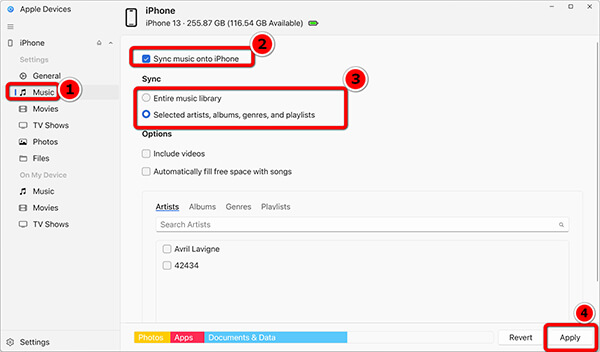
1. Open the Microsoft Store, search for Apple Devices, and install it. Open the app and plug your iPhone into your PC.
2. Open the Apple Devices app. In the left sidebar under Settings, click Music.
3. At the top of the window, check the box for Sync music onto iPhone. Under the Sync section, pick how you want to transfer your files:
4. Check the storage bar at the bottom to ensure you have enough free space, then click the Apply button in the bottom right corner to start syncing.
Once you check Sync music onto iPhone and click Apply, it replaces the synced music on your iPhone with your current PC library. If your iPhone contains songs synced from an older laptop or another computer, syncing here will wipe them off your device immediately.
1. Connect your iPhone to your Mac via cable. Open Finder and select your iPhone under Locations in the sidebar.
2. Click the Music tab along the top row.
3. Check Sync music onto [Your Name]'s iPhone. Choose either Entire music library or Selected artists, albums, genres, and playlists. Click Apply in the bottom right corner.
Do not click Erase and Sync if a pop-up appears warning you that your device is paired with another library. Doing so wipes every non-purchased track off your phone immediately.
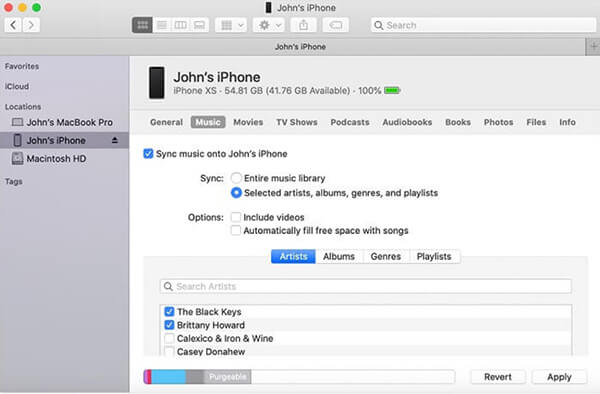
The Apple Devices app on Windows 11 feels much lighter than the old iTunes, but syncing is still rigid. When we tested syncing an album to an iPhone that had existing songs from my laptop, the app prompted me to erase the phone's music library before proceeding. Use manual management mode if you need to keep your existing tracks safe.
Does iPhone support MP3 files?
Yes. iOS natively supports standard MP3 audio. You can play the MP3 files across the Music app, Files app, Safari, and third-party media players.
Does iTunes still exist?
Not on modern systems. Apple discontinued iTunes on macOS in 2019 and replaced it with Finder and the Music app. On Windows 11, Apple replaced iTunes with the Apple Devices, Apple Music, and Apple TV apps.
Can I add MP3 to iPhone without a computer?
Yes. You can save MP3 files to cloud storage like iCloud Drive or Dropbox, open them inside the iOS Files app, or play them through apps like VLC. They will not appear in the native Apple Music app without a computer sync.
Why won't my MP3 play on iPhone?
MP3 cannot be played on iPhone may be led by various reasons: corrupted file headers, variable bitrates (VBR) that fall outside standard parameters, or DRM copy protection can cause playback errors. Re-encoding the track to a standard constant bitrate (CBR) MP3 usually solves this.
Will syncing erase my iPhone music?
Yes, if you use Apple's default sync on a new computer. Apple allows an iPhone to sync with only one official library at a time. Third-party tools like AnyMP4 iPhone Transfer Pro do not overwrite your existing songs.
Can I AirDrop MP3 files to my iPhone?
Yes, AriDrop is the built-in feature on iOS devices, including Mac and iPhone. From any Mac, you can AirDrop the MP3 songs to your iPhone, and save the file to the Files app. AirDrop cannot deposit tracks directly into the Apple Music library.
How do I get FLAC or WAV songs onto my iPhone?
The iOS Files app and third-party players like VLC play FLAC and WAV directly. To get them into Apple Music, convert them to ALAC or MP3, or use transfer software that handles audio conversion automatically. Follow this guide to know if iPhone can play FLAC.
Can I set an MP3 as an iPhone ringtone directly?
Not without converting it first. iOS requires ringtones to be in .m4r format and under 30 seconds long. You can convert tracks using a desktop ringtone maker or assemble them on your phone using GarageBand.
Where do downloaded MP3s go on an iPhone?
If you download an MP3 from Safari or receive it via AirDrop, it saves to your Downloads folder inside the Files app, located either in iCloud Drive or On My iPhone.
Getting MP3 to iPhone is not difficult. If you do not want any cable connections and only have a few MP3 files, then you can save them directly to the Files app via the cloud service. If you have multiple MP3 collections on your PC and want everything organized inside the official Apple Music player without losing your current songs, AnyMP4 iPhone Transfer Pro is the smoothest way to put MP3s on an iPhone.
Secure Download
Secure Download
 Updated by Alice Thorne to Convert Audio, Mobile Transfer
More readings
 8 Proven Ways to Transfer Music from iPhone to Another New iPhone
How to sync music from one iPhone to another? This article gathers 8 ways to make it via iTunes, Wi-Fi, Bluetooth, Finder, Apple Music, AirDrop, and other ways.
 3 Easy Ways to Transfer Songs and Playlists from iPhone to iTunes
How do you transfer music from iPhone to iTunes? Here is the full guide in 3 easy ways to sync songs and playlists to iTunes from iPhone, iPad, and iPod.
 The Ultimate Guide to Transfer Videos from iPhone to PC/Mac
Need to transfer videos from your iPhone to computer? This article will tell you all possible ways to import videos from iPhone to PC or Mac.
 4 Ways to Transfer Videos from PC/Mac to iPhone with/without iTunes
Wondering how to transfer videos from PC/Mac to your iPhone? In this post, we will show you 4 easy-to-use methods to transfer videos efficiently on PC and Mac.
 Add your comments to join the discussion here