
Quick Answer
When you download a movie clip, family recording, or work video in standard MP4 format, pass it over to your iPhone, and... total silence. Either the Files app shows a vague error, or Photos shows a blank screen with no audio. What gives? Isn't MP4 supposed to play on everything? Here is the truth: MP4 is just a container, not the actual encoding format. Inside that file wrapper is a video codec, and if your iPhone doesn't natively support that codec, it won't play. In this guide, we will break down exactly how to put MP4 on iPhone via quick wireless transfers, Windows PC tricks, and how to fix broken files that won't play.
The short answer is yes, but with conditions.
Your iPhone supports MP4 files natively, but only when compressed with codecs Apple explicitly approves.
If you run into a situation where an mp4 file won't play on an iPhone, it almost always means the file was created with VP9 (standard on web video rips) or AV1, or contains non-standard audio tracks.
| Video Codec | iPhone Native Support | Recommended Action |
|---|---|---|
| H.264 + AAC |  Universal Support Universal Support |
Direct transfer via AirDrop, Files, or USB. |
| HEVC (H.265) | iPhone 7 and Newer |
Saves 50% space; ideal for modern iPhones. |
| VP9 / AV1 |  Unsupported Unsupported |
Requires conversion to H.264/AAC. |
| MPEG-4 | Legacy Support |
Plays fine, but larger file sizes than H.264. |
Apple's hardware specifications state that all iPhones support H.264 High Profile up to Level 4.2 or 5.2. If you want a video file to play on literally every iOS device, stick to H.264 video with AAC audio.
If your MP4 file is already compatible with iPhone, there’s no need to convert it again. The best way to transfer the video depends on how you manage your files, so here are three simple methods you can use.
Let's be completely candid: iTunes on Windows is clunky, slow, and risky. Manually syncing often overwrites existing videos or music on your device. If you are trying to figure out how to put videos on an iPhone from pc in bulk, a direct desktop utility works much better.
We rely on AnyMP4 iPhone Transfer Pro when moving large video folders from a PC. It acts like a drag-and-drop bridge, pushing files directly into iOS storage without triggering destructive database syncs.
How to Transfer MP4 Files via AnyMP4 iPhone Transfer Pro:
1. Free download and launch AnyMP4 iPhone Transfer Pro on your PC.
Secure Download
Secure Download
Plug your iPhone into the PC using a USB-C or Lightning cable. Tap Trust on your iPhone screen.
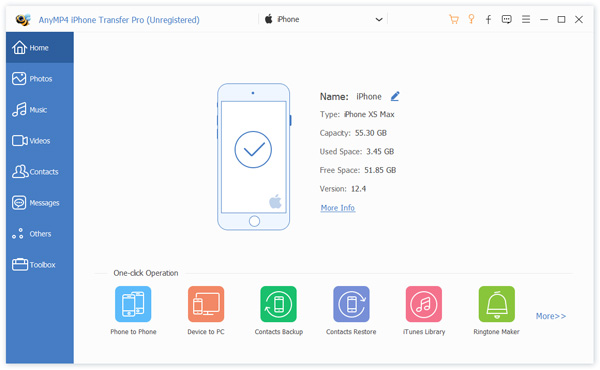
2. Click Videos in the left panel. Click the Add File(s) button at the top bar, pick your MP4 files from your hard drive, and click Open.
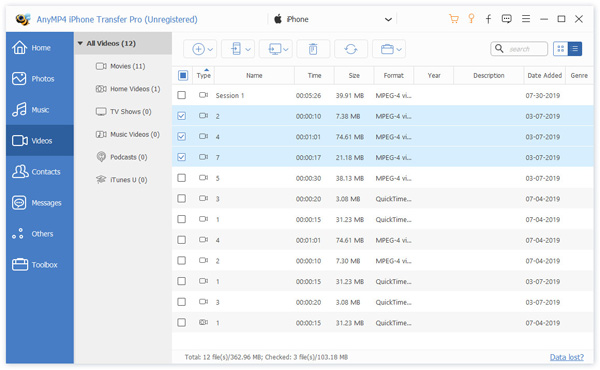
Then this software transfers the videos straight to your device in seconds.
After losing an entire playlist years ago to iTunes' infamous 'Sync & Replace' pop-up, I completely stopped using iTunes for media management. Using a dedicated USB transfer tool like AnyMP4 iPhone Transfer Pro feels like treating your iPhone like a normal USB flash drive, no library overwrites, no cloud waiting times, just straightforward drag-and-drop.
If you are using a Mac, AirDrop is the absolute fastest way to transfer an MP4 to an iPhone. No cords, no extra setup.
How to AirDrop MP4 to iPhone:
1. On your iPhone, swipe down to open Control Center, long-press the network box, tap AirDrop, and choose Everyone for 10 Minutes.
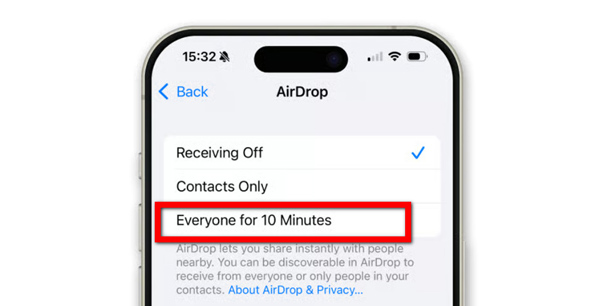
2. Ensure both Bluetooth and Wi-Fi are active on the Mac and iPhone.
3. On your Mac, locate the MP4 file in Finder, right-click it, and select Share > AirDrop. Click your iPhone's name when it pops up.
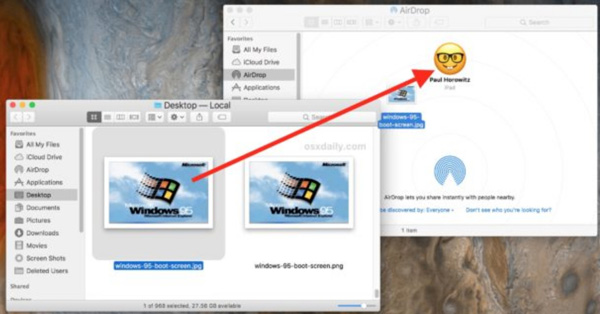
4. Tap Accept on your iPhone. The video will land directly in your Photos app.
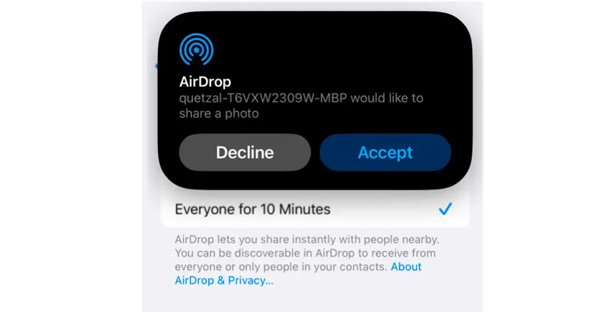
Here, if you cannot see the Accept interface, follow the solutions here to fix AirDrop not working.
If AirDrop sends your video to the Files app instead of Photos, it means iOS detected a codec variant that the main Camera Roll cannot index natively.
AirDrop is my go-to for quick 30-second video clips between my Mac and iPhone. But here's my honest rule of thumb: never use it for files over 2GB or movie folders. Large AirDrop transfers fail silently half the time, without telling you which file caused the failure, leaving you guessing whether it actually finished.
If you want to transfer MP4 files from Windows to iPhone wirelessly without installing software, cloud storage is your best friend.
How to Transfer MP4 via iCloud Drive:
1. Open your web browser on a PC or Mac and log in to iCloud.com using your Apple ID.
2. Select the Drive icon and drag your MP4 file into any folder. Wait for the upload bar to complete.
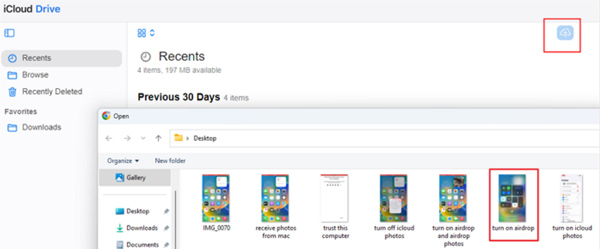
3. On your iPhone, open the native Files app, go to Browse > iCloud Drive.
4. Locate the file. Tap to play it immediately, or tap Share > Save Video to move it into your Photos app.
After that, you can find the video in your Photos app. If you cannot load the video on your iPhone, just read the guide here.
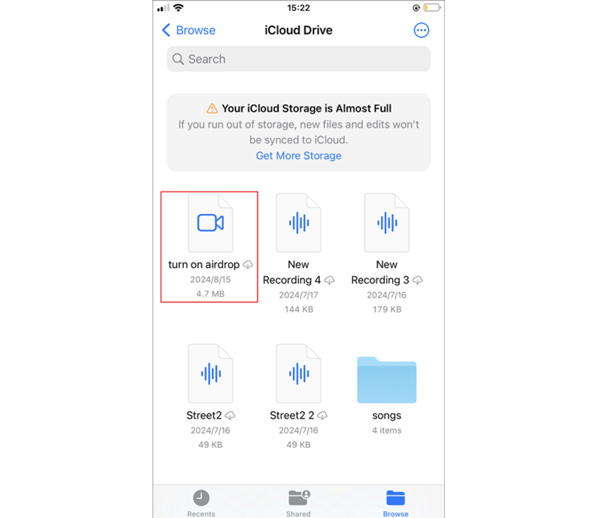
iCloud Drive is super convenient if you're stuck on a Windows PC without a cable. Just keep in mind that free iCloud storage caps out at 5GB. If you're trying to send a heavy 4K video, your upload will crawl unless you have gigabit internet—and you'll likely run out of cloud space real fast.
Transferred the file, but still getting playback errors? Here are the three main culprits behind unplayable MP4 files on iOS:
For more information, check out our guide to iPhone video formats.
When you encounter broken or unsupported files, you need to convert MP4 for iPhone using a reliable desktop encoder. AnyMP4 Video Converter Ultimate is built precisely for this scenario, which offers hardware-accelerated processing and dedicated iPhone profile presets. The encoder can convert almost any video and audio format into iPhone-supported formats.
Secure Download
Secure Download
1. Open AnyMP4 Video Converter Ultimate on your PC or Mac. Click Add Files or drag your unplayable MP4 videos into the main window.
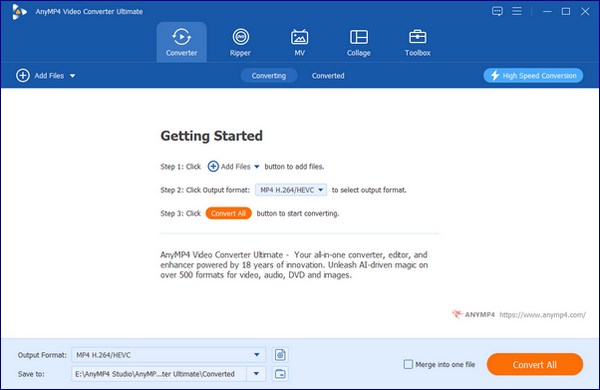
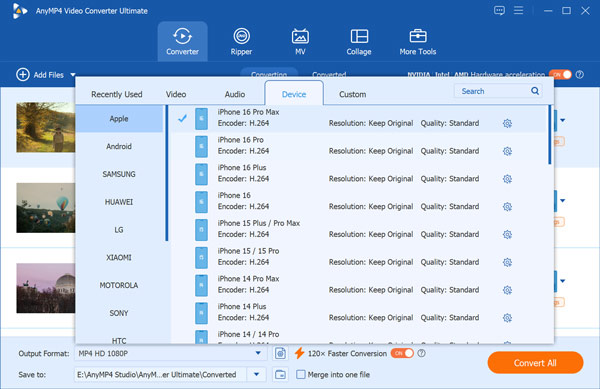
2. Click the Output Format dropdown menu in the upper-right corner.
Switch to the Device tab, pick Apple, and select your specific phone model (e.g., iPhone 15/16 Series or General iPhone Preset). This automatically configures H.264 video and AAC audio.
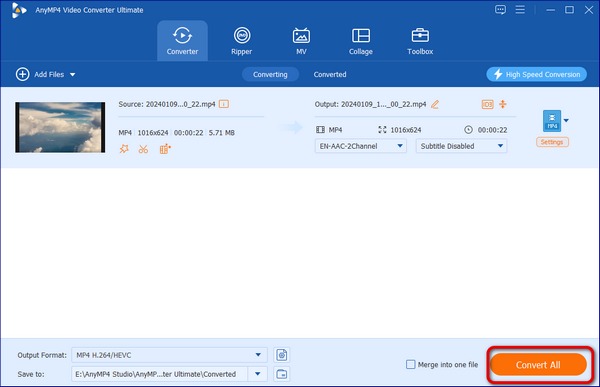
3. Click Convert All in the bottom-right corner.
Once converted, use AirDrop or AnyMP4 iPhone Transfer Pro to send your freshly optimized video to your phone!
If you are exporting video from editing tools like Premiere, Final Cut, or HandBrake, use these exact settings to guarantee flawless playback:
Does iPhone support MP4 natively?
Yes, iPhone natively supports MP4 files as long as they are encoded in H.264, HEVC, or MPEG-4 with AAC audio.
Why won't my MP4 file play on my iPhone?
Your MP4 file likely uses an unsupported video codec (such as VP9 or AV1) or an incompatible audio format (such as AC3).
How do I put an MP4 on an iPhone from a PC without iTunes?
You can upload files to iCloud Drive on your browser, or use AnyMP4 iPhone Transfer Pro to move files via USB without overwriting your library.
Can I AirDrop an MP4 from Windows to an iPhone?
No. AirDrop is an Apple-exclusive feature. Windows PC users must use cloud drives or USB transfer tools.
What is the best video converter for iPhone?
AnyMP4 Video Converter Ultimate is highly recommended for its official Apple device presets and fast hardware acceleration.
Putting MP4 on an iPhone is pretty easy, and it can be done with the right tool for your setup. Here is how to choose the best way depending on your needs:
Don't let the .mp4 extension fool you into thinking a file is ready to play. If your iPhone throws playback errors or silent audio, run the file through AnyMP4 Video Converter Ultimate using the standard H.264/AAC iPhone preset. A quick conversion upfront saves hours of frustrating troubleshooting later!
 Updated by Alice Thorne to Convert Video
More readings
 (2026) 2 Best Methods to Flip Video on iPhone with Ease
Wondering how to flip videos on iPhone? Today, we will introduce two of the best methods, along with detailed steps. If you are interested in it, read on.
 Convert MOV to MP4 on iPhone (4 Methods That Actually Work)
Struggling with iPhone video compatibility? Master how to convert MOV to MP4 on iPhone using native apps, third-party apps, web tools, and desktop software.
 Can iPhone Play FLAC Files? How to Open and Listen Easily
Find out if the iPhone can play FLAC files directly, how iOS handles them, and the easiest ways to access high-resolution audio through conversion.
 How to Record a Ringtone on iPhone Out of Voice Recording
Learn how to record ringtone on iPhone right here, and get the best practices for recording, setting, and changing the default ringtones on iPhone easily.
 Add your comments to join the discussion here