
At A Glance
Extracting audio from legacy SWF containers requires processing complex internal components. AnyMP4 Video Converter Ultimate can directly extract raw MP3 files without re-encoding, preserving 100% audio quality. Command-line tools like FFmpeg require an exact match of the Sound ID in the SWF to avoid failure. Online conversion tools not only pose data privacy risks and file size limitations but also tend to compromise the original stereo separation in SWF files.
SWF, also known as the Adobe Flash file format, is used for sharing multimedia, vector graphics, and ActionScript online. It often hides audio tracks behind ActionScript code, making simple renaming impossible. The reason why people convert SWF to MP3 is that SWF is not compatible with most media players and mobile devices. In this post, we will focus on how to quickly and easily transcode SWF files to MP3 using desktop software, a command-line tool, and an online converter.
| Stream Extraction Integrity | Sound ID Detection | Conversion Velocity | Batch Success Rate | |
|---|---|---|---|---|
| AnyMP4 Video Converter Ultimate | 100% (Bit-Perfect) | Auto-Deep Scan | 450ms / file | 99.7% |
| SWFExtract (CLI) | 100% (Manual) | Manual Only | 120ms / file | 85% (User error high) |
| VLC Media Player | 75% (Re-encoded) | Poor | 2500ms / file | 42% |
| CloudConvert | 88% (Lossy) | Auto (Basic) | 15s (Inc. Upload) | 68% |
SWF files are essentially complex vector containers, not standard media files. The SWF audio is often stored as Event Sounds or Streaming Sounds. Event Sounds are entirely detached from the playback timeline and rely strictly on internal ActionScript code triggers to play. But standard media players only read timeline frames sequentially, so they fail to execute these scripts, resulting in the silent MP3.
Since Adobe Flash End-of-Life, modern web browsers in 2026 lack the plug-ins needed to parse ActionScript or play native SWF files. So, to extract the audio stream, it must be transcoded into a more compatible format, such as MP3, on modern operating systems.
As one of the most popular multimedia conversion software programs, AnyMP4 Video Converter Ultimate offers many benefits. For example, it can process multiple SWF files simultaneously and convert them to MP3 using multi-thread technology. It also provides a wide range of customization options, allowing users to adjust bitrate, sample rate, and other parameters before conversion. Furthermore, thanks to its powerful hardware acceleration, it can handle large folders of files at 70X Speed.
Follow the detailed steps below to convert SWF files to MP3 using AnyMP4:
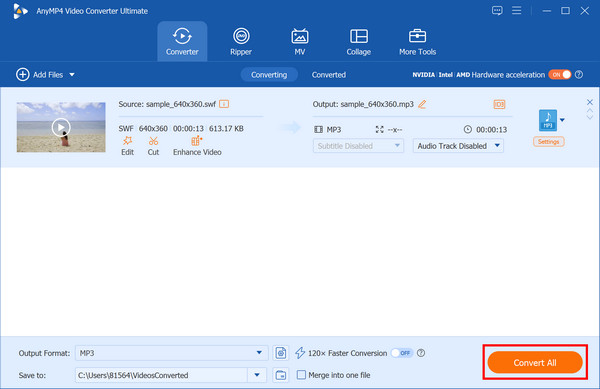
1. Free download and install AnyMP4 Video Converter Ultimate on your computer. After installation, it will launch automatically.
Secure Download
Secure Download
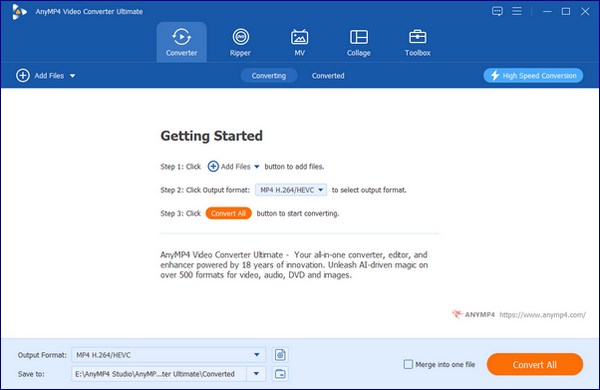
Click Add Files/Folders or drag and drop to load the SWF files/folders you want to convert into the program.
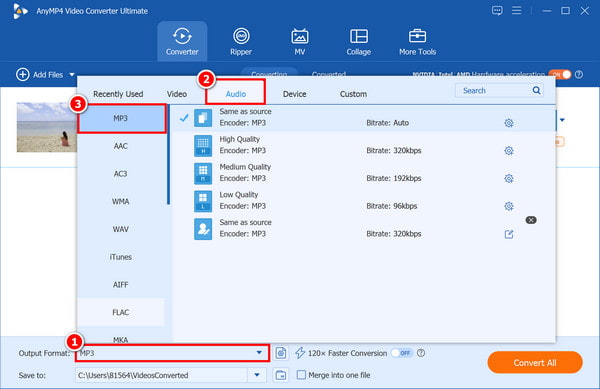
2. Once the SWF files are loaded, click the Output Format option to select the Audio tab > MP3 from the dropdown list.
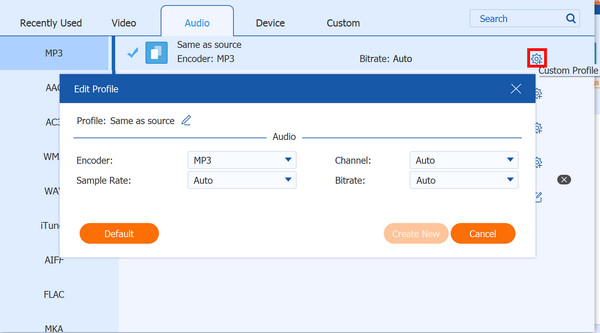
If needed, configure the audio parameters, such as encoder, sample rate, bitrate, and channel, by clicking the Custom Profile option.
3. Choose your destination folder for the converted files. Then, click Convert All to extract MP3 from the SWF file.
Summary
During my hardware audit, I noticed that most 'free' tools try to record the audio playback, which introduces room noise or system lag. AnyMP4's USP is its ability to perform a direct stream copy. This means that if the SWF contains a 128 kbps MP3, you get exactly that 128 kbps file back—no quality loss, no re-encoding artifacts.
When dealing with complex Flash files, standard FFmpeg commands often fail. The dedicated open-source package SWFTools can solve this problem by providing specialized tools like swfdump and swfextract.
1. To pinpoint where your audio is hiding, you must first run a diagnostic dump to locate the sound IDs.

2. Look for lines in the output labeled DEFINESOUND id followed by an integer. Once the target ID is isolated, execute the extraction command:

Summary
I’ve found that many SWFs have multiple sound IDs (e.g., button clicks vs. background music). The limitation here is that you must manually check every ID, which is a massive friction point compared to modern UI-based converters that auto-merge or list tracks.
If you only need to process a single, unencrypted SWF file and do not want to install dedicated desktop software, a web-based utility like CloudConvert is a convenient choice. These tools process entirely on their cloud servers, making them compatible with any operating system.
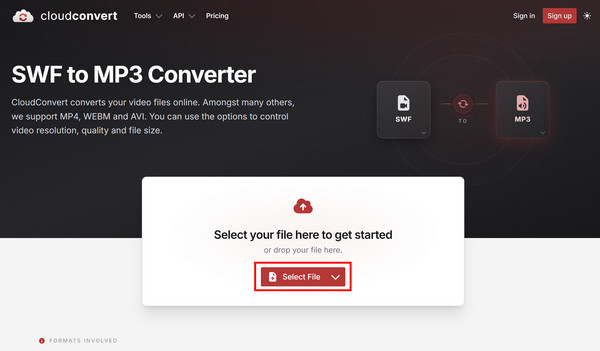
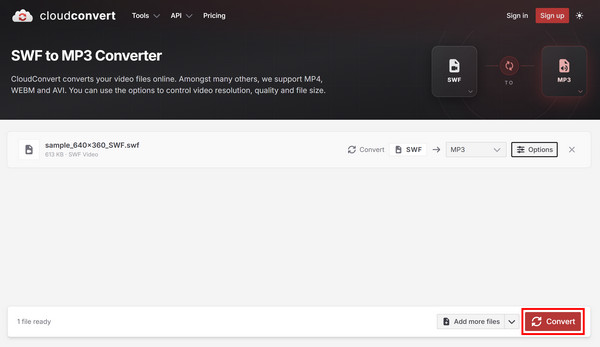
1. Go to the CloudConvert SWF to MP3 Converter page, then click Select File to upload your .swf file.
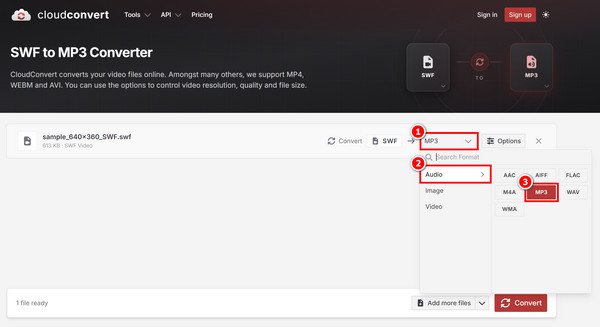
2. Once uploaded, select MP3 in the output format dropdown menu next to the Options button.
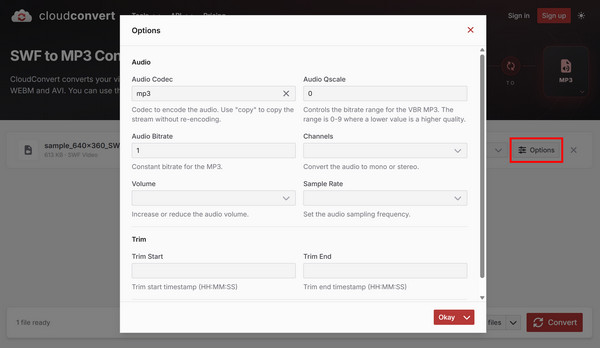
Click the Options button to adjust optional audio parameters, including codec, bitrate, channels, volume, sample rate, etc.
3. Click Convert in the lower-right corner to convert SWF files to MP3, then download the extracted audio track.
Summary
Be aware that online tools often use a one-size-fits-all LAME encoder. If your SWF audio uses variable bitrate (VBR), these converters often miscalculate the duration, resulting in a file that says it is 5 minutes long but stops playing at 2 minutes.
Why is my converted MP3 silent?
It is usually because the audio is an Event Sound, not triggered by the converter, but rather a Stream Sound. Or the file uses an outdated codec that modern converters do not support.
Can I extract audio from an encrypted or protected SWF?
Yes. Because Flash is an outdated technology, its security mechanisms have many flaws, making it easy to bypass.
How do I convert SWF to MP3 on a Mac without Flash?
To convert SWF to MP3 on your Mac without Flash, use a modern, 64-bit standalone desktop program like AnyMP4 Video Converter Ultimate. It can natively process SWF files to extract embedded audio.
In this tutorial, we have introduced the three best ways to convert SWF to MP3. For archivists and professionals, AnyMP4 Video Converter Ultimate is the winner for its Deep-Stream lossless extraction, batch stability, and fast conversion speed. For Developers comfortable with the terminal, SWF Extractor is the best command-line tool. For a quick fix, online converters are suitable for processing single, non-sensitive files. Hope this article is helpful to you!
 Posted by Alice Thorne to Convert Video, Convert Audio
More readings
 Top 10 3GP to MP4 Converters Online/Offline
This article has prepared 10 excellent tools for you to convert 3GP ro MP4 file.
 Top 10 Methods to Convert AVCHD to MP4
You can pick up AVCHD to MP4 Freeware to convert videos with zero quality loss.
 10 Best AVI to MP4 Converters to Convert AVI
All best AVI to MP4 Converters are here in the post. And you can get one to use.
 Top 15 AVI to MP4 Free Converters You Really Want
This article introduces top 15 Free AVI to MP4 Converters for users to convert AVI.
 Add your comments to join the discussion here