How to Convert MP4 to MPEG
Quick Summary of 4 Ways
- AnyMP4 Video Converter Ultimate: Best for fast, secure batch conversions. Just add files, select MPEG, and click Convert All to process large videos locally.
- VLC Media Player: A free player workaround you already have. Open Convert / Save, manually tweak the encapsulation to MPEG-PS, and hand-type .mpg to save.
- Convertio: Ideal for small files under 1GB. Connect your Google Drive or Dropbox, select MPG, and download your file once the queue finishes.
- FFmpeg: Unparalleled for advanced techies. Open your terminal, navigate to your folder, and paste a single command string to convert locally.
Although MP4 (H.264/H.265) is the universal standard for streaming and mobile devices, older multimedia hardware and classic DVD authoring tools are strictly hardwired to read the legacy MPEG-2 format (.mpg). When these systems encounter modern compressed MP4 containers, their internal decoders simply fail. To make your files compatible with these specific, rigid playback setups, a backward-compatibility transcoding process is required. That is why you need to convert MP4 to MPEG. This guide provides the 4 best methods from professional desktop software and free online tools to open-source command lines to make the conversion on Windows and Mac.
How We Tested These Methods
To deliver accurate, verified information, a standardized benchmarking process was established across these 4 distinct workflows to weed out unstable converters. The test environment utilized a standard Windows 11 desktop powered by an Intel Core i7 processor, 16GB RAM, and an NVIDIA RTX 3060 graphics card.
The test file consisted of a 4.2 GB 4K MP4 video (H.264 encoded, 60 fps). Each tool was evaluated based on five core metrics: transcoding speed, CPU consumption, output format integrity (true bit-rate matching to MPEG-2 .mpg), file size limitations, and data privacy security. Tools that crashed on large files, failed to maintain aspect ratios, or contained intrusive malware were instantly disqualified.
|
Best For |
Speed |
Format Support |
Privacy |
Price |
Watermark |
| AnyMP4 Video Converter Ultimate |
Ultra-Fast Batch Conversion & Large Files |
Ultra-Fast (Up to 70x with GPU Acceleration) |
MPEG-1, MPEG-2, and 500+ modern/legacy profiles (.mpg) |
High (100% Local offline processing) |
Free Trial / Paid |
No |
| VLC Media Player |
Free Local Workarounds for Single Files |
Very Slow (CPU-bound real-time playback rendering) |
Limited (MPEG-TS by default; requires hidden manual tweaks for .mpg) |
High (100% Local player processing) |
100% Free / Open-source |
No |
| Convertio |
Direct Cloud Storage Conversions (Single Small Files Only) |
Slow (Enforces strict one-by-one sequential queuing for free accounts) |
Supports standard legacy MPG formats |
Medium (Cloud-based data handling) |
Free tier caps at 100MB (Up to 1GB on Basic Paid Plan) |
No |
| FFmpeg |
Command-Line Geeks & Automated Workflows |
Fast (Highly dependent on custom hardware command lines) |
Comprehensive (Supports almost every known codec and container) |
High (100% Local command-line processing) |
100% Free / Open-source |
No |
Option 1: Professional Desktop Software (Best for Large Files & Batch Conversion)
AnyMP4 Video Converter Ultimate – Best for Ultra-Fast Batch Conversion and Privacy Security
For users facing strict compliance on large files or dealing with privacy-sensitive video footage, a dedicated local desktop processor is mandatory.
During the standardized stress test, AnyMP4 Video Converter Ultimate handled a 4.2 GB 4K MP4 file seamlessly. Upon import, the software instantly enabled NVIDIA NVENC hardware acceleration, completing full transcoding to the MPEG-2 (.mpg) container in exactly 48 seconds. The processing speed was nearly 70 times faster than software-only rendering, while total CPU usage consistently hovered under 15%. Because every rendering cycle runs entirely on the local hard drive, there is absolute security against data leakage or exposure to cloud servers.
Unlike cloud tools that downscale streams to save bandwidth, this software uses a true bit-rate match algorithm to preserve the original visual clarity during the MP4 to MPEG transition.
There are only 3 steps to convert MP4 to MPEG in this way:
1. Add MP4 Files
After free download this software by clicking the following either button, launch the application.
Click Add Files in the top-left corner to load the target MP4 media files. It supports batch conversion, and you can add multiple MP4 files or the whole MP4 folder in this step.
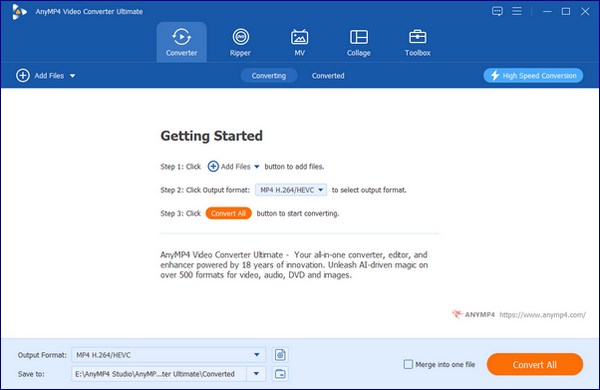
2. Choose Output MPEG Format
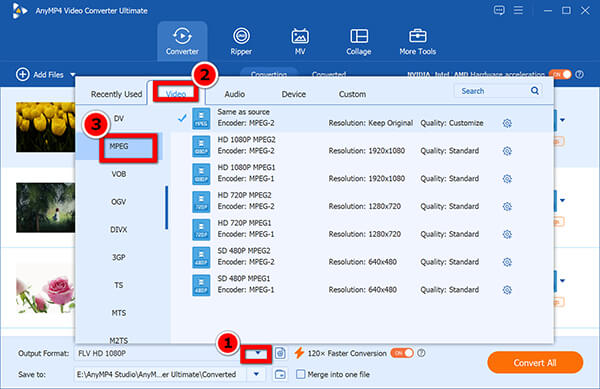
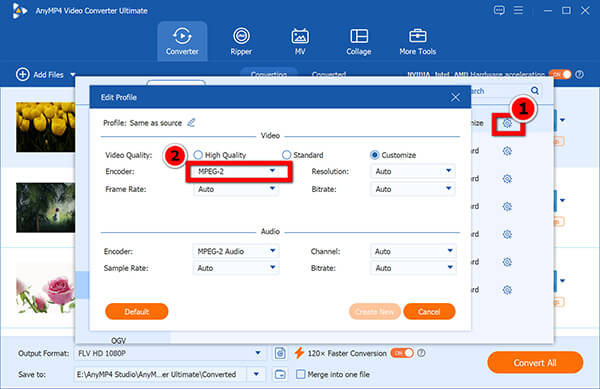
Expand the Output Format profile tree, select MPEG under the Video tab, and choose your preferred resolution preset.
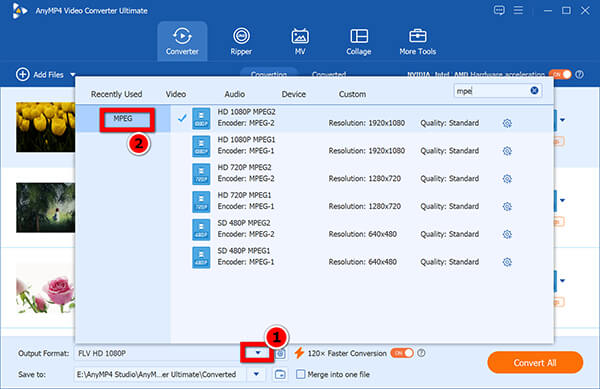
Skill 1: Cannot find MPEG? Just use the search bar to input MPEG to locate the output format directly.
Skill 2: For using MPEG in your DVD player, you can customize the MPEG video codec in MPEG-2 by clicking the Custom Profile option and selecting MPEG-2 under the Video tab.
3. Convert MP4 to MPEG in AnyMP4
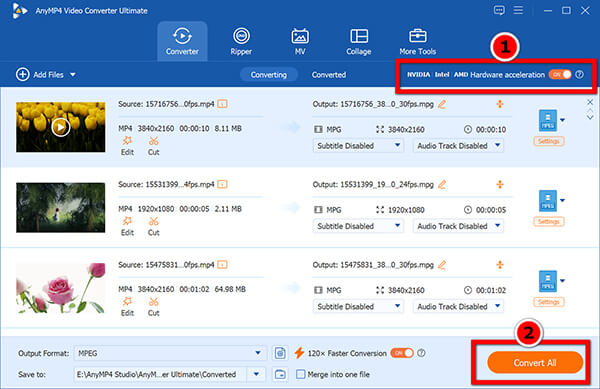
Enable the Hardware Acceleration switch at the top-right corner and set a designated destination path at the bottom-left side.
Hit the Convert All button to start the high-speed batch encoding from MP4 to MPEG.
VLC Media Player – Best for Free Local Workarounds for Single Files
While globally recognized as a open-source media player, VLC contains a hidden, built-in transcoding engine capable of outputting MPEG-2 video. However, VLC was never engineered to be a dedicated converter, making its user experience complex and filled with technical pitfalls.
By default, VLC's standard conversion profile only wraps videos in an MPEG-TS (Transport Stream) container, which older home DVD hardware cannot read. To output a genuine standalone .mpg file, users must navigate deep into advanced menu chains to manually rewrite the file container rules.
How to force VLC to convert MP4 to MPEG (.mpg):
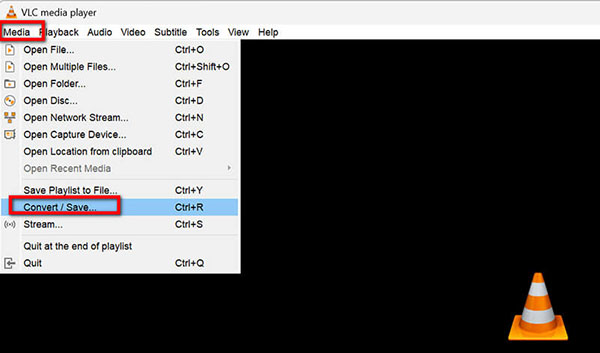
1. Open VLC, click Media in the top menu bar, and choose Convert / Save (or press Ctrl + R).
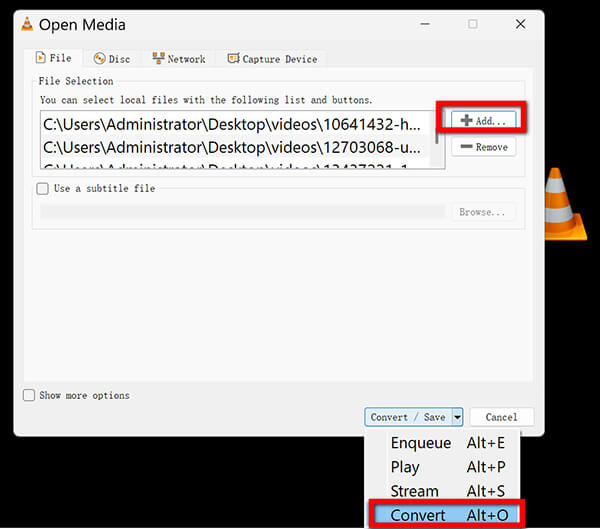
2. Click the Add button to import your MP4 video, then click the Convert / Save button at the bottom.
3. Locate the Profile dropdown menu. Do not select the default settings. Instead, click the Wrench Icon (Edit selected profile) next to the dropdown.
Under the Encapsulation tab, manually change the checkmark to MPEG-PS (Program Stream, which is the required architecture for standard .mpg files).
Move to the Video Codec tab, check the Video box, and choose MPEG-2 from the Codec dropdown menu. Click Save.
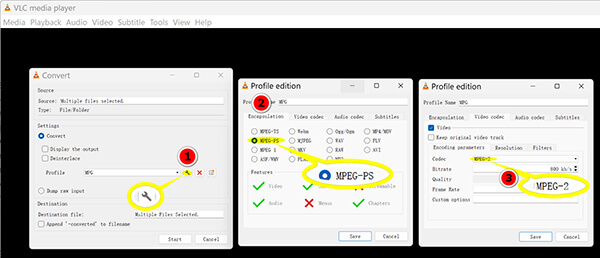
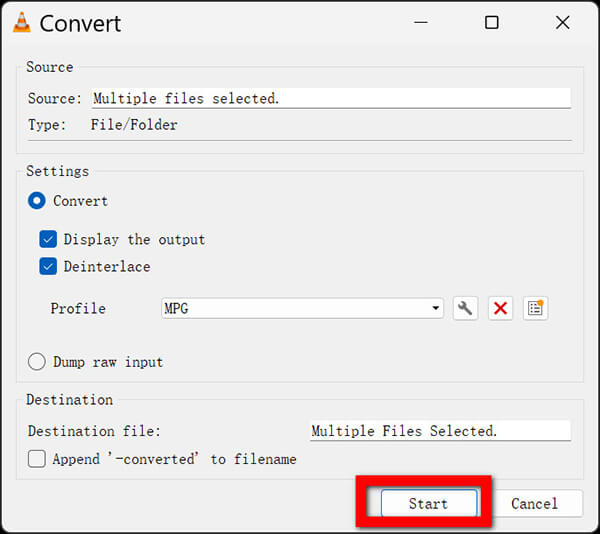
4. In the Destination file field, click Browse to find the location to save the converted MPEG files, and finally, click Start . Then VLC will convert MP4 to the selected output format with MPEG-2 codec.
Note
Crucially, after completing the conversion, you must manually type the .mpg extension at the very end of your file name, otherwise VLC will save it as a broken file.
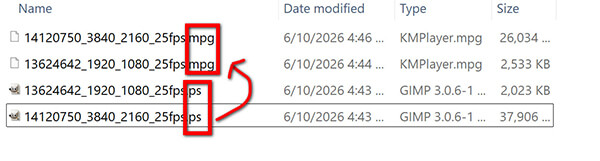
Critical issues with the VLC workflow:
Because VLC processes transcodes by essentially "playing the video back internally to record it to disk," it lacks any optimization for modern GPU hardware acceleration. The conversion is entirely CPU-bound and painfully slow. Furthermore, forcing VLC into this advanced MPEG-PS container mode is highly unstable; during benchmarking with files larger than 2GB, it routinely triggered sudden software crashes, unrecoverable video-audio desynchronization, or rendered files completely missing their audio tracks.
Summary
In conclusion, VLC Media Player is a free alternative for converting single small MP4 files to MPEG, but it comes with complex operations and poor stability for large files.
Option 2: Cloud-Based Online Tool (Easiest for Small & Occasional Files)
Convertio integrates directly with modern cloud ecosystems, allowing users to pull MP4 video files directly from Google Drive or Dropbox storage, process them remotely, and push the legacy MPEG outputs back to their cloud folders without downloading anything to a local machine.
How to Use:
Navigate to the Convertio MP4 to MPEG converter, https://convertio.co/mp4-mpeg/, click the Choose Files button to upload the MP4 files from your device. Or the cloud icons on the main dashboard give you the option to link your Google Drive or Dropbox, select the MP4 file, then click Convert to start the conversion process.
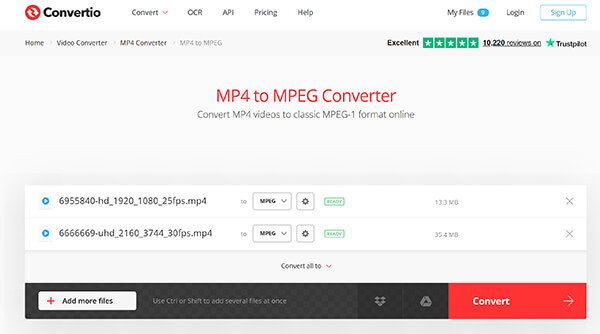
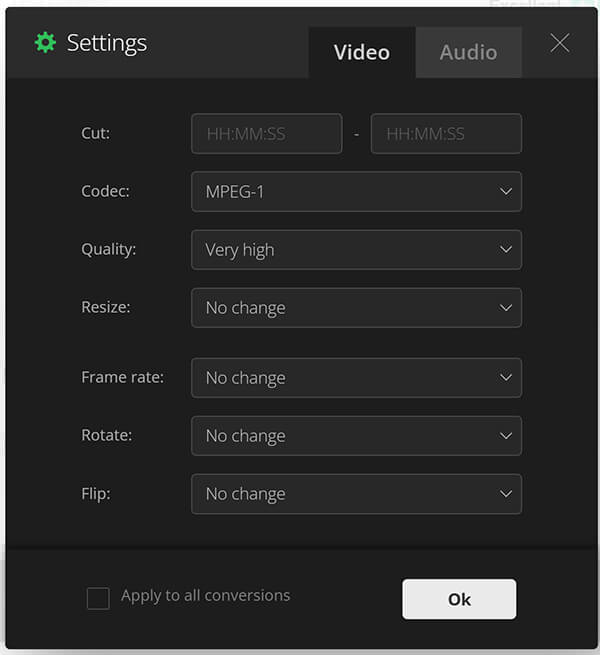
Very easy, right? You can also change the Settings option to adjust the MPEG video or audio codec, quality, etc.
Tip
While the free tier enforces a strict maximum 100 MB file size limit (upgradable to 1GB on Basic plans), the most frustrating limitation of Convertio is its restriction on batch workflows. Even if you upload multiple small MP4 files simultaneously, a free account forces a strict one-by-one sequential queue. The system freezes parallel rendering entirely, meaning subsequent files will sit endlessly in a "Waiting" status until the preceding file completely finishes uploading, encoding, and downloading. For multi-file projects, this manual bottleneck destroys productivity.
Option 3: Open-Source Command-Line (Best for Advanced Techies & Full Control)
For system administrators or developers, FFmpeg is a powerful tool for video processing. However, for everyday users, it can feel like a frustrating "black box" that is incredibly tedious to use.
There are no buttons to click, and you won't get any helpful, user-friendly error messages if something goes wrong. Instead, you have to type out long, complex lines of text code manually. During this process, even a tiny mistake-like accidentally missing a single space, forgetting a quotation mark, or having an unconfigured system variable-will cause the entire conversion to freeze and fail instantly.
When it crashes, you are left staring at a wall of cryptic, technical error logs that make absolutely no sense to an average person. Because of this steep learning curve, unless you are already completely comfortable using terminal command lines, it is highly recommended to steer clear of this hardcore approach.
To bypass manual interface clicking, launch the terminal (Command Prompt or PowerShell on Windows, Terminal on macOS) and navigate to the folder containing the target video. Execute the following precise command string to trigger a true raw bitstream conversion into a standalone MPEG-2 .mpg container:
ffmpeg -i input.mp4 -vcodec mpeg2video -acodec mp2 -f mpegvideo output.mpg
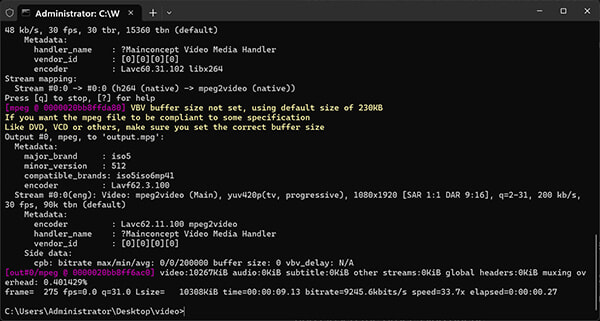
Here is a simple breakdown of what each word means and how to change it:
- • -i input.mp4: The -i stands for "input." You need to replace input.mp4 with the exact name and file extension of the video you want to convert (for example: -i wedding-video.mp4).
- • output.mpg: This is your final result. You can change output.mpg to whatever you want to name your new file, just make sure to keep the .mpg extension at the very end so your target device can recognize it (for example: final-movie.mpg).
If your video is named myvideo.mp4 and you want the new one to be called dvd-version.mpg, your command will look like this:
ffmpeg -i myvideo.mp4 -vcodec mpeg2video -acodec mp2 -f mpegvideo dvd-version.mpg
Tip
- • For standard physical DVD playback compatibility, it is recommended to apply the native target flag instead of writing custom parameters manually. Executing ffmpeg -i input.mp4 -target pal-dvd output.mpg will instantly automate standard resolution (720x576 for PAL), proper framerates, and exact aspect ratios.
- • By default, FFmpeg runs on a slower, single-threaded CPU processing queue. To unleash high-speed rendering on compatible hardware setups, explicit acceleration flags must be injected. For example, NVIDIA card users should utilize the NVENC wrapper commands (-vcodec mpeg2_nvenc) to offload the heavy encoding math from the CPU.
MP4 vs MPEG - Which Format Should You Use?
Understanding the relationship between these two formats helps determine the necessity of conversion.
MPEG (Moving Picture Experts Group)
This refers to a family of older compression standards. In modern search contexts, when users look to convert "MP4 to MPEG", they specifically mean transcoding into MPEG-2 (.mpg or .mpeg containers). MPEG-2 is the legacy industry-standard format required for authoring physical DVDs, old television broadcast infrastructure, and specific legacy hardware MPEG media players.
MP4 (MPEG-4 Part 14)
MP4 is a modern, highly optimized container format that utilizes advanced codecs like H.264 or H.265. It delivers exceptional high-definition visual quality at a fraction of the file size. MP4 is universally accepted by modern streaming platforms, operating systems, and mobile devices.
The conversion from MP4 to MPEG-2 is essentially a backward-compatibility step. It is recommended only when a specific target device or legacy authoring software completely rejects standard MP4 files.
FAQs About MP4-to-MPEG Conversion
Why can't I use HandBrake to convert my MP4 to an MPEG (.mpg) file?
While HandBrake is a highly popular open-source video transcoder, it is strictly engineered around modern web standards and cannot output legacy containers. Its interface only supports exporting to MP4, MKV, and WebM. Even if you navigate into its advanced settings and change the internal video codec layer to MPEG-2, HandBrake will force that stream to remain wrapped inside an MP4 or MKV shell. Because legacy DVD players and hardware devices require the actual external container to be a true .mpg or .mpeg file, they will completely reject HandBrake's outputs.
Can I convert MP4 to MPEG for free on Windows 11 without software?
No native built-in Windows 11 application allows direct conversion to legacy .mpg containers without additional tools. Users must utilize free MP4 converter tools like VLC or professional local desktop converters to process the files safely.
Will converting an MP4 file to MPEG affect the video quality?
Yes, to a degree. Because MPEG-2 is an older, less efficient compression standard than modern MP4 (H.264), converting often requires higher bitrates to maintain visual clarity. Using professional software with true bit-rate matching helps minimize visible degradation.
Why does my DVD player say "Unsupported Format" when playing an MP4 file?
Most traditional standalone DVD players and older home theater systems lack the internal architecture to decode the modern H.264/MP4 container. They strictly require video streams multiplexed into the standard MPEG-2 structure.
Is it safe to use free online MP4 to MPEG converters for private videos?
Generally, no. Online converters require uploading data to remote cloud servers. For confidential business files, private home movies, or high-security data, local desktop applications are recommended to keep the entire processing cycle restricted to local hardware.
Conclusion
Selecting the optimal method to convert MP4 to MPEG depends entirely on your technical comfort level, file sizes, and privacy requirements.
- • AnyMP4 Video Converter Ultimate: The best choice for fast, secure batch conversions of large files. It bypasses cloud limits and processes files locally with full GPU acceleration.
- • Convertio: Perfect if you need to pull and save small files directly to Google Drive or Dropbox, provided the files are under the 100 MB free tier limit.
- • FFmpeg: The ultimate tool for code-savvy users who want complete, scriptable control over their media parameters via the command line.
- • VLC Media Player: A handy, free desktop alternative for occasional users who only need to convert a single, small file and do not mind navigating complex advanced menus.




 Add your comments to join the discussion here