
Summary
Converting stereo to mono audio involves combining your left and right channels into a single channel. This can be done easily with a professional converter, an audio editor, or a command-line tool.
Has it happened to you that you downloaded an audio file for your podcast, voice recording, or announcement, only to find that your recording or listening setup does not support stereo sound? Stereo-to-mono conversion is a usual problem for podcasters, broadcasters, and others who work with audio voice recordings. Fortunately, stereo-to-mono conversion can be done easily with the right software. In this post, we will show you various methods, ranging from a professional converter that supports batch conversion to a free audio editor and a command-line application.
How We Tested These Stereo-to-Mono Conversion Methods
| Output Quality | Conversion Speed | Batch Conversion | Ease of Use | Best For | |
|---|---|---|---|---|---|
| AnyMP4 Video Converter Ultimate | Excellent | Up to 120× | Basic | High-quality conversion and efficient batch processing. | |
| Audacity | Same as source | Normal speed | Moderate | Manual stereo-to-mono conversion with advanced editing options. | |
| FFmpeg | Same as source | Fast | (through scripts) | Advanced | Script-based stereo-to-mono conversion |
Stereo and mono denote the number of audio channels used for recording or playback. Stereo sound utilizes two separate audio channels, namely the left and right channels. Stereo sound is ideal for music, movies, and games because it creates a wide soundstage. On the other hand, mono sound combines all sounds into a single audio channel. Whether a single or several speakers are used, the same sound signal is delivered from each output point.
Why Convert:
If you want to convert stereo to mono reliably, AnyMP4 Video Converter Ultimate is the best option. It offers the most powerful solution for managing audio channel conversions. It supports more than 500+ formats, including standard digital audio formats such as MP3, WAV, AAC, and OGG. You can also adjust the audio encoder, channel, sample rate, and bitrate. It is to ensure optimal audio quality, file efficiency, and playback compatibility. But what will really catch your attention is its batch conversion support. You can import up to 100+ files and convert them simultaneously without losing quality. Also, there is a built-in media player that lets you preview files before converting them.
Key Features
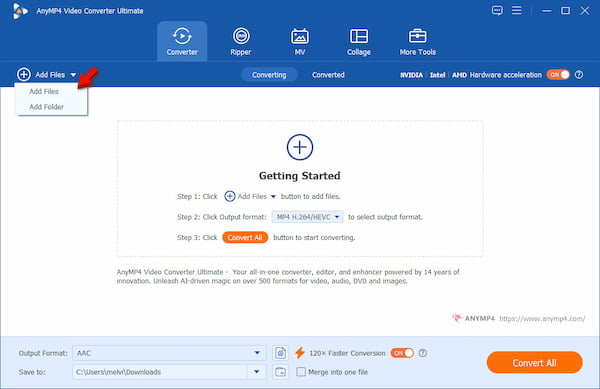
1. Download AnyMP4 Video Converter Ultimate and complete the installation. After setup, launch it and click +Add Files to import the stereo audio or video file. If you have multiple sources in a single folder, use Add Folder to batch-import them.
Secure Download
Secure Download
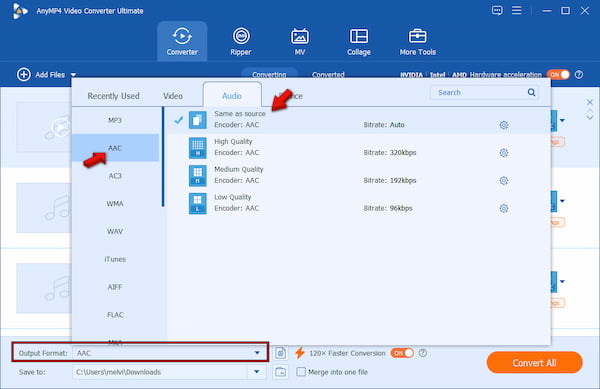
2. Click the Output Format picker and select AAC in the Audio category. This format offers higher quality at smaller file sizes. Next to it, choose a profile preset depending on the quality of your source.
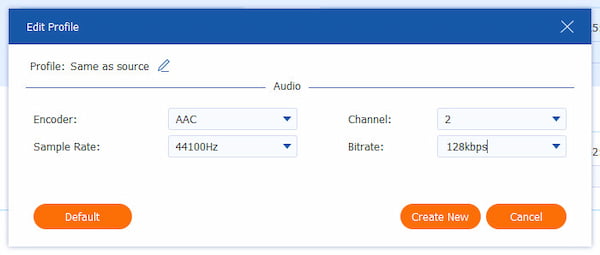
Before you convert, click Custom Profile and select 2 (Mono) in the Channel picker. Then, use the built-in Bitrate converter to adjust the bitrate settings. For mono audio, use 44.1 kHz and 128 kbps for music and podcasts. Click Create New to apply the settings.
3. Go back to the main interface and enable the Hardware Acceleration button to speed up the conversion. Lastly, click Convert All to change stereo to mono.
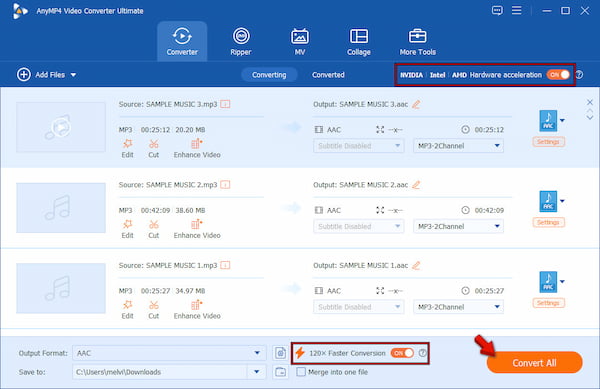
We perform hands-on testing to assess AnyMP4's speed, quality, and batch-processing capabilities. In our test, we use Windows 10 Pro to convert a 2.65 GB file into exactly 100 stereo audio files. It took 1 minute and 43 seconds to output a mono audio. Upon output playback, there is 0% loss in quality, and it achieves 44.1 kHz and 128 kbps.
Don’t want to pay for a converter? Audacity is a free stereo-to-mono conversion software that supports dual-channel mixing. It allows you to combine the left and right channels into a single mono track. It is useful when you want to reduce the size of your MP3 or AAC file without compromising audio quality.
To split a stereo track into mono tracks: Open the Audio Track dropdown menu to the left of the waveform and select Split Stereo to Mono. Audacity will split your stereo audio track into two separate mono tracks. Go to Fle, select Export Audio, and change the Export Range option to Multiple Files.
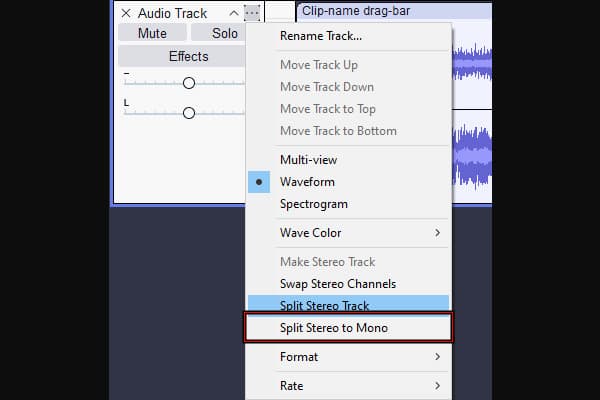
That’s how you can easily convert stereo to mono in Audacity. However, you need to split tracks, perform dual-channel mixing, and export files. It means the process is too complicated to complete in a single click.
If you prefer not to install desktop software, you can use FFmpeg. With a single command, you can change stereo to mono while keeping the original audio format. However, since it is a command-line-based tool, you may find it difficult to use.
To mix a two-channel stereo file down to a single mono channel: Use the audio filter (-af) switch and either the pan or ac (audio channels) command. Open up your command line in the folder containing your audio file and type: ffmpeg -i input.mp3 -ac 1 output.mp3.
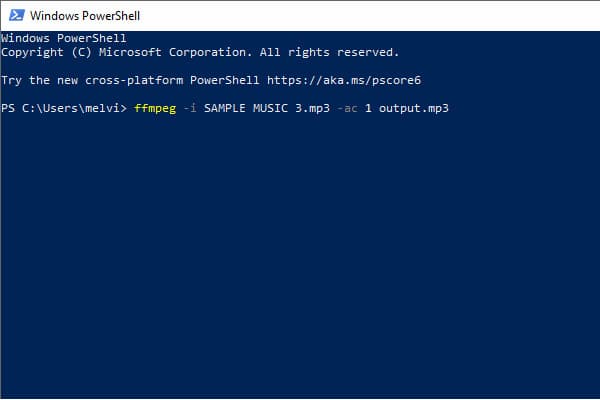
If you wish to have total control over the mixing process of left and right channels to the mono track without any chance of clipping, apply the pan filter: ffmpeg -i input.mp3 -af “pan=mono|c0=0.5*c0+0.5*c1” output.mp3.
Does converting stereo to mono reduce audio quality?
No, converting stereo won’t reduce its quality when you convert it to mono. However, it will permanently collapse the spatial with and can cause volume changes or phase cancellation. This is where certain vocals or instruments seem to disappear.
Can I convert multiple stereo files to mono at once?
Yes, you can convert multiple stereo files to mono at once. The easiest way to accomplish this is by using AnyMP4 Video Converter Ultimate. This software allows you to import up to 100+ stereo files and convert them to mono simultaneously.
Is mono better for podcasts and voice recordings?
Yes, mono is always better for podcasts and voice recordings. Because a single voice comes from a single source, it should sound like it is coming directly from the center rather than panning between the left and right ears.
Will mono audio play on stereo speakers?
Yes, mono audio will play perfectly fine on stereo speakers. When you play a mono track through a stereo speaker system, the single audio channel is routed to both the left and right speakers simultaneously. This creates what is known as dual mono.
It does not have to be difficult to convert stereo to mono; it only requires choosing the most suitable method. If you want the fastest conversion method, batch conversion, support for more than 500 file types, and high audio quality, then the AnyMP4 Video Converter Ultimate is definitely the way to go. However, if you prefer a free audio editor with a few additional manual steps, Audacity is worth considering. If you like doing conversions through the command line, FFmpeg will definitely work for them.
 Updated by Alice Thorne to Convert Audio
More readings
 5 Best Software to Edit MP3 Tags to Organize Songs Better
Are you seeking a trustworthy MP3 metadata editor? Read this article to discover five of the most popular MP3 tag editors available in 2026.
 10 Best Audio Trimmers (Free & Paid) for Mac, PC & Mobile
Looking for the best audio trimmer? Trim MP3, WAV, and AAC without losing quality. Compare the top 10 free & paid audio cutters for different devices here.
 10 Audio Enhancer: Improve Sound Quality and Denoise by AI
We can use these ten incredible AI audio enhancer tools for desktop and mobile phone processing. Review them and see how to use them by the step-by-step guide.
 5 Best Bitrate Converters (Lossless & Fast MP3 Change) 2026
Compare the top-5-rated MP3 bitrate converters to change audio quality from 128kbps to 320kbps instantly. Free online tools and professional software included.
 Add your comments to join the discussion here