How to Insert a Video into PowerPoint on Windows & Mac
Summary
If the file is compatible, insert a video in PPT by direct insertion. However, if your video is in another format, you need to convert it to MP4 (H.264/AAC). AnyMP4 provides batch video conversion, fast processing speed and built-in tools to prepare your clips before inserting them for frequent presentations with multiple videos.
I’m 5 minutes before a presentation, and the video won’t play in my slides. The audio works, but the screen is black. I don’t know what to do.
Dealing with this kind of problem right before a presentation is frustrating, especially when you know the video itself works outside PowerPoint. In many cases, the issue is the video format and codec that PowerPoint cannot properly decode. This guide covers the best ways to insert a video into PowerPoint. We will cover both direct insert and convert-and-insert methods. And if you have multiple videos, we will introduce a tool to help you prepare them before inserting them into PowerPoint.

How We Test Video Insertion Methods in PowerPoint
| Testing Device/Tool |
Windows 10 Pro and PowerPoint 2021 |
| Test File(s) |
10 videos: MP4 (H.264/AAC), HEVC MKV, WMV, AVI, and MOV. |
| Evaluated Criteria |
Format detection, playback, and file size limits. |
| Finding(s) |
MP4 (H.264/AAC) are the most compatible, HEVC MKV needs conversion, while AVI works but increases the file size. |
Quick Comparison
Direct Insert
If your videos are in compatible formats, this method offers the fastest option. Use this method when your video plays correctly in PowerPoint and does not cause performance problems.
Convert & Insert
When you cannot embed a video in a PowerPoint slide, convert it before inserting it. A good target for modern PowerPoint is an MP4 encoded in H.264 video and AAC audio.
Link vs Embed
Embedding stores the video in the presentation, which increases its file size. On the other hand, Linking keeps the video as a separate file and tells PowerPoint where to find it.
Method 1: Insert a Downloaded Video Directly into PowerPoint
Add a Video on Windows (PPT 2010 & Later)
Windows has the simplest method to add video to PowerPoint presentations. You only have to insert the MP4 (H.264/AAC) video directly into the PowerPoint presentation.
To add: Go to the slide where you want to add the video. Click Insert, navigate to Video, and select the This Video… option. Select the video and click Insert to add it to your presentation.
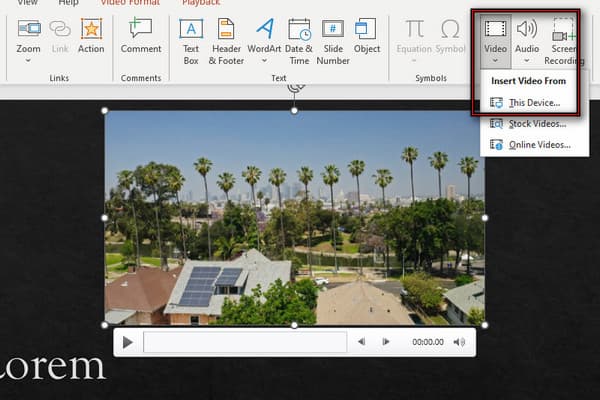
Embedding is much safer when taking the presentation to another computer. It is because a linked file may break if you move, rename, or delete the source video.
Insert Video on Mac PowerPoint
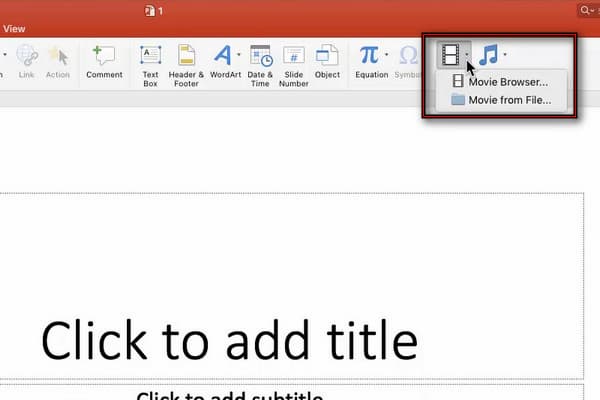
PowerPoint for Mac follows a similar process, although the menu names vary slightly by version. See the quick guide below to insert MP4 video into PowerPoint on Mac:
To insert: Select your target slide and go to the Insert tab. Click the Video option and select Movie from file… to insert the video into your slide.
Note
Select the video to access playback controls, and choose whether it plays automatically or when clicked.
PowerPoint Playback Options: Automatically vs. When Clicked
There are two video playback options in PowerPoint: Automatically and When Clicked On. Check the description below to see how they work:
- • Automatically: The media starts on its own when you transition to that slide.
- • When Clicked On: The media stays paused until you click the media or anywhere on the slide sequence.
PowerPoint Supported Video Formats by Version
Why won't PowerPoint let me insert a video? PowerPoint-supported video formats depend on the version and codecs it includes. Remember, the file extension alone does not guarantee compatibility.
| PPT Version |
Recommended Format |
Other Supported Formats |
| Microsoft 365, 2019, 2021, and 2026 |
.mp4 with H.264/AAC |
.mov, .m4v, .webm, .wmv, .asf, and .avi |
| 2010 to 2013 |
.mp4 with H.264/AAC |
.mov and .m4v |
| 2007 and Older |
.wmv |
.avi, .asf, and .mpg |
Method 2: Fix Video Format Issues with a Third-Party Converter
Check Video Format Against PowerPoint's Compatibility List
When PowerPoint refuses to insert a video, check the container format and codec. If they are correct, you’re probably using a different version of PPT. We suggest you go back to the previous section and review the full list of compatible video formats for PowerPoint.
Convert Unsupported Videos with VLC
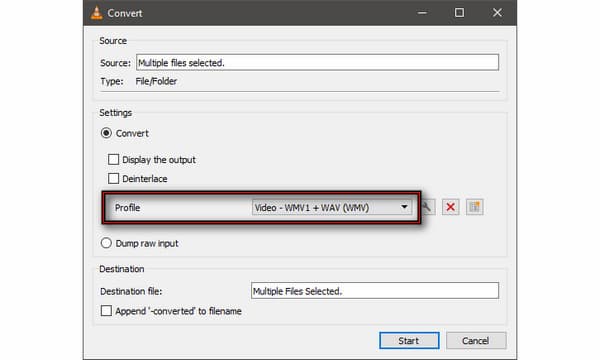
If you have MP4 (H.264/AAC) files and the installed version is 2007 or older, you can use VLC’s hidden Convert/Save feature. This tool lets you convert video to WMV for PowerPoint compatibility.
To convert: Press Ctrl+R to access the Open Media window. Click +Add to import the MP4 (H.264/AAC) files, then click Convert/Save to continue. In the Convert window, select Video - WMV1 + WAV (WMV) in the Profile picker and click Start to convert.
Tip
Don’t just rename a file from .mp4 to .wmv. Doing so will only change the extension name, not convert the underlying codecs.
Resize or Compress Large Videos for Better PPT Performance
If the PowerPoint video is too large to embed, you can use the built-in video compressor. With it, you can compress the video to Full HD (1080p), HD (720p), or Standard (480p).
To compress: Open the presentation with embedded video, then click File. Navigate to Info, click Compress Video, and select HD (720p) to keep the image clear.
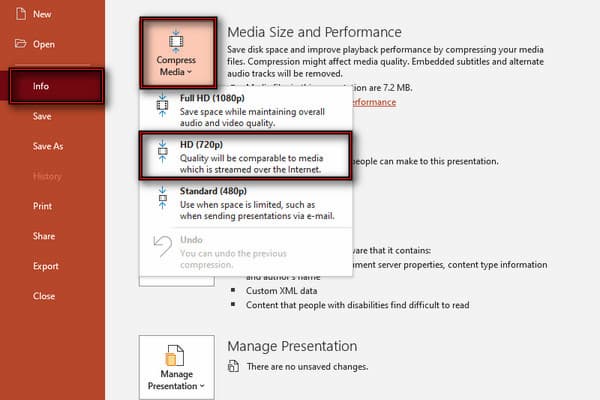
Compressing media improves video playback performance and reduces presentation size. If you have several large clips, we suggest compressing them beforehand.
[Alternative] Use AnyMP4 Video Converter Ultimate for Batch Video Prep
| Best for |
Batch preparation, format conversion, compression, and video editing |
| Price |
Starts at $18.75 |
| Platform |
Windows and Mac |
| Formats |
MP4 and 500 other formats |
| Watermark |
 |
| Trial |
 |
Why Choose AnyMP4 Over Free Tools
AnyMP4 Video Converter Ultimate is a, by design, premium video-to-video conversion software. With it, you can batch-convert hundreds of videos without watermarks. It uses the advanced hardware-accelerating media processing to achieve 120× speed. Before you insert a video into PowerPoint, you can use the built-in editor to trim, rotate, and add effects.
Convert Any Video to PowerPoint-Compatible Formats
1. Open AnyMP4 Video Converter Ultimate and click +Add Files to import the unsupported videos. For this demonstration, we use HEVC MKV as our source input.

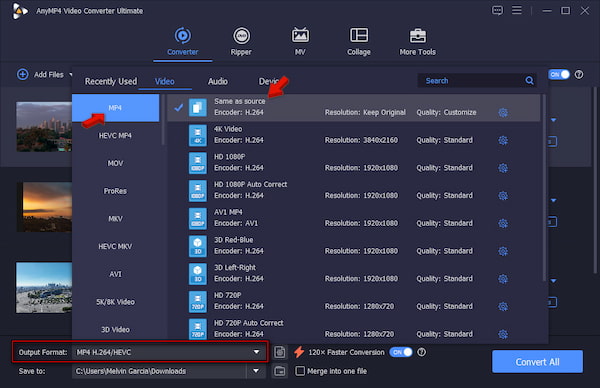
2. Go to Output Format, click the Video category, and select MP4. If your source video is 720p or lower, use the Same as Source quality preset to avoid unnecessary upscaling.
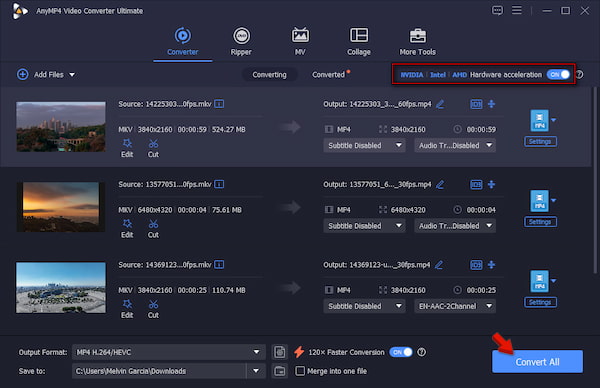
3. Activate the Hardware Acceleration to speed up the conversion. Set the output destination, then click Convert All to batch-convert incompatible video formats.
Bonus - Trim, Rotate, and Add Effects Before Insertion
Before you embed the video in a PowerPoint slide, you can make further edits. Here’s what you can do:
- • Trim: Use the Cut tool to trim unnecessary introductions, endings, or sections. (Check the detailed guide here to trim a video in PowerPoint.)
- • Rotate: Click Edit and go to Rotate & Video to correct the video's orientation.
- • Add Effects: Click Edit, then navigate to Effect & Filter to adjust basic video effects.
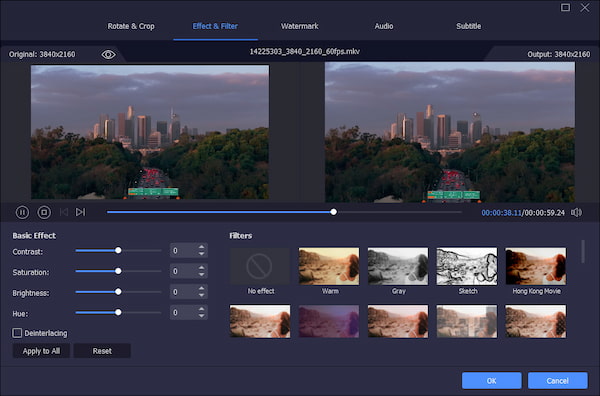
In our testing, we used 10 HEVC MKV files totaling 1.9 GB. It took only 1 minute and 42 seconds to batch convert HEVC MKV to MP4. The built-in editing tools are also helpful for trimming, rotating, and adding effects.
Troubleshooting: Why Can't I Insert a Video into PowerPoint?
Video Format Not Supported
If you insert a video file from PowerPoint and it rejects, the container, codec, or both are not supported. In this case, convert the video to MP4 with H.264 video and AAC audio.
Video Won't Play During Full-Screen Presentation
If the PowerPoint video is not playing during a full-screen presentation, it might reach the resolution limit. If your video is more than 4K resolution, compress it to Full HD (1080p) or HD (720p).
PowerPoint 2007 and Earlier
Older versions of PowerPoint, particularly PowerPoint 2007 and older, rely on linked media. When you insert a video into PowerPoint with a hyperlink, it may play on your computer but may fail to play in current versions of PowerPoint.
Video File Too Large - Freezes PowerPoint
Large video files can make PowerPoint sluggish when opening or presenting a slide. If PowerPoint freezes or becomes unresponsive, reduce the number of high-resolution videos.
FAQs about Inserting Video into PowerPoint
Why is my video not playing in PowerPoint?
If your video is not playing in PowerPoint, go to File and select Info. If the inserted media is in an incompatible format, click Optimize Compatibility to improve it.
How do I make a video play automatically in PowerPoint?
Playing embedded video in PowerPoint is easy. Select the video on the slide, then go to the Playback tab. Click the Start pulldown menu and set it to Automatically.
How to embed a YouTube video in PowerPoint?
Copy the YouTube video URL, then go to the slide where you want to insert it. Navigate to Insert, click Video, and select Online Videos. Next, paste the copied URL and click Insert to embed a video in PowerPoint.
Conclusion
If you have a compatible video, Method 1 is the quickest way to insert a video into PowerPoint. If PowerPoint rejects your video, Method 2, using VLC, provides an easy fix. However, if you’re a frequent presenter who inserts videos into PowerPoint every week, AnyMP4 Video Converter Ultimate is what you need. It lets you prepare videos, including converting to PowerPoint-compatible formats, before inserting them to your slide.