
Quick Guide: Converting MP3 to M4A
What is the best way to convert MP3 to M4A? The best method depends on your needs: AnyMP4 Video Converter Ultimate is best for fast batch processing; iTunes/Apple Music is the best free native option for Windows/Mac; VLC is the top open-source choice; and CloudConvert is best for quick online conversions without software.
If you’ve ever looked at your music library and wondered if MP3 is starting to feel a bit 'old school,' you’re definitely not alone. Most of us are searching for that perfect middle ground: getting better sound quality without watching our phone storage disappear. Whether you’re trying to make your tracks play nice with your iPhone or iTunes ecosystem, or you’ve heard that M4A (AAC) can actually sound crisper than an MP3 at the same file size, the move to M4A just makes sense. People are looking for safe, high-speed, and batch-friendly ways to upgrade their audio game without the headache. Today, this article will share with 4 effective ways to convert MP3 to M4A with ease.
| Feature | AnyMP4 Video Converter Ultimate | iTunes / Apple Music | VLC Media Player | CloudConvert |
|---|---|---|---|---|
| Sound Quality | Lossless | High | High | Standard |
| File Size | Highly Optimized (Excellent compression/quality ratio) | Standard (Controlled by encoder settings) | Flexible (Depends on your manual codec settings) | Standard (Typical AAC compression) |
| Batch Conversion | 70X Faster (One-click folder processing) | Manual (Must select multiple files in library) | Possible (But tricky/requires playlist or CLI) | Limited (Free tier has daily & size caps) |
| Privacy & Safety | 100% Secure (Offline processing) | 100% Secure (Native app) | 100% Secure (Open-source & Offline) | Safe (Files deleted after 24 hours) |
| Best For | Pro users with bulk files who need speed and max quality. | Apple users who want a free, native solution. | Tech enthusiasts who want a secure, no-install-required tool they already own. | Casual users needing a quick, one-time conversion without software. |
If you’re wondering whether it’s worth the hassle to flip your library from MP3 to M4A, the short answer is: Yes, if you care about efficiency and modern tech.
While MP3 is the 'old reliable' that plays on literally everything, M4A (which usually uses the AAC codec) is basically its smarter, younger sibling. MP3 starts to sound 'muffled' or loses detail in the high frequencies (like cymbals or vocal breathiness) at lower bitrates.
One of the biggest wins for M4A is how it handles compression. If you compare an M4A and an MP3 both at 128kbps, the M4A is almost always going to sound crisper. M4A (AAC) uses a more advanced algorithm, meaning you can have a smaller file size without your ears bleeding. It’s the 'sweet spot' for saving phone storage while keeping the vibes high.
| Feature | MP3 | M4A (AAC/ALAC) |
|---|---|---|
| Quality | Good (at 320kbps) | Excellent (more efficient) |
| File Size | Larger for same quality | Smaller for same quality |
| Compatibility | Universal (Even your 2005 car stereo) | Most modern devices (iPhone, Android, PC) |
| Lossless? |  |
 (via ALAC) (via ALAC) |
For users seeking the ultimate audio experience, AnyMP4 Video Converter Ultimate stands out as the professional choice for lossless audio conversion. It is specifically engineered to batch convert MP3 to M4A at an incredible 70X faster speed, allowing you to process entire folders with a single click - a major advantage over limited online tools.
By leveraging advanced Hardware Acceleration (GPU Acceleration) and multi-thread technology, it ensures high-speed performance without sacrificing stability. For those aiming for peak fidelity, the software offers deep customization: you can manually set the Sample Rate to 48,000Hz and Bitrate to 320 kbps, ensuring your M4A files reach the maximum acoustic fidelity of the source. Beyond conversion, it functions as a comprehensive toolkit to edit ID3 tags, split, or merge files, making it the most efficient way to upgrade your library to high-quality M4A.
Secure Download
Secure Download
How to convert MP3 to M4A with Video Converter Ultimate
1. Add MP3 files into the best M4A converter
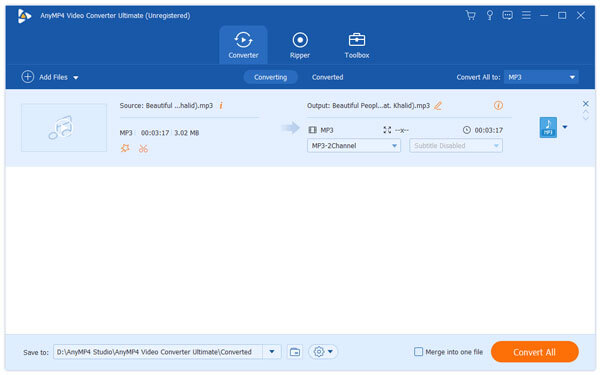
Video Converter Ultimate has two versions, one for Windows 10/8/8.1/7/XP and the other for Mac OS. Install the right one according to your operating system. Then open the application and hit the Add Files menu on the top ribbon to add the MP3 files into the converter.
You can also drag and drop or click the big plus button in the middle to add the MP3 files into this program.
2. Select M4A as the output format
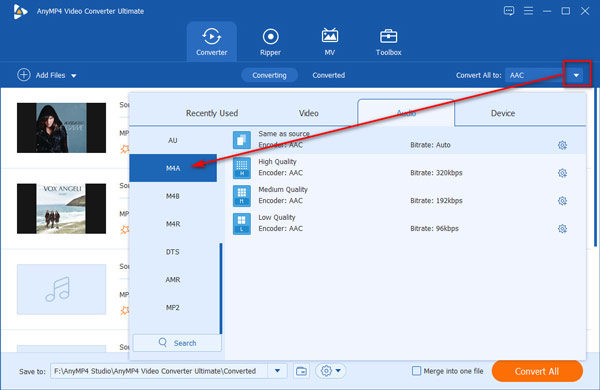
Next, head to the top area, pick up M4A from the dropdown menu of Convert All to. If you are looking for more custom options, hit the Custom Profile icon next to the M4A output format to open the settings dialog. Here you can change the bitrate, sample rate, and other parameters.
3. Convert MP3 to M4A without quality loss
Click on the Convert All button. Wait for the process to complete. Then you will be taken to the main interface. Now, you can listen to the results.
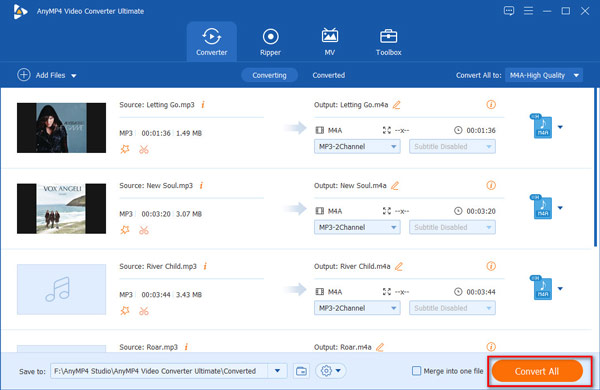
This powerful tool includes rich features that allow you to adjust audio effects, in addition to the basic conversion function. If you need, you can explore these features for audio optimization. This tool offers a free trial for you to try it in advance.
For Apple fans or Windows users who prefer not to install new software, iTunes is the go-to official and native solution to convert MP3 to M4A for free. Since M4A is the backbone of the Apple ecosystem, this method ensures perfect compatibility with QuickTime, iPhone, and iPad.
To get started, simply adjust your Import Settings to the iTunes AAC encoder, right-click your track, and select 'Create AAC Version.'
Pro Tip: Keep in mind that iTunes creates a new M4A copy rather than replacing the old one. To save storage space, you'll need to manually delete the original MP3 files once the conversion is finished.
Here are the detailed steps for you to use iTunes.
1. Locate the Encoder Settings
Open the application on your computer.
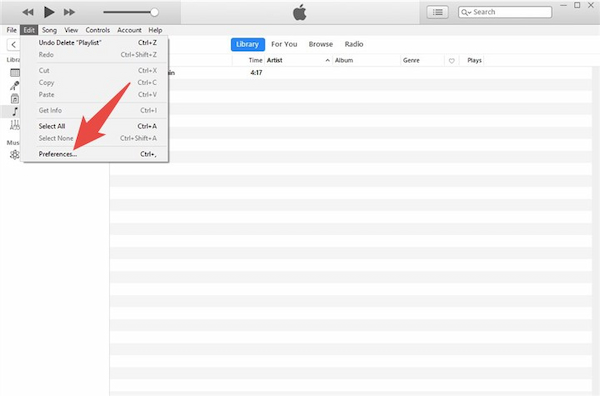
2. Set the AAC Encoder
In the pop-up dialog, click the dropdown menu next to Import Using and select AAC Encoder. To ensure the best audio quality, change the Setting dropdown from 'High Quality' to Custom and set the Bitrate to 320 kbps. Click OK to confirm and return to your library.
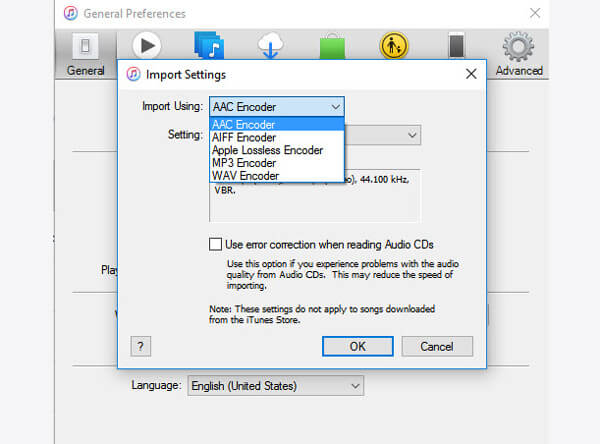
3. Create the AAC Version
If your MP3s aren't in iTunes/Music yet, drag and drop them into the library. Select the MP3 files you wish to convert, then go to the top menu and select File > Convert > Create AAC Version.
4. Identify and Clean Up
The app will process the files and create new M4A copies. To distinguish them from the originals, right-click any track and select Song Info (or Get Info) to verify the 'kind' is AAC audio file.
Remember: You will now have duplicates; you’ll need to manually delete the old MP3 files to free up space.
iTunes/Music cannot convert DRM-protected files or certain copyright-restricted tracks. Since this is a transcode (compressed to compressed), while it improves compatibility with Apple devices, it will not technically 'improve' the underlying audio quality of the original MP3.
If you’re a power user who values privacy, you likely already have the VLC audio converter sitting on your desktop. VLC is a beast for open-source MP3 to M4A conversion because it works entirely offline, meaning 100% privacy with zero ads or tracking.
Since VLC’s default presets lean toward video, the pro move is to create a custom 'Audio - M4A' profile. Set the encapsulation to MP4/MOV and the audio codec to AAC with a 320kbps bitrate - this locks in your settings for future one-click use. For the real geeks out there, VLC even supports command-line operations, allowing you to automate massive audio libraries with a simple script. It’s not just a player; it’s a robust, secure engine for anyone who wants total control over their local files.
1. Open VLC
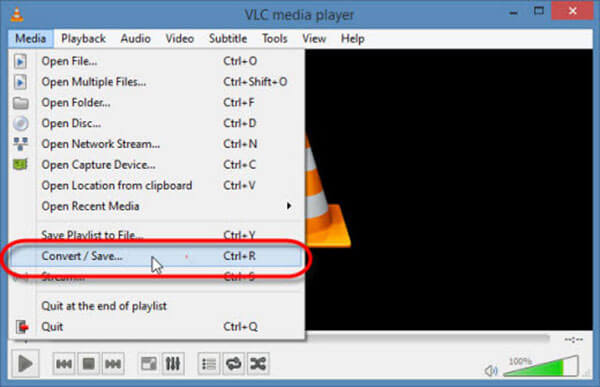
Open VLC on your computer, and choose Media > Convert/Save to enter the conversion interface.
2. Import the MP3 File
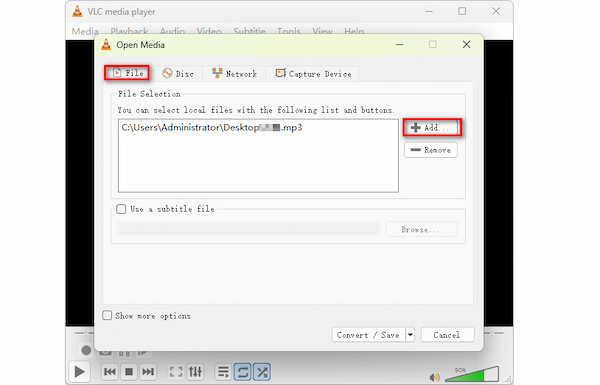
Under the File section, click Add to import one or several MP3 files you want to convert. Then, click the bottom Convert/Save to proceed.
3. Select AAC and Export
Click the wrench icon and select MPEG 4 Audio (AAC) as the output format from the Audio codec section. Lastly, click Start to begin the conversion.
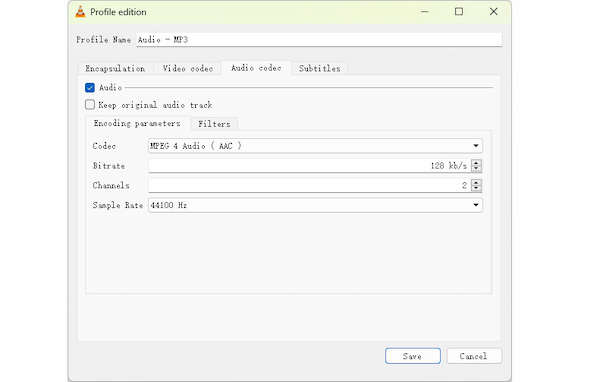
This way gives you ease and convenience to convert MP3 audio files with a click. If you have installed VLC on your computer, try it for free.
If you’re looking for a quick and browser-based way to flip a few tracks, CloudConvert is a total lifesaver. It’s perfect for converting MP3 to M4A online because it plugs directly into your Google Drive, Dropbox, or OneDrive—a huge plus if you’re working from a phone or keeping everything in the cloud. There’s no installation required, so you can just hop on, convert, and go.
CloudConvert's safety is actually pretty solid; they have a clear policy where your files are automatically deleted after 24 hours, so your data doesn't just sit there forever.
Now, let's see how to convert MP3 to M4A in detail.
1. Open CloudConvert and Import MP3
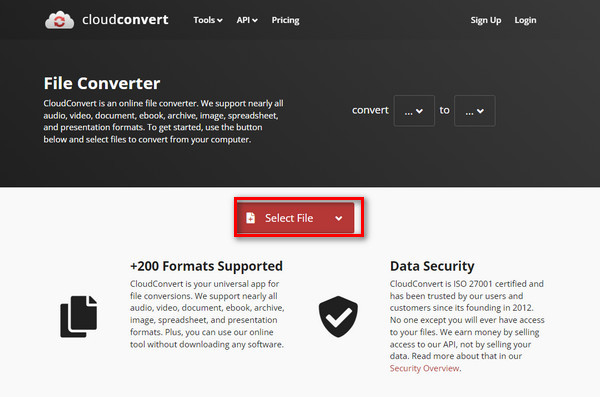
Access CloudConvert via the browser and click Select File to import the MP3 file you want to convert.
2. Choose M4A Output
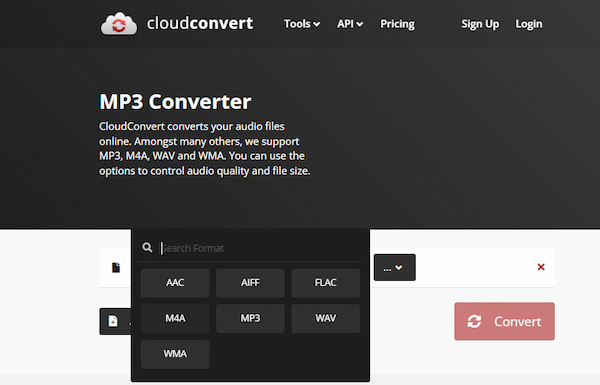
Click the Convert to drop-down list and select the M4A format as the output.
Note: You can click Add more Files to batch convert audio files.
3. Convert and Save File
Lastly, click the Convert button to start the conversion. Once the process is done, click the Download button in the pop-up window to save it to your default download folder.
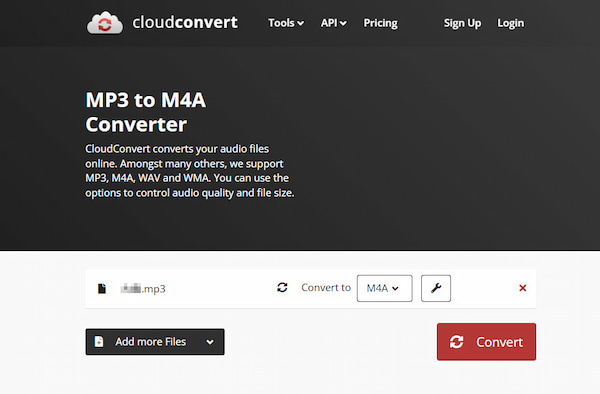
This tool is easy and intuitive for quick audio conversion. However, the free version is great for small tasks, but it does have a 200MB file size limit and a daily conversion cap. If you just need to handle a couple of standard-sized songs quickly and securely, it’s easily one of the most convenient options out there.
Is M4A better than MP3?
Yes, in terms of efficiency. M4A (using AAC encoding) generally provides better sound quality than MP3 at the same bitrate, especially at lower bitrates like 128kbps. It is also the preferred format for Apple devices.
Will I lose quality when converting MP3 to M4A?
Since both are 'lossy' formats, a slight quality loss occurs during transcoding. To minimize this, use a high-quality converter like AnyMP4 Video Converter Ultimate and set the output bitrate to 320kbps or match the original file's bitrate.
How can I convert MP3 to M4A for free on Windows?
You can use built-in tools like iTunes (Apple Music) or open-source software like VLC Media Player. Simply import your MP3, adjust the encoder settings to AAC, and export the file as M4A.
Can I convert MP3 to M4A online without software?
Yes, tools like CloudConvert allow you to upload MP3 files and convert them to M4A directly in your browser. This is ideal for small files and quick conversions without installation.
Generally speaking, there are three methods to convert MP3 to M4A. We suggest you try AnyMP4 Video Converter Ultimate, because it is a professional MP3 to M4A converter. Users can enjoy plentiful easy-to-use features and get the highest quality results. On the other hand, it is another option to convert MP3 to M4A or convert M4A to MP3 iTunes, if you already install it on your computer. Finally, online converters are attractive too. The biggest advantage is to do everything online. But the downsides are, for example, take longer time, cannot guarantee the result quality, and more. Now, you can select your favorite way and listen to music in M4A simply.
 Updated by Alice Thorne to Convert Audio
Related Articles
 How to Convert MP4 to WMV on Windows and Mac
Create Microsoft WMV videos with MP4 in high quality on Windows, Mac or online.
 How to Turn MP4 into GIF With Top 5 Methods
Ever wonder how to turn your MP4 videos into GIF images? Don't worry. Read on and learn, this article will introduce 5 methods for you to achieve it.
 Difference Between MOV and MP4, M4V and MP4
This article list MOV vs MP4 comparison and M4V vs MP4 comparison to you.
 Top 7 Methods to Convert MTS to MP4 Video
Get the best solution to convert MTS to MP4 and feel free to play converted MTS.
 Add your comments to join the discussion here